It was passed down without ceremony, always in a small cloth bag, always with the same instruction: don’t put it on. No one in the family remembered who the original instruction came from. The story had been compressed into a fact over generations. The ring is bad luck. The ring is not to be worn. And when a cousin, dismissive, rational, and perfectly modern, wore it to a party as a joke and then broke her wrist two days later falling on dry pavement, the cloth bag came back out of the drawer.
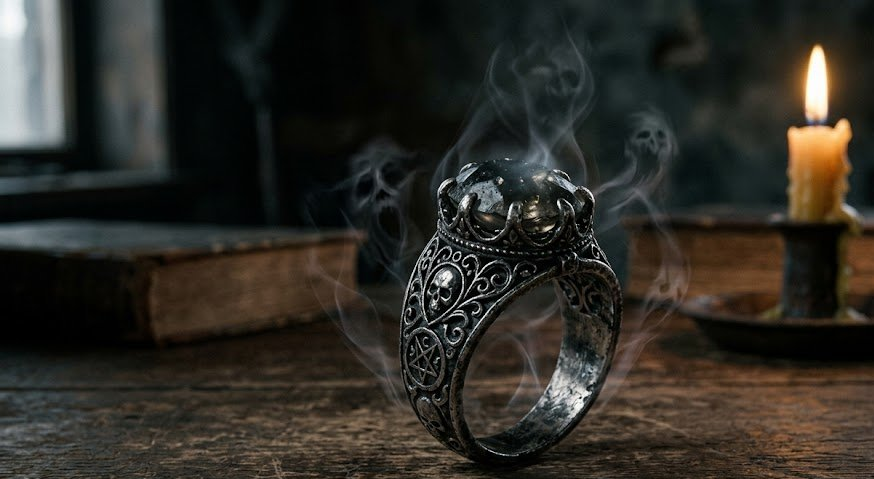
Cursed jewelry occupies a specific emotional territory that other haunted objects do not. Jewelry is worn on the body. It is intimate and personal, associated with the most emotionally charged moments of life: love, death, inheritance, and loss. When a piece carries a dark history, the connection between the object and the wearer is not abstract. It is skin-deep.
The Hope Diamond and the Manufactured Curse
The Hope Diamond is far and away the most famous cursed gem in Western culture, and it is also, according to researcher Richard Kurin, largely a marketing invention. The curse narrative was substantially manufactured and amplified in the early twentieth century to increase the diamond’s mystique and value. The Black Orlov diamond’s supposed curse was similarly constructed to explain its unusual color.
The Hope Diamond’s manufactured legend should not, however, obscure a much richer category of object-based curse belief that connects to genuine human experiences of grief, inheritance, and the psychological weight of objects that carry charged history. The most compelling cursed jewelry cases do not involve celebrity gems. They involve things passed quietly between generations with instructions nobody can fully explain.
Victorian Mourning Jewelry
From the 1840s through the early 1900s, it was common practice in Britain and America to commission jewelry incorporating the hair of the deceased, woven into elaborate brooches, sealed in lockets, and braided into bracelets. These pieces were intended to maintain connection with the dead, to keep the beloved physically present even after burial. They are extraordinarily beautiful and extraordinarily unsettling in equal measure.
Owners of Victorian hair jewelry consistently report specific emotional responses: a heaviness associated with a particular piece, a reluctance to wear it or a compulsion to do so, and dreams that began after the object entered the home. These responses are not necessarily paranormal. The emotional charge of an object specifically created to embody grief, worn by generations of bereaved people, handled at moments of maximum emotional intensity, is real regardless of mechanism. But that charge is also exactly what the haunted object tradition describes.
The Delhi Purple Sapphire
The Delhi Purple Sapphire, actually a violet amethyst, was donated to the Natural History Museum in London in 1943 by its owner Edward Heron-Allen, accompanied by a letter warning that the stone was cursed and had brought misfortune to every owner since its theft from a Hindu temple during the 1857 Indian Mutiny. Heron-Allen had reportedly thrown it into Regent’s Canal twice, only to have it returned to him both times. The museum accepted it, kept it sealed in a case with the warning letter for many years, and the piece remains one of the more striking examples of an institution taking object-based curse belief seriously enough to preserve rather than dismiss it.
Engagement Rings From Failed Marriages
A contemporary and surprisingly widespread category of cursed jewelry belief involves engagement rings from marriages that ended in divorce, infidelity, or death. The belief that these rings carry bad energy and should not be passed on to other relationships is held in secular as well as traditional communities and generates a substantial secondary market in estate jewelry that has been ritually cleansed before resale.
The psychological logic is straightforward: a ring associated with a specific relationship is the object most densely saturated with the emotional content of that relationship. Wearing it in a new relationship maintains a symbolic connection to the old one that most people correctly identify as unhealthy, independent of any supernatural belief. Whether the mechanism is psychological or something else, the practical effect is the same.
What Objects Can and Cannot Hold
Mainstream science has no mechanism for objects retaining emotional or spiritual residue from previous owners. But a significant body of psychological research on object attachment and the extended self theory, the idea that people incorporate owned objects into their self-concept, suggests that the energy attributed to charged jewelry may be a real psychological phenomenon even without a paranormal mechanism. The object becomes a trigger for specific memories, associations, and emotional states that genuinely affect the owner’s well-being. Whether that is the full story or whether it is one layer of a story with more layers beneath is a question worth holding rather than closing.
References & Further Reading
• Robinson’s Jewelers: The Truth About Haunted Jewelry
• Sammy D. Vintage: History’s Most Famous Haunted Jewelry
• National Jeweler: These Jewels Will Haunt You
• National Jeweler: A Look at the World’s Most Cursed Jewels


[…] Cursed Jewelry Stories: Rings, Lockets, and the Fear of Carried Energy […]
[…] As if the dress weren’t already a problem, see our other post on haunted jewelry. […]