The lights flicker, the thermostat drops, and the locks click at midnight. There is a name for this haunting, and it is not a spirit.
The thermostat falls to fifty-five degrees at two in the morning. Nobody touched it. The next night, the porch light strobes for eleven minutes. The smart lock clicks open while you sleep upstairs.
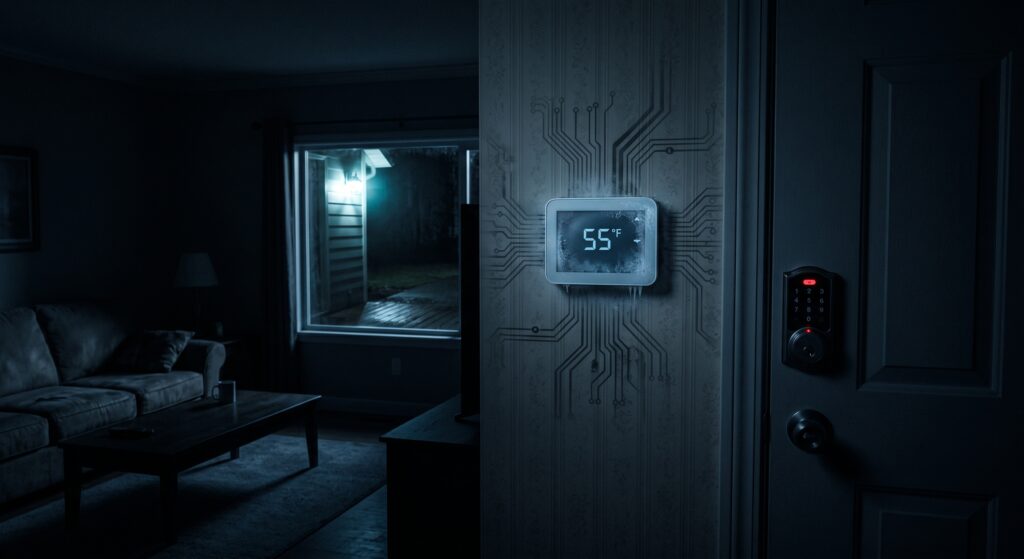
You do what anyone would do. You search for explanations. You wonder about wiring, about interference, about the previous owner. Eventually, quietly, you wonder about something older than wiring.
Security researchers call it SHOT, and the entity behind this haunting has a pulse, a phone, and a login.
The Acronym Nobody in Paranormal Circles Knows
In 2020, researchers publishing through arXiv coined a specific term to separate two things that people constantly confuse. They distinguished ordinary tech abuse, meaning harassment through phones and social media, from something narrower and stranger.
They named it Smart Home-facilitated Tech Abuse, or SHOT. The acronym lands with an unpleasant thud, which may be the point.
The distinction matters more than it sounds. A hostile text message announces itself. A thermostat does not. When an abuser controls your phone, you know something is wrong with it. When an abuser controls your house, you begin to wonder what is wrong with you.
Smart home abuse works because the victim reaches for an alternate (sometimes supernatural) explanation before she reaches for a human one. The technology supplies plausible deniability at an industrial scale.
Why the Ghost Story Comes First
Consider the shape of a classic haunting. Objects move. Temperatures drop. Doors open. Lights behave strangely. Sounds arrive from empty rooms.
Now consider the standard feature list of a connected home. Smart plugs move current. Smart thermostats change temperature. Smart locks open doors. Smart bulbs dim and flare. Smart speakers play audio into empty rooms.
The overlap is not a coincidence. It is a nearly perfect map. Every phenomenon that folklore assigned to a restless spirit now sits behind a mobile app, waiting for someone with credentials to tap it.
Georgetown Law Technology Review published an analysis of exactly this problem, and the researchers reached an uncomfortable conclusion about remedies. Turning the device off does not reliably help. Some devices resist a hard reset. Disconnecting a system can escalate the abuser’s behavior rather than end it. The obvious solution—unplugging everything—carries its own risk.
The Courts Started Noticing Before the Ghost Hunters Did
One of the earliest documented court cases involving connected device abuse surfaced in May 2018. A couple in the United Kingdom had installed a shared smart home system covering lighting, heating, and alarms.
After the relationship ended, the abuser used a wall-mounted iPad to watch his estranged wife. He logged into the tablet’s audio function through a mobile app and listened to her conversations. The house he had helped configure became an instrument.
Legislators moved slowly, then decisively. New York enacted a law in November 2020 permitting courts to prohibit a restrained party from remotely controlling connected devices affecting a protected person’s home, vehicle, or property. The statute exists because the problem does.
What Investigators Should Rule Out Before Anything Else
Every serious paranormal investigator already understands the discipline of elimination. You check the plumbing before you accept phantom footsteps. You check the drafts before you accept a cold spot.
Smart home abuse belongs in that same checklist, and it belongs near the top. The screening questions are practical.
Who set up the network originally? Whose email address anchors the accounts? Who installed the hub, the locks, and the cameras? Does an ex-partner, former roommate, or estranged family member still appear on any account?
Examine the router’s admin panel for unfamiliar devices. Review each smart device’s activity log, which often records exactly when a command arrived and which account sent it. Look for location trackers, which retail for twenty dollars and hide easily.
Researchers studying intimate partner violence emphasize that survivors frequently cannot identify the intrusion vector. They know something is happening. They cannot prove how. That confusion is not a failure of intelligence. It is the designed outcome of systems built for convenience rather than for safety.
The Uncomfortable Reframe
Paranormal writing loves a hostile intelligence in the walls, something that knows the layout and responds to your presence.
The description survives translation into the language of network security without losing a single detail. What changes is the ontology, though. Intelligence is a person. The walls are a mesh network. The response is an API call.
Australian research cited in 2026 reporting found that technology now features in the overwhelming majority of gender-based violence cases. Smart glasses record. Connected refrigerators log eating patterns. Vehicle apps report every stop a car made in the last thirty days.
Such data should frighten you more than a poltergeist, not less. A poltergeist, whatever else it may be, cannot read your calendar.
What to Do If Your House Feels Occupied
If any of this is recognized in your own home, start with people rather than devices.
Contact a domestic violence organization that offers technology safety planning before you change any passwords. Advocates understand that abruptly locking an abuser out can trigger escalation, and they help sequence the steps.
Document what happens and when. Timestamps matter enormously, because device logs can corroborate them later. Photograph any unfamiliar hardware without dismantling it.
In the United States, the National Domestic Violence Hotline operates at 1-800-799-7233, and the Safety Net project at the National Network to End Domestic Violence publishes technology safety resources.
The key point is this. Ghosts do not need your Wi-Fi password. Anything that does is worth investigating, and the investigation may matter far more than any story you were prepared to tell.
The Deniability Engine
Every abusive smart home tactic shares one property. It looks like a malfunction.
That property is not incidental. It is the entire value proposition for the abuser.
Consider the alternative. A person who shouts leaves witnesses. A person who strikes leaves marks. A person who lowers a thermostat by remote leaves an event in a log that nobody will ever read and a partner who sounds increasingly unstable when she describes it.
Advocates describe survivors being told that smart systems glitch. The statement is true. Smart systems do constantly glitch. The abuser exploits that truth as cover, which is why researchers borrow the vocabulary of gaslighting when they describe the pattern.
So the technology performs two jobs simultaneously. It executes the harassment, and it manufactures the alibi. No poltergeist ever managed that combination.
The Devices Doing the Work
Reporting from 2026 documented the current inventory, and it extends well past lights and locks.
Smart refrigerators with food tracking reveal eating patterns, calorie intake, and whether anyone is home. Connected glasses record without indicating that they are recording. Doorbell cameras log every arrival and departure.
Location trackers cost twenty dollars and outlast most patience. Advocates describe them sewn into the lining of a child’s backpack, which reveals the child’s position and, during custody exchanges, the mother’s.
Connected car applications may be the least understood. If a survivor’s name was not on the loan or original account setup, she may be unaware the application exists. The other party opens a phone and reads thirty days of destinations. Her workplace. Her attorney’s address. Where she sleeps now.
For ghostlier or more folklore-related articles on smart home devices, see our other posts:
Haunted Smart Home Devices: When Alexa, Cameras, and Sensors Feel Paranormal
Is Alexa Possessed? The Evidence, the Glitches, and the Paranormal Case
The Ghost in the Machine: From Descartes to Your Amazon Echo
References & Further Reading
Are Smart Home Devices Abandoning IPV Victims? (arXiv)
Smart Home Devices as Tools of Harassment and Abuse (Georgetown Law Technology Review)
A Domestic Violence Dystopia (California Law Review)
Smart Home Tech Abuse (NY Office for the Prevention of Domestic Violence)
Safeguarding the Internet of Things for Victim-Survivors (PMC)


[…] our other post on smart home tech abuse (SHOT) and what you can do about […]