Staff at the Red Onion Saloon say good morning to a ghost before they open the safe. Skip the greeting, and the safe supposedly refuses to budge. It sounds like a gimmick until you hear the employees tell it, plainly, as part of their workday. Lydia, they insist, still runs the upstairs.
Most articles exploit the haunted-brothel angle for shivers and do not develop it further. The Red Onion deserves better. Its ghost stories are inseparable from the stark economics of the women who worked here, the “goodtime girls” the Gold Rush exploited. The most honest way to tell their story is to center them.
A building with a backward front
The Red Onion opened as a saloon and brothel around 1897 and 1898, during the peak of the Klondike Gold Rush. Skagway’s founder, Captain William Moore, cut planks for it. When the town boomed, crews moved the building closer to the rail depot using rolling logs and a single horse.
They set it down facing the wrong way. Rather than turn it, they sawed off the front and back, swapped them, and nailed it together again. The cut lines still show today. That slapdash history suits a place built fast to serve a stampede that would not last.
The doll system and the money tube
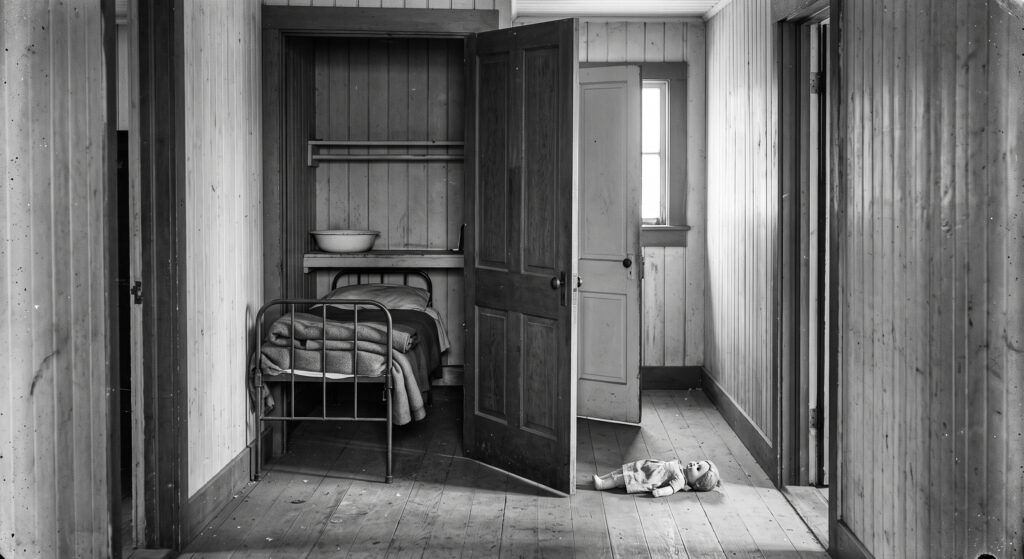
The mechanics of the business were coldly efficient. Ten small upstairs rooms, called cribs, each had several doors for a quick escape from a dangerous customer. Ten dolls sat behind the bar, one per woman. If a doll lay down, that woman was busy. Standing up meant being available.
Payment moved through a copper tube. When a session ended, the woman dropped coins or gold dust down a floor hole to the bartender. He stood her doll upright to signal she was free again. The system reduced human beings to inventory, tracked in real time at the bar.
The lives behind the legend
After paying the madam and the bodyguard, a woman might keep only about 1.25 dollars, relying on private tips, sometimes tiny gold nuggets, to survive. Some came north for the work. Others found it the only way to eat or to escape.
When restorers pulled up the floorboards, they found the women’s prized possessions tucked away and forgotten, along with a silver dress. Those hidden objects say more than any apparition. They are the real traces of real people, largely erased from the triumphant Gold Rush story we usually hear.
Who Lydia was, and was not
The saloon’s famous ghost is Lydia, said to be a former worker or madam who never left. Staff and guests report footsteps on the original upstairs floors, cold spots, and the strong scent of floral perfume. She reportedly waters plants, leaving the soil damp, and tends the old brothel as if still on duty.
Honesty requires a caveat. Very little is truly known about Lydia, not even whether that was her name—a name staff simply passed down. Stories that she died of illness or by her own hand are speculation. The gaps in her story mirror the gaps in the record for all these women.
Respect over spectacle
What sets the Red Onion apart is how its staff treat their ghosts. General managers speak of Lydia as a constant presence and greet her each day. One employee sings to her through the quiet winter. When fan mail arrives after a documentary, staff read it aloud upstairs. Someone once sent a teddy bear.
Tour guides insist visitors acknowledge Lydia when entering the brothel museum, out of courtesy. There are lighter tales too, of receipts drifting and a rude customer’s chair flying out from under him. Whether you believe or not, the tone is care rather than exploitation, which is rare in ghost tourism.
So take the Red Onion’s haunting seriously, but for the right reason. The building holds the memory of women the Gold Rush used and discarded. Treating Lydia with dignity is a small, ongoing act of remembering them. That, more than any cold spot, is what makes the place feel truly alive.
The other spirit upstairs
Lydia is not the only presence staff describe. Some speak of a malevolent male spirit they call John, blamed for shoves, slammed doors, and a foul smell. The story among employees holds that he was a bouncer, stabbed to death by a worker who had endured his harassment once too often.
True or not, that darker tale reflects the real dangers these women faced. The crib rooms had multiple doors precisely so a worker could escape a threatening customer. Whatever haunts the upstairs, the architecture itself testifies to a workplace where violence was a constant, practical concern.
Preserving a hidden history
The building has had many uses since the Gold Rush, serving as a dance hall, army barracks, bakery, laundry, union hall, and even a television station. In 1978, Jan Wrentmore bought and restored it, reopening it as a saloon and brothel museum with much of the original interior intact.
That preservation does real cultural work. The upstairs museum keeps a rarely told chapter of frontier history visible. It honors the labor of the “soiled doves” who serviced a stampede, then got written out of its heroic story. Whether or not you believe in Lydia, the museum insists these women existed and mattered.
That may be the Red Onion’s truest form of haunting. It refuses to let the past stay buried under gold-rush romance. Every tour, every greeting to Lydia, every artifact under glass keeps a stark history alive. The ghost is really a memory that the building will not allow Skagway to forget.
Visit today and you can still climb the “Stairway to Heaven” to the preserved cribs. You can drink in the saloon below and join a tour led by a costumed madam. The champagne and the jokes are fun. The deeper gift is simple. Over a century after the gold ran out, people still remember the women of the Red Onion.
References & Further Reading
Lydia’s Ghost at Red Onion Saloon (Into Horror History)
[…] parlor, the Pioneer Cemetery, and the Red Onion Saloon cluster within an effortless walk of one another. That density is why ghost tourism thrives here. […]