Everyone knows Nessie. Loch Ness Monster‘s legend has sold postcards and funded submersible searches. It has inspired a thousand blurry photographs. But two more monsters hide in Scotland’s glacial lochs, and almost nobody outside the Highlands can name them.
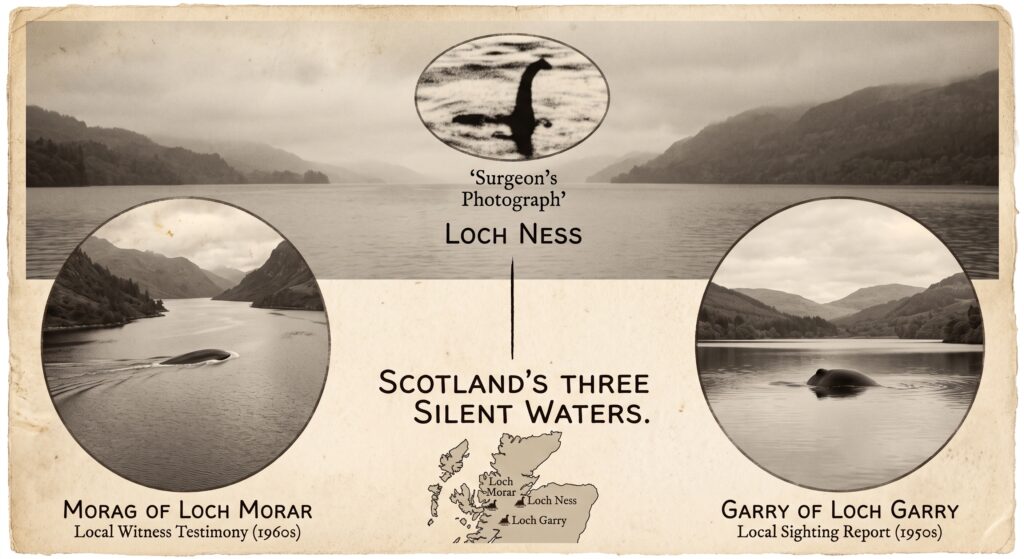
Meet Morag of Loch Morar and Garry of Loch Garry. Both predate the modern Nessie craze. Both come from real communities with their own sighting histories. And both got quietly absorbed into a single, media-friendly idea: the surviving plesiosaur.
Morag, the Deep Sister of Loch Morar
Loch Morar plunges to 310 meters. That makes it the deepest freshwater body in the British Isles, deeper than much of the surrounding North Sea. Glaciers carved the basin roughly 10,000 years ago. They left a trench darker and colder than almost anywhere else in Scotland.
The loch also stretches wide. It covers nearly 27 square kilometers, giving a large creature plenty of room to stay hidden between sightings. That depth and that space gave a legend room to breathe long before anyone in Fort William had heard of Nessie.
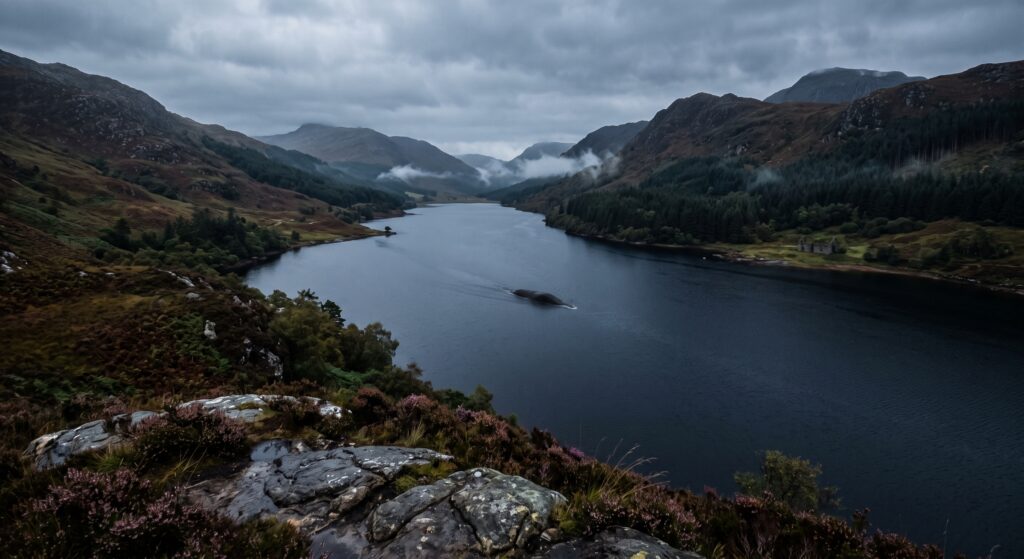
The first recorded sighting of Morag dates to 1887. Folklorist Alexander Carmichael gathered local accounts in 1902, and reports kept surfacing through the 1960s. Witnesses describe her rising in a dark, water-logged mass. She moves low and deliberately across the surface, more like a loaded boat than an animal.
Older tradition treated her differently than a simple beast. Highlanders saw her as an omen, a sign that death was near for someone in the glen. That detail separates Morag from her famous neighbor. Nessie is a spectacle. Morag was a warning.
Garry, the Quiet Cousin of Loch Garry
Garry’s story is thinner. Loch Garry never drew the tourists. It never drew the sonar surveys or the film crews that turned Loch Ness into a global brand. Most of what survives comes through secondhand folklore collections rather than named eyewitnesses. The trail goes cold well before the twentieth century.
That thinness is the point. Not every Highland loch produced a marketable monster. Some legends simply stayed local. They passed between neighbors instead of newspapers, and they never grew the scaffolding of expeditions and eDNA studies that Nessie eventually accumulated.
How Nessie Ate Her Sisters’ Fame
Loch Ness itself was a quiet corner of the Highlands until 1933, when a road-building project along its northern shore opened up new sightlines across the water. A wave of press reports followed almost immediately, and the modern Nessie phenomenon was born within a matter of months.
By the 1930s, that coverage had made the plesiosaur shape the default image for any Scottish lake creature. Reporters and tour operators borrowed the image freely. Morag’s older, stranger death-omen tradition got flattened into a Nessie knockoff instead of standing on its own terms.
Cryptozoological writers still lean on the idea of a Lazarus taxon, a species thought extinct that turns up alive much later. It is a real paleontological concept. Here, it is stretched to explain three separate lochs with one convenient template.
Morag and Garry deserve better than footnote status. They are older stories, shaped by different waters and different fears. They were flattened into a single narrative mostly because one loch happened to sit near a main road and a hungry press corps. Next time the conversation turns to Scotland’s monsters, give the sisters equal billing.