The Chupacabra was born in 1995, and unlike most cryptids whose origins disappear into pre-industrial oral tradition, we know exactly how it happened. On August 8, 1995, in the Puerto Rican municipality of Canóvanas, a woman named Madelyne Tolentino reported seeing a creature outside her window. She described a four-foot-tall being with large black eyes, a row of spines running down its back, and arms and legs of roughly human proportion. Her description, gathered by radio journalist Silverio Perez, was broadcast widely in Puerto Rico during a period when rural livestock deaths from mysterious causes had been accumulating for months. Perez gave the creature its name: chupacabra, from chupar (to suck) and cabra (goat).
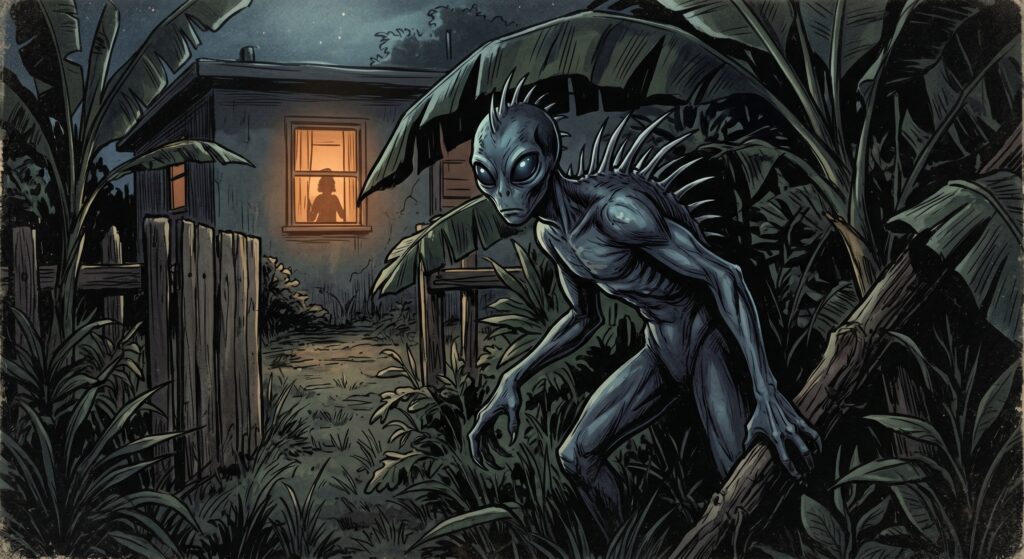
Within weeks, hundreds of people across Puerto Rico were reporting encounters with the same creature. Within months, the Chupacabra had spread to Mexico, then to Central America, and then to the United States. Within a decade, it was the most reported new cryptid in the Americas since Bigfoot. Within twenty years, researcher Benjamin Radford had traced Tolentino’s original description to its source: the creature Sil from the 1995 science fiction film Species, which Tolentino had seen before her report. The alien creature in Species is nearly identical to the original description of the Chupacabra. The modern Chupacabra legend began, in its initial Puerto Rican form, as a misidentification of a film character.
The Pre-History: El Vampiro de Moca
The Chupacabra’s 1995 emergence was not without precedent. In February 1975, in the Puerto Rican town of Moca, a series of livestock deaths attributable to unknown causes generated significant regional press coverage. Animals were found dead with circular puncture wounds and evidence of blood drainage. Newspapers called the phenomenon El Vampiro de Moca. The Moca Vampire was described at the time as a bird-like creature, a large bat, or a supernatural entity, with no consistent physical description across accounts. The 1975 events established in Puerto Rican community memory the concept of a bloodsucking predator targeting domestic animals, a concept that resurfaced and crystallized around the Tolentino description twenty years later.
The Texas Transformation
As the Chupacabra spread north into Texas and the American Southwest, it underwent a significant physical transformation. The original Puerto Rican Chupacabra was bipedal, with a spiny back and alien features. The Texas Chupacabra, documented from the late 1990s onward, is typically quadrupedal, hairless, blue-gray in color, and considerably less supernatural-looking. Several alleged Texas Chupacabras have been captured or found dead and subjected to DNA analysis. Every one has proved to be a coyote or raccoon and, in some cases, a dog severely affected by sarcoptic mange: a parasitic mite infestation that causes hair loss, thickening and discoloration of skin, and a distinctively gaunt appearance that can make a familiar animal look alien and frightening.
The two Chupacabras, the Puerto Rican alien-creature original and the Texas mange-coyote variant, are now effectively separate legends that share a name. The Puerto Rican tradition connects to UFO culture, government conspiracy theory, and the specific social anxieties of 1990s Puerto Rico. The Texas tradition is a straightforward misidentification of suffering animals. Both are compelling. They are not the same thing.