The real decapitation happened nine miles away, and nobody ever found the body.
A Dutch Village Caught Between Armies
Long before Washington Irving gave it a name, this stretch of the Hudson Valley was a Dutch farming settlement caught in a dangerous no man’s land. During the Revolutionary War, the ground north of British-held New York City and south of the Continental Army earned the nickname Neutral Ground.
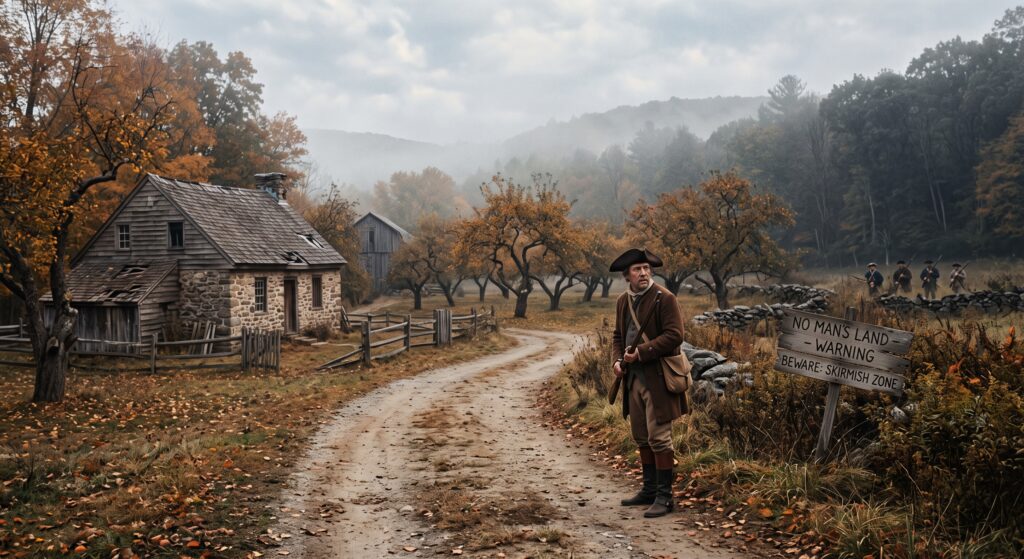
Neither side fully controlled it, and both sides raided it. Loyalist and Patriot militias clashed in the fields and orchards. Captured spy Major John Andre passed through this same corridor after conspiring with Benedict Arnold. The violence here was constant, personal, and rarely recorded in full.
Irving grew up hearing fragments of this history secondhand. He wove those fragments into the story that eventually renamed the whole village.
He first visited the area as a teenager in 1798, fleeing a yellow fever outbreak in Manhattan with his family. The Dutch customs and the old wartime stories left a lasting impression. That impression resurfaced two decades later when he sat down to write, thousands of miles away in England.
The Skirmish Nobody Talks About
Most retellings of the Headless Horseman legend skip a key detail. The cannonball that inspired Irving’s Hessian trooper did not fall in Sleepy Hollow. It fell nearly nine miles away, at the Battle of White Plains.
American General William Heath recorded the moment in his own journal. On November 1, 1776, he wrote that a shot from an American cannon took off the head of a Hessian artilleryman near Merritt Hill. Irving almost certainly read this account before writing his tale decades later.
The true story behind the horseman belongs to White Plains, not to the village that now bears his name. No record exists of the soldier’s remains ever being recovered or identified. Nobody ever brought a body back to Sleepy Hollow for burial.
The link between that corpse and the Old Dutch Church cemetery is a later invention. Generations of storytellers stitched it on, wanting their own headstones to carry the legend. We also know almost nothing about the man himself. Heath’s journal names no soldier and records no burial. He remains anonymous, a single violent moment that outlived his own identity by more than two centuries.
Irving likely layered in older European folklore too. Headless riders appear in German, Scandinavian, and Celtic legends long before 1776, including the Irish dullahan and the German Wild Huntsman. Irving had recently met the Scottish writer who translated that huntsman poem, and the timing lines up neatly.
Where the Whispers Live Now
The Old Dutch Church and its cemetery remain the emotional center of the haunting, regardless of where the real decapitation happened. More than forty-five thousand people rest here, including Washington Irving himself, Andrew Carnegie, and Elizabeth Arden.
Visitors report soft, disembodied whispers drifting between the headstones, especially near dusk when the cemetery empties of tourists. Nearby Patriots Park, the wooded site where Major Andre was captured, holds its own resident. A shadow figure paces the tree line there, and witnesses describe murmured conversation with no visible source.
At Raven Rock, a deep ravine on the village outskirts, locals tell of a wailing woman who froze to death in a blizzard generations ago. Her cries reportedly return whenever a heavy snowstorm rolls through the valley, echoing off the rock walls that gave the ravine its name.
Each of these figures predates the horseman in local memory. Yet none draws the crowds that the horseman draws every October. The village embraced one famous ghost so completely that its quieter hauntings became footnotes on the same tour.
A Legend Built on a Real Cannon Shot
None of this diminishes the legend. If anything, the nine-mile gap between fact and folklore makes the story more interesting, not less. Irving took a documented military death and stripped it of its real location. Then he grafted it onto a village he loved for its Dutch character and its ghost stories.
The village leaned into that gift. North Tarrytown officially renamed itself Sleepy Hollow in 1996, permanently merging its identity with a story that technically belongs to its neighbor.
Walk the cemetery today, and you stand in the emotional home of the Headless Horseman, even though his head rolled somewhere else entirely. That contradiction is the town’s real haunting: a place forever tied to a death it never actually witnessed.
It is also worth remembering the anonymous Hessian. Buried nowhere, mourned by no one, he survives only because an American general jotted down a single line in a war journal. Two hundred and fifty years later, tourists still travel here to trace the story of a man whose name history never bothered to record.
The Legend That Ate the Town
Few short stories have ever taken over a real place the way Irving’s tale took over Sleepy Hollow. The 1949 Disney film introduced the Headless Horseman to an entire generation of children. The 1999 Tim Burton adaptation reintroduced him to another generation entirely, this time with a body count and a much darker tone.
A long-running television series later borrowed the town’s name outright, pulling in fans who had never read a word of Irving’s original text. Each adaptation added new visual details to a legend that started as a few paragraphs on a page.
Roughly a quarter million visitors now travel to the village each year, most of them arriving in the weeks surrounding Halloween. Local businesses lean fully into the season, and the cemetery gates see more foot traffic in October than most historic sites see in six months combined.
That level of tourism creates its own kind of haunting. The story has grown so large that the actual Battle of White Plains, the real event behind it, is rarely mentioned on the tour.
Somewhere beneath the pumpkin displays and the gift shop replicas, a real cannon still sits on Merritt Hill. It marks the spot where an actual soldier lost his life. That monument draws only a fraction of the visitors the cemetery down the road receives every autumn. The imbalance between the true story and the famous one it inspired is quiet but persistent.
The horseman will likely outlive every other detail of this history, and that is not entirely a negative thing. A story this durable keeps people curious about the era that produced it. Most visitors, though, never make the short drive to see where the real cannonball actually fell.
References & Further Reading
The Real Mercenary Behind Sleepy Hollow’s Headless Horseman, Coffee or Die
What Inspired The Legend of Sleepy Hollow? HISTORY
Halloween History: The Legend of Sleepy Hollow, New-York Historical Society
10 of America’s Spookiest Small Towns, Daily Passport
12 Most Haunted U.S. Towns for a Spooky Fall Trip, Best Life

[…] ghost archetypes, appearing on roads and near water from coast to coast. New York offers the whispers of Sleepy Hollow, while New Jersey locals still warn of the Matawan Creek […]