How the Civil War’s deadliest single day and its bloodiest spring battle still speak through sound and water
Two Battles That Taught a Nation the War’s True Cost
Antietam and Shiloh both erupted in 1862, the Civil War’s first full year of large-scale slaughter. Neither side had yet grasped how costly the war would become, and both battles delivered brutal lessons.
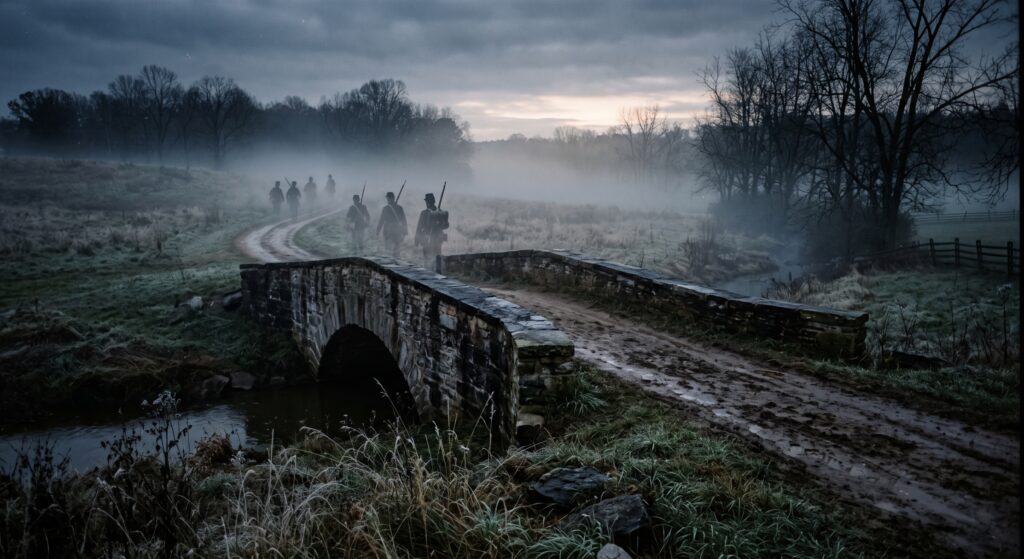
Antietam, fought near Sharpsburg, Maryland, on September 17, 1862, remains the bloodiest single day in American history. More than 22,000 men fell dead, wounded, or missing in about twelve hours. Union forces under George McClellan clashed with Robert E. Lee’s Confederates across cornfields, a sunken farm road, and a stone bridge over Antietam Creek.
Seven months earlier, on April 6 and 7, Union and Confederate armies collided at Shiloh in Hardin County, Tennessee. That battle produced more than 23,000 casualties, a number that stunned a nation still learning how long the war would run. Burial crews worked in haste, often placing soldiers from both armies into shallow, unmarked trench graves.
Both sites share a grim pattern. Enormous numbers of dead accumulated faster than either army could process them, and that unfinished business seems to have followed visitors ever since.
The Folklore and the Legends
Bloody Lane and the Carol That Isn’t
At Antietam’s Sunken Road, later renamed Bloody Lane, Thomas Meagher’s Irish Brigade charged into withering Confederate fire. Losses piled up fast in the narrow farm road, which turned into a killing ground within minutes.
For decades, schoolchildren visiting the site have reported hearing a faint chant drift across the lane. It sounds remarkably like “Deck the Halls,” specifically the “fa la la la” refrain. Historians offer an explanation rooted in linguistics rather than the supernatural. The Irish Brigade charged while shouting a Gaelic battle cry, roughly translated as “clear the way.” Spoken quickly under stress, and distorted by wind and distance, the phrase can phonetically resemble the familiar carol lyric.
Burnside’s Bridge and the Hospitals
Downstream at Burnside’s Bridge, Union troops spent hours trying to cross a narrow stone span under Confederate fire from the bluffs above. Visitors report floating balls of blue light hovering near the water after dusk. They also describe the faint cadence of a drum that fades before it resolves into a full rhythm. Some witnesses describe the beat approaching, then retreating, as though a unit is marching in a loop it cannot complete.
St. Paul’s Episcopal Church and the Pry House both served as field hospitals during and after the battle. Surgeons at both sites performed amputations for days without rest, and blood soaked deep into the floorboards. Staff and visitors at the Pry House report footsteps crossing empty upstairs rooms, along with lights that flicker without any electrical cause.
Shiloh’s Bloody Pond
At Shiloh, wounded soldiers from both armies reportedly crawled to a small pond to drink or wash their injuries, turning the water red with blood. The pond has carried the name Bloody Pond ever since, and visitors still report the water taking on a reddish tint during warm months.
Here is the twist worth knowing before your next visit. No wartime document places a pond at this exact spot in April 1862. Park rangers explain the modern red coloring as a seasonal algae bloom, common in shallow, warm water throughout the region. The story may be a postwar addition to Shiloh’s landscape rather than a literal record of events. That makes the pond worth visiting. It has become a place where people pause and reflect on the scale of suffering at Shiloh, whether or not its waters ever ran truly red.
The Mounds, the Hornet’s Nest, and the Lady in White
Shiloh’s battlefield sits near ancient earthworks built by Indigenous mound-building cultures centuries before the Civil War. Visitors report glowing orbs near these mounds after dark, along with distant musket fire near the Hornet’s Nest, where Union troops held a desperate defensive line for hours.
The most unusual figure reported at Shiloh is known as the Lady in White. Unlike most battlefield apparitions, she appears as a comforting presence rather than a frightening one. Witnesses, often women and children who feel lost or distressed on the grounds, describe her approaching gently before vanishing.
Visitor Information and Decorum
Antietam National Battlefield closes at sunset. The park prohibits fires, unpermitted gatherings of more than twenty-five people, and any use of metal detectors or relic hunting anywhere on the grounds.
Shiloh National Military Park follows similar rules, closing to visitors after dark and asking guests to stay on marked trails near the mounds and cemetery areas. Both parks remain active cemeteries and memorials, and rangers ask visitors to treat every field with the same quiet respect they would show at any gravesite. Nighttime ghost hunting at either site is both illegal and disrespectful to the thousands who remain buried there.
Both parks also host ranger-led programs during daylight hours that cover the documented history in far more depth than any ghost tour could offer. Checking the visitor center schedule before arriving is worth the extra planning. Seasonal programming changes throughout the year and often includes access to areas otherwise closed to casual visitors.
References & Further Reading
Antietam National Battlefield (NPS)
The Irish Brigade Monument (NPS)
Pry House Field Hospital Museum (NPS)
Battle of Shiloh: Shattering Myths – American Battlefield Trust