You pull onto the old covered bridge after dark on a dare, headlights off as the local legend demands. The wooden planks rattle under the tires. And then, for a moment before you hit the gas, you could swear something is standing at the far end.
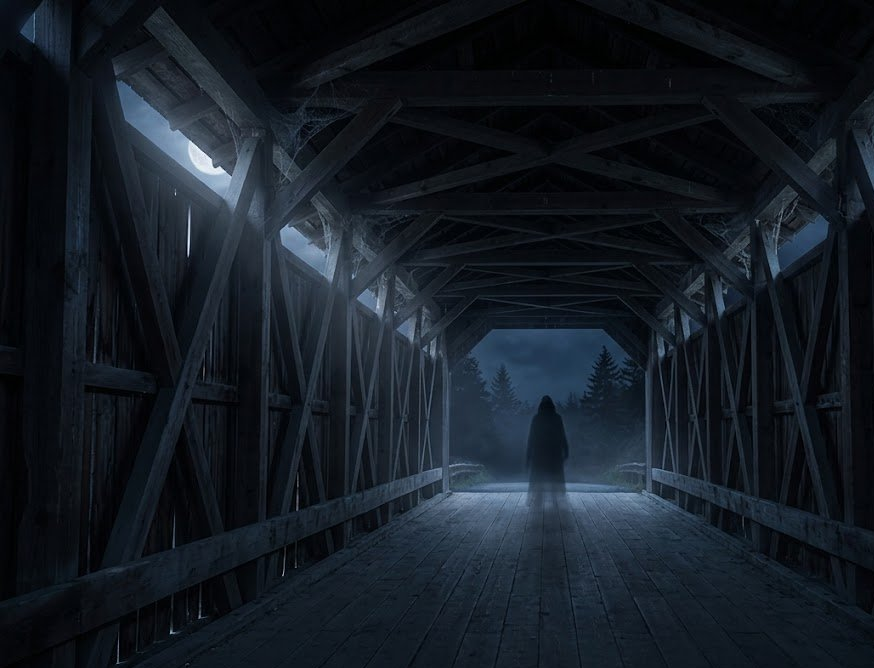
Bridges are among the most reliably haunted structures in American folklore. Not because of any single famous case, but because of a pattern that repeats across dozens of states: a tragic death, a story that attaches to the location, and generations of visitors who arrive expecting to see something and occasionally do. Understanding what makes bridges so fertile for ghost stories tells you something genuinely interesting about the relationship between landscape, memory, and fear.
Why Bridges in Particular
The geography of a bridge creates the psychological conditions for supernatural belief more reliably than almost any other structure. A bridge is a threshold. It connects two places while belonging fully to neither. It suspends you above water or a void, removed from the solidity of solid ground. In nearly every world mythology, crossing water is associated with transition between the living world and the dead: the River Styx, the Norse Bifrost, and the Aztec Chiconahuapan. When you stand on a bridge at night, you are standing in the precise kind of liminal space the human brain has associated with the presence of spirits for as long as people have been telling stories.
Bridges are also sites of documented tragedy. The combination of height, water, and vehicle traffic has made bridges the location of accidents, suicides, and violent events across every era. Where real deaths have occurred repeatedly, folklore accumulates. The grief and shock of those events leave a mark in community memory that is retold, embellished, and eventually becomes a legend that outlives the specific incident that seeded it.
The Templates That Keep Appearing
Paranormal researchers who study bridge folklore note that the same story structures appear independently across different states and countries. The most common is the tragic young woman: a girl who died near or on the bridge, often on her way to meet a lover, whose presence is reported by passing drivers. Emily’s Bridge in Stowe, Vermont, a covered wooden bridge built in 1844, accumulated a legend about a young woman named Emily who hanged herself from the rafters after being stood up at an elopement. Vermont ghost researcher Joseph Citro traced the story and found it dated not to the 1800s but to the 1970s, growing rapidly from there. The bridge is one of Vermont’s most visited paranormal sites.
Sachs Covered Bridge in Pennsylvania carries a different kind of weight. Built in 1854 and used as a crossing point and makeshift hospital during the Battle of Gettysburg in July 1863, it stands near ground where thousands of men died. Paranormal investigators have reported consistent EMF anomalies and audio phenomena at the location, and the site has been featured in numerous documented investigations. The history here is real and dense. Whether that density produces paranormal activity or simply creates a powerful emotional atmosphere that makes experiences feel significant is the question serious investigators continue to debate.
Goatman’s Bridge and the Weight of Historical Atrocity
Old Alton Bridge in Denton County, Texas, carries a legend rooted in genuine historical violence. According to documented local accounts, a Black goat farmer known as Oscar Washburn was lynched at the bridge by Klansmen in 1938. The legend that has grown around the location takes various forms, but the core of it reflects something real: a violent death, a community that could not process the injustice openly, and a story that preserved the horror in the only form available. Researcher Shaun Treat, writing on why ghost legends at sites of racial violence persist, noted that such stories often function as an alternative historical record, keeping alive what official histories prefer to leave unnamed.
The Psychology of Bridge Hauntings
Several factors converge to make bridge encounters feel paranormal even when the stimulus is mundane. The isolation of a rural bridge at night produces alertness and mild adrenaline. The visual environment, darkness, water below, and narrow passage reduce context clues that the brain normally uses to identify shapes. Expectation primes perception: someone driving to a reportedly haunted bridge is already in a heightened interpretive state before anything happens. And the acoustic environment of a wooden covered bridge, with its enclosed space and resonant construction, produces sounds that carry and distort in genuinely unusual ways.
Here is what that means practically: you can have a completely genuine, memorable, frightening experience on a haunted bridge that has a fully mundane explanation. That does not make the experience less real to the person who had it. And it does not explain every account. The cases worth paying attention to are those where multiple independent witnesses, who have not compared notes, describe the same specific detail at the same location. When the woman at the far end of the bridge appears in enough accounts, from enough separate strangers, to suggest a pattern rather than a rumor, that pattern is worth investigating carefully.
References & Further Reading
• Atlas Obscura: 11 Haunted Bridges You’ll Just Have to Cross
• Listverse: 10 Haunted Bridges
• The Ghost Posts: 6 Most Haunted Bridges in the World
• Vermont’s Very Best: The Legend of Emily’s Bridge


[…] Haunted Bridge Folklore Explained: Why Ghost Stories Gather at Crossings […]
[…] Haunted Bridge Folklore Explained: Why Ghost Stories Gather at Crossings […]