You have seen the image: a long hotel corridor lit by fluorescent panels, beige carpet, numbered doors stretching to a vanishing point. Or an indoor swimming pool at night, the water perfectly still, no one in the lanes. Or a school hallway on a Sunday, lockers closed, floor waxed, absolutely silent.
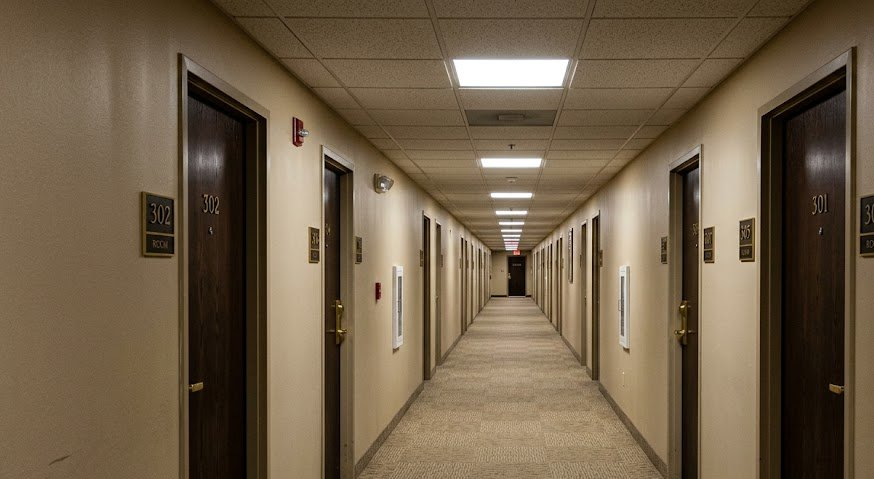
Something happens when you look at it. Not quite fear, not quite nostalgia. Something in between that has no clean name until recently, when a word began circulating online that describes the experience with uncomfortable precision: liminal. A liminal space is a transitional space, one that exists to be passed through, not inhabited. Strip away the people, and something in the human brain responds to the vacancy in a way that people consistently describe as haunted.
What the Research Actually Shows
In 2022, two psychologists from Cardiff University published research identifying the precise psychological mechanism behind liminal space unease: the uncanny valley effect applied to built environments. The uncanny valley is most commonly associated with human faces on non-human objects, the feeling of revulsion produced when something is simultaneously deeply familiar and subtly wrong. The Cardiff study showed that across over 100 images of spaces categorized as liminal, participants consistently rated them as uncanny rather than simply unfamiliar.
A complementary explanation comes from predictive processing theory. The brain is a prediction machine, constantly generating models of what the next moment should contain. A school corridor on a weekday generates strong predictions: noise, movement, and the social density of a crowd. When those predictions are violated by total emptiness, the brain generates what psychologists call a prediction error, a signal that something is wrong. The uncanny feeling is the subjective experience of a threat-detection system firing without a specific threat to point at. You feel watched. You feel unsafe. And the brain, which has no tolerance for an empty explanation, reaches for the available narrative: something is here that should not be.
Memory and the Ghost of Normal Life
The specific emotional quality of liminal spaces, that mixture of nostalgia and dread, connects to the way they intersect with personal memory. A school hallway is not just a school hallway. It is the repository of a thousand specific mornings, specific encounters, specific states of being. Encounter it empty, and you encounter both the absence of its occupants in the present and the vivid ghost of its occupants in memory. The space is simultaneously empty and full of something invisible. That double occupancy is structurally similar to how we experience grief, and the emotional register is similar too.
The Online Phenomenon and the Backrooms
The liminal space aesthetic emerged as a recognizable internet genre around 2019, when the r/LiminalSpace subreddit began accumulating images of empty pools, airports, shopping malls, and corridors. The defining rule of that community was deliberately chosen: no people. The absence was the content.
The same year, the Backrooms legend was born on 4chan from a single image of a yellow-carpeted empty office space, and the resonance was immediate. The Backrooms tapped directly into liminal unease to generate genuine dread from the most mundane possible setting. By 2022 it had generated a YouTube short film with tens of millions of views, multiple video games, and a forthcoming A24 feature film. The power of liminal horror is that it requires no monster. The emptiness is the monster.
What It Means That We Find These Places Haunted
The particular resonance of liminal imagery for audiences in the 2020s may have something to do with the specific dislocation of a period in which familiar spaces were suddenly, genuinely, occupied by neither people nor comfort. Empty airports. Closed schools. Office buildings without offices. Liminal spaces feel haunted, in the end, not because they contain ghosts but because they contain the memory of what should be there. That absence, when you sit with it, turns out to be one of the most disturbing presences of all.
References & Further Reading
• IFLScience: Why Are Liminal Spaces Creepy?
• HowStuffWorks: Why Do Liminal Spaces Feel So Unsettling?
• Connect Paranormal: Understanding Ghosts in Liminal Spaces
• Uncanny Lounge: Liminal Spaces Explained
• Wikipedia: Liminal Space (Aesthetic)