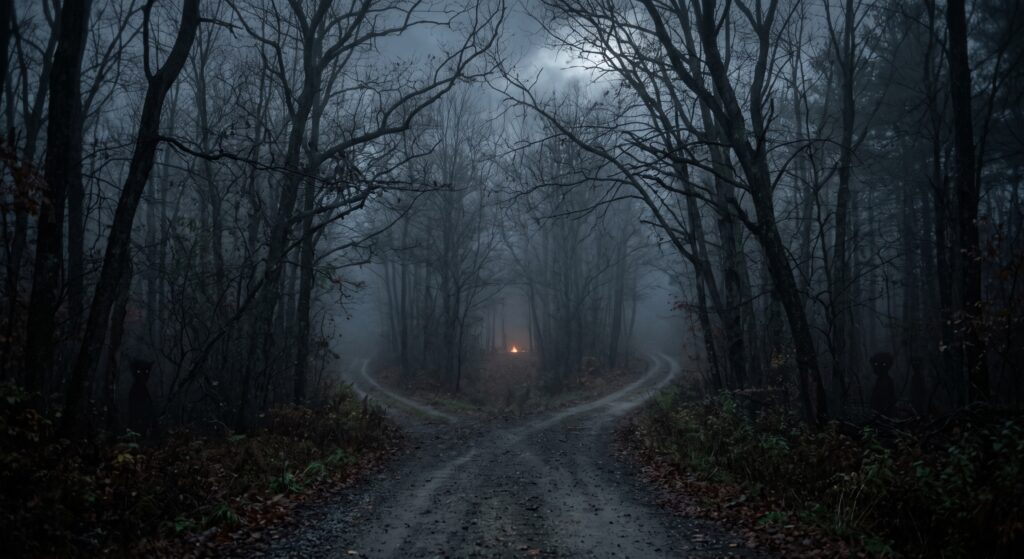
Standing Bear came home wrong.
He had walked into the mountain forest as the village’s greatest warrior, steady and fearless. He returned clawing at his own eyes. His wife, Running Deer, watched him tear at his face and understood two things at once: the demon Ew’ah had found him, and she was the only one left who could do anything about it.
What she chose to do next would transform her into something the Cherokee people of Etowah would honor for generations, not a monster, not an exile, but a guardian. The Wampus Cat most people have heard of is a cursed woman, punished and pitiful. This is the other version. And it is the one that carries a very different kind of power.
The Demon at the Heart of It
The Ew’ah, sometimes written as Ewah, occupied a specific and terrifying place in Cherokee spiritual belief. Known as the Spirit of Madness, this demon‘s weapon was not physical violence but psychological devastation. A single direct glance from the Ew’ah was said to permanently destroy a man’s sanity. The creature did not need claws or speed. It needed only to be seen.
That detail matters more than it might initially seem. The Ew’ah’s power is entirely a function of the gaze, of who looks at whom and under what conditions. When Standing Bear confronts the demon directly and loses, his defeat is a failure of vision, of facing something he was not equipped to face without protection. Running Deer’s eventual solution flips that logic on its head. She does not confront the Ew’ah with her own face. She brings something else entirely.
The village of Etowah, sometimes called Chota, had already tried and failed through conventional means. Standing Bear was the strongest warrior they had, and the demon had undone him. When Appalachian History describes the legend, it frames the Ew’ah as a creature that had been actively terrorizing the community, a sustained threat rather than a single encounter. The village had no more warriors left to send.
Running Deer Goes to the Shamans
In most tellings, Running Deer does not simply grab a weapon and charge into the forest. She understands that the Ew’ah cannot be defeated through ordinary courage, because courage requires facing something, and facing the Ew’ah is exactly what destroys you. She goes instead to the village shamans and asks for the right kind of protection.
What they give her is remarkable in its specificity. The shamans equip her with two things: a paste, usually described as black, applied to conceal her scent and her physical presence; and a booger mask, specifically a cat-spirit mask that represents the mountain cat’s power.
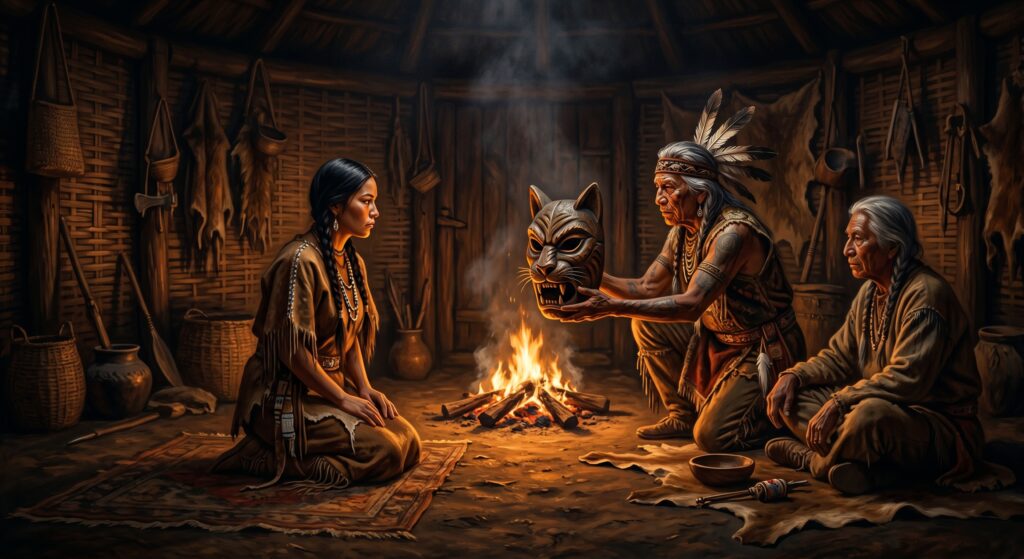
The booger mask is not a simple prop. In Cherokee culture, the Booger Dance was a genuine and important ritual tradition, performed at night around campfires in late fall and winter. Participants wore masks representing evil spirits, foreign intruders, or threatening forces and enacted a kind of controlled chaos that allowed the community to confront and symbolically expel what threatened them. Masks of this kind were crafted from wood, gourds, and hornets’ nests, each representing a specific type of danger or darkness that needed to be named and faced in ritual form.
When the shamans give Running Deer a cat-spirit booger mask, they are not giving her a costume. They are giving her a ritual instrument, a way to embody the mountain cat’s power and make that power visible to whatever she faces. She will not look at the Ew’ah with her own eyes. She will look at it through the mask’s carved face.
The Ambush at the Mountain Stream
Running Deer tracks the Ew’ah to a mountain stream and sets up an ambush. The choice of location is quietly important. Running water appears repeatedly in Appalachian and Cherokee spiritual traditions as a boundary space, a place where the natural and supernatural worlds sit closest to each other. The confrontation happens at a threshold.
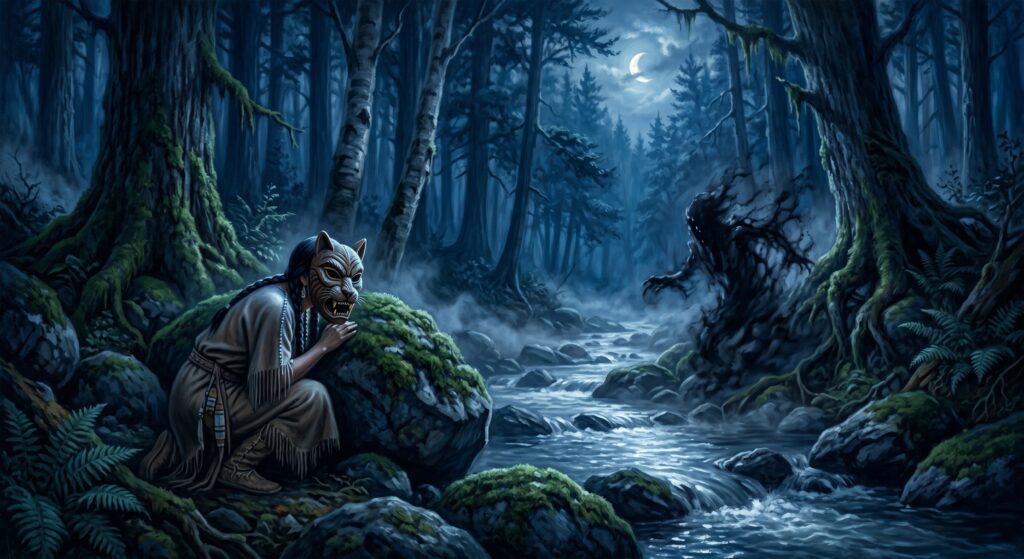
When the Ew’ah turns and looks at Running Deer, it does not see a woman. It sees the cat-spirit mask. And here is where the legend turns on itself: the Ew’ah’s power is its gaze, the ability to impose madness on whatever it looks at. But the mask Running Deer carries reflects that gaze back. The demon’s own madness, thrown outward, bounces off the cat spirit’s face and returns to its source. The Ew’ah tears itself apart.
Running Deer wins not through superior force but through superior understanding of how the demon’s power actually works. She uses the Ew’ah’s strength against it. That structural reversal is one of the reasons this version of the Wampus Cat legend reads so differently from the curse narrative. The woman here is not a transgressor caught in the wrong place. She is a strategist.
Spirit-Talker and Home-Protector
After the Ew’ah’s destruction, the village honors Running Deer with two titles that carry considerable weight: Spirit-Talker and Home-Protector. These are not ceremonial honorifics. In Cherokee spiritual life, communication with the spirit world and the defense of the community from supernatural threat were understood as serious and active responsibilities, not positions awarded and forgotten.
According to the legend’s closing movement, Running Deer’s spirit merges with or inhabits the body of the Wampus Cat. The result is not a monster. It is a guardian. In this form, she continues to prowl the forests and ridges of Cherokee territory, not to threaten the living but to intercept the unseen threats that the living cannot perceive. Dark forces, hidden evils, and spiritual predators of the kind that destroyed Standing Bear: these are what the guardian Wampus Cat hunts.
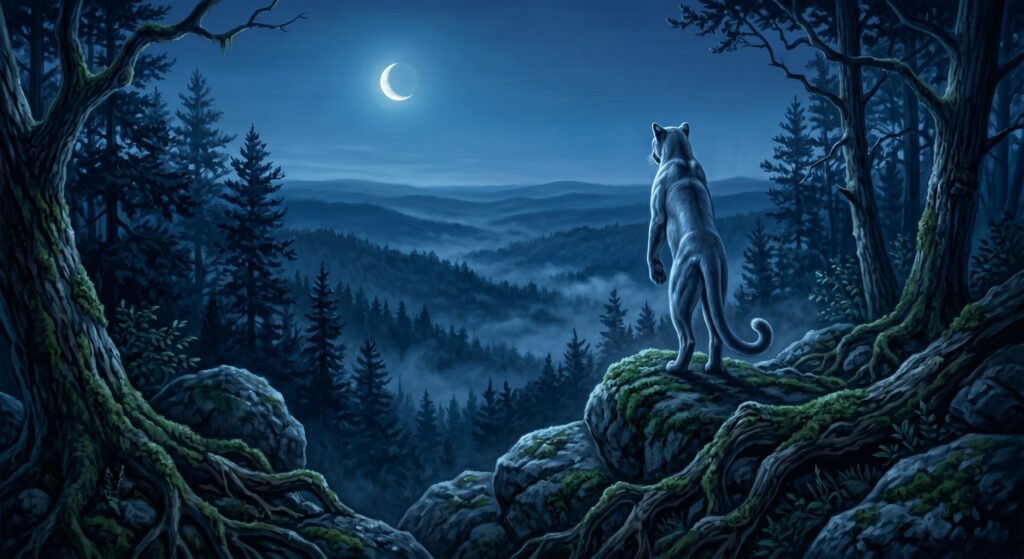
The creature described in this version of the legend is functionally a spiritual sentinel. She works at the edges, in the places where the human world yields way to the unknown, and her presence there is not something to fear but something that keeps worse things from coming closer.
Two Wampus Cats, One Appalachian Mountain
The coexistence of these two radically different narratives, the cursed transgressor and the honored guardian, within the same regional tradition is one of the more fascinating aspects of the Wampus Cat as folklore. Both stories use the same central image: a woman fused with the power of a wild cat, roaming the mountains at the edge of human habitation. One is punishment. The other is consecration. Both leave the creature permanently outside the ordinary world.
Scholars who have studied the Wampus Cat’s history, including researchers at Appalachian Historian, note that both the punishment narrative and the guardian narrative are best understood as modern syntheses. Before the late twentieth century, no firm documentation exists for the specific, fully formed stories of Running Deer and the spying wife. They draw on genuine Cherokee elements, particularly the booger mask tradition, beliefs about animal spirits, and the spiritual significance of the mountain cat, but these particular narratives appear to have emerged largely through written folklore collections and regional storytelling from the 1970s onward.
That historical context does not flatten the stories’ meaning. It does, however, suggest something interesting about how the Wampus Cat has functioned in American culture more broadly: the legend has served as a container into which different communities have poured different anxieties and different hopes. In settler Appalachian culture, the creature became a monster associated with witchcraft and unexplained night terrors. In the Cherokee-inflected versions that developed through the twentieth century, she became something more complex: both a warning and a protector, depending on which story you needed that night.
The Booger Mask and What It Actually Meant
Because the Running Deer legend centers on the booger mask, it is worth spending a moment with that tradition directly. The Cherokee Booger Dance (called tsu’nigadu’li in Cherokee, meaning ‘many persons’ faces covered over’) was performed at night around a campfire in late fall and winter. Male participants left the gathering, donned their masks, and returned as ‘boogers,’ figures representing threatening outsiders, evil spirits, or dangerous forces.
Masks were crafted to represent specific threats: foreigners, colonists, rival tribes, or abstract evil. The dance allowed the community to confront those threats symbolically, to give them faces and names, and then to enact their expulsion. It was simultaneously protective ritual, social satire, and communal catharsis. One scholar described the Booger Dance as a way for the Cherokee to deal with unwanted or harmful spirits while also providing humor and release for everyone watching.
When Running Deer’s shamans provide her a cat-spirit version of this mask, they are drawing on that tradition deliberately. The mask is not decoration. It is a weapon designed for exactly the kind of confrontation she is about to have: a face-to-face encounter with a force that destroys through the act of being seen.
What the Guardian Tradition Offers
The guardian version of the Wampus Cat matters for reasons beyond its narrative shape. In a regional folklore tradition heavily weighted toward female figures as victims, cautionary examples, or witches to be feared, Running Deer is something rare: a woman who acts with strategy, receives spiritual authority, and earns a permanent role as protector rather than exile.
She does not stumble into power. She pursues it deliberately, on behalf of someone she loves and a community she refuses to abandon. The transformation that follows her victory is not a punishment but an elevation. She becomes something outside the ordinary human world because the ordinary human world cannot do what she now does.
Whether or not the Running Deer narrative has deep pre-contact roots, that is the story it tells. The guardian Wampus Cat stands out in the full landscape of Appalachian cryptid lore, a tradition that is more often populated by threats than by protectors.
Where the Howl Comes From
Both versions of the Wampus Cat share one detail: the sound. Across Appalachian accounts, the creature produces a cry that witnesses consistently describe as wrong. The cry is too high for a bobcat, too sustained for a fox, and too human in its register. Settlers who heard it sometimes reported a sound like a woman screaming. Ranchers who lost livestock in the 1920s and 1930s pointed to that cry as the signature of something they could not name.
In the guardian tradition, that sound takes on a different meaning. Running Deer is not wailing in grief or anguish. She is calling out something darker, warning the community, or driving back whatever is gathering at the edge of the forest. The cry that terrified settlers in the hollow is the sound of protection in progress.
Whether you find that comforting probably depends on how well you sleep through mountain nights. But the next time something screams in the Appalachian dark and no animal you know of explains it, it is at least worth considering that maybe it is not coming for you. Maybe it is out there specifically to keep something worse from coming for you.
References
Appalachian Historian: The Wampus Cat of Appalachia
Appalachian History: The Story of the Wampus Cat
Appalachian History: The Cherokee Booger Dance
HowStuffWorks: The Wampus Cat Myth Explained
Cherokee Phoenix: Cochran Shares Booger Mask History