The Ningen, which means ‘human’ in Japanese, is one of the few cryptids with a clearly traceable origin on the internet rather than in oral tradition. The legend appears to have begun on the Japanese text board 2channel (now known as 5channel) around 2002, in threads where anonymous users shared reports and photographs of enormous, white, vaguely humanoid figures seen in Antarctic waters by Japanese government research vessels. The original posts were anonymous, the photographs inconclusive, and the claims unverifiable. But the combination of governmental context, the extreme mystery of Antarctic waters, and an unsettling physical description proved irresistible, and the Ningen spread rapidly through Japanese internet culture before reaching Western cryptid communities via translation sites around 2010.
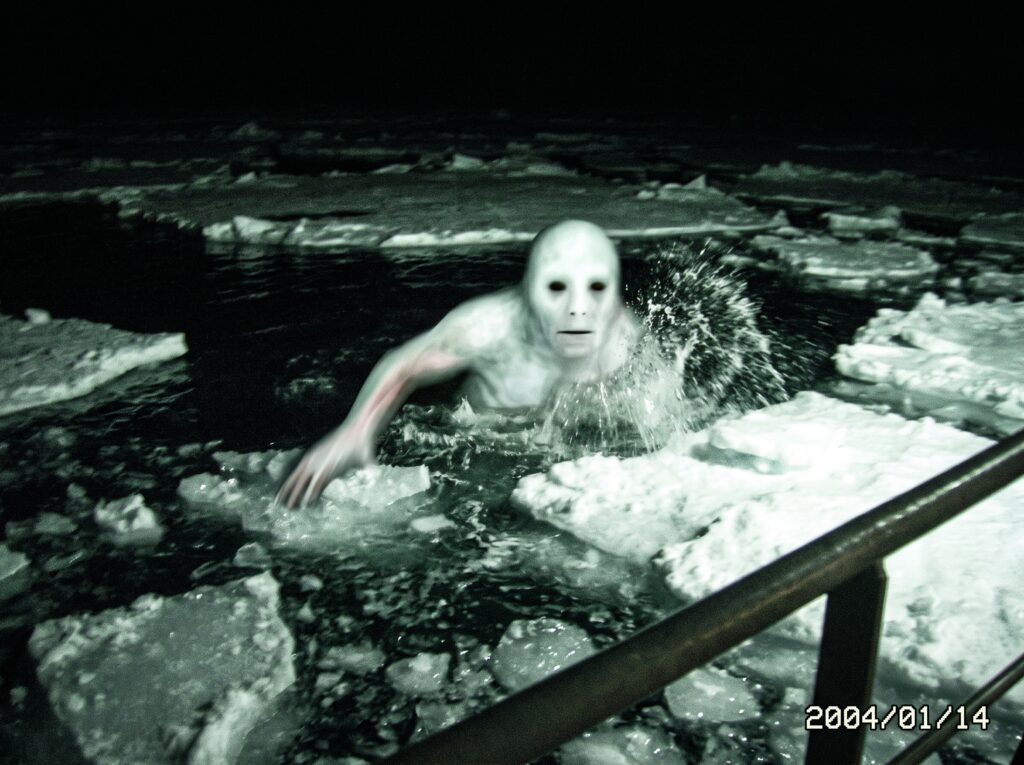
The Ningen is described as enormous: estimates range from twenty to thirty meters in length. Its body is described as white, smooth, and vaguely human-shaped, with two arms ending in five-fingered hands, a lower body that may split into two legs or terminate in a fish-like tail depending on the account, and a face with just two eyes and a slit for a mouth. It is described as moving slowly through Antarctic waters, occasionally surfacing near vessels.
The Source Problem
Every element of the Ningen’s documented history presents the same problem: anonymity and unverifiability. The original 2channel posts were anonymous. The photographs cited are invariably non-specific satellite or aerial images of ice formations that various users interpreted as humanoid shapes. No government or research institution has confirmed any encounter. No physical evidence exists. The creature is, in every documentable sense, a pure internet creation.
This does not make it uninteresting. The Ningen is one of the most fully developed examples of a digital folklore entity: a creature created and refined entirely through online collective imagination, with no pre-internet oral tradition behind it. The process by which the 2channel posts became a globally known cryptid, through progressive elaboration, translation, and retelling in different cultural contexts, illustrates exactly how internet-era legends form and spread.
Why Antarctica
The Ningen’s Antarctic setting is the most genuinely interesting element of the legend, and it reflects a real cultural relationship between Japan and Antarctic research. Japan has maintained a major Antarctic research presence since 1956, and the Japanese Antarctic research fleet has conducted extensive whale research under controversial research quotas that brought Japan into repeated conflict with environmental organizations. The original 2channel framing of Ningen sightings by Japanese research vessels places the creature in a specific institutional context that was both familiar and slightly opaque to Japanese internet users.
Antarctica itself is genuine mystery territory. Its deep waters are among the least surveyed on earth, and the Southern Ocean continues to produce genuine biological surprises. The colossal squid, the longest known invertebrate, was confirmed as a real species only in 2003, based on specimens found in the Southern Ocean. Even if the Ningen is an implausible creature, Antarctic waters remain genuinely mysterious.



[…] biological logic. At the opposite end of the globe, the internet age has birthed the legend of the Ningen, a massive, pale humanoid said to inhabit the freezing waters of […]