The Mission Valley in northwestern Montana is home to Flathead Lake. It sits between the Mission Mountains to the east and the Salish Mountains to the west. It is 28 miles long, up to 370 feet deep, and the largest natural freshwater lake west of the Mississippi River. Its water is cold and exceptionally clear, fed by glacial melt and mountain runoff, with visibility to 30 feet or more on a calm day. It is also home to one of the longest continuously documented lake monster traditions in the American West.
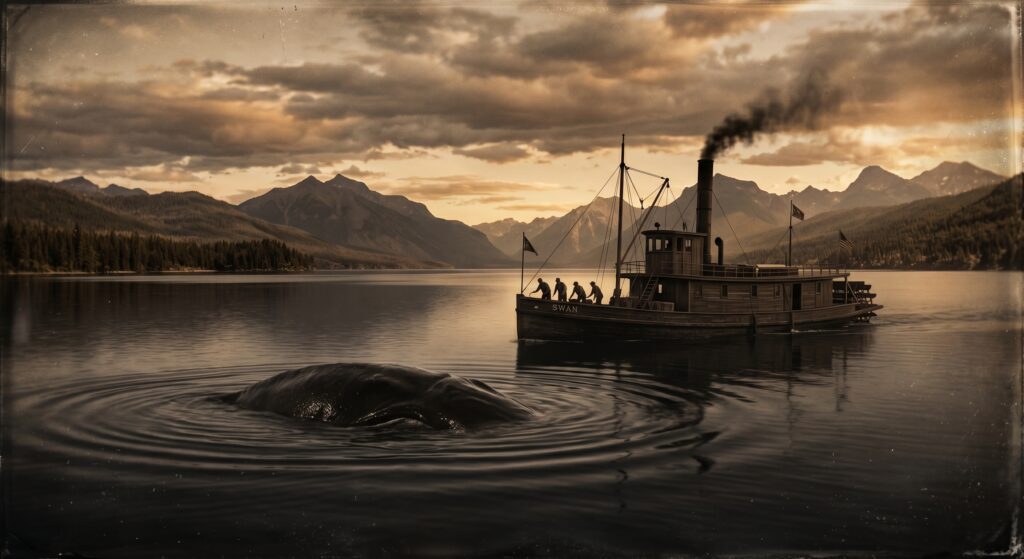
Reports of something unusual in Flathead Lake extend back to the 1880s, shortly after the first substantial European settlement of the Mission Valley. A July 1885 account in the Flathead Herald describes a group of passengers on the steamer U.S. Grant who observed a large, dark creature surface near the vessel. The ship’s captain, James Kerr, a professional whose livelihood depended on his credibility, and multiple passengers provided the account. It set the template for what would become over 130 years of Flathead Lake monster accounts: brief, unexpected surface appearances near the main shipping lane, at distances that prevented detailed examination, witnessed by people with no particular reason to fabricate the encounter.
The Pattern of Sightings
Flathead Lake monster reports concentrate in three areas: the main deep-water channel between Polson at the southern end and Somers at the north, the eastern shore near the Flathead Indian Reservation, and the area around Wild Horse Island in the lake’s midsection. The consistency of location across independent accounts spanning over a century suggests either a genuine phenomenon localised to specific parts of the lake or a very well-established cultural script that shapes where people expect to see something and therefore where they report seeing it.
Contemporary accounts describe a creature of varying size, from ten to forty feet, typically dark in colour, seen surfacing briefly with a single large hump or a long, neck-like projection above the water. Several recent accounts include video footage showing an elongated dark object moving through the water. None of this footage has been definitively identified as any known animal.
Biological Candidates
The most scientifically credible explanations for Flathead Lake monster reports focus on the lake’s known biology. White sturgeon, which are native to the Columbia River system and connected waterways, have been documented in Flathead Lake and can reach six feet or more in length. Lake trout in Flathead are known to reach very large sizes. Large concentrations of kokanee salmon, a landlocked sockeye, sometimes produce unusual surface behavior that observers can misread at a distance. The lake’s exceptional clarity means that animals moving through the water column at significant depths can cast shadows or create surface disturbances that appear anomalous from above.
The Salish and Kootenai Traditions
The Salish and Kootenai Nations, whose ancestral territory includes Flathead Lake, have traditions about the lake’s spiritual significance that predate any monster legend in the European sense. The lake is considered a place of power requiring respect, and specific areas, particularly around the island complexes on the eastern shore, are treated as spiritually charged. Salish and Kootenai cultural authorities, rather than outside researchers, are best suited to answer whether the creature accounts that accumulated after European settlement connect to the older Indigenous tradition of the lake as a place with unusual power.

[…] deep, cold waters of the West hold their own leviathans. Montana’s Flathead Lake Monster has generated dozens of reports of a massive, whale-like creature. Across the border in British […]
[…] Canada boasts one of the world’s most famous lake monsters: Ogopogo of Okanagan Lake, a serpent-like creature that predates Nessie in the historical record. (Its southern cousins include Champ, Bessie of Lake Erie, and the Flathead Lake Monster). […]