Before the Syilx people of the Okanagan Valley encounter any European who will later name it Ogopogo, they know it as N’ha-a-itk: the water demon. Not a monster to be hunted or disproved, but a spirit of the lake that commands respect, requires offerings before passage, and has been part of the valley’s spiritual geography for as long as the Syilx have lived beside the water. Travelers crossing the lake leave tobacco, animal meat, or small chickens at the surface before the passage. Those who do not are risking something the elders describe concisely.
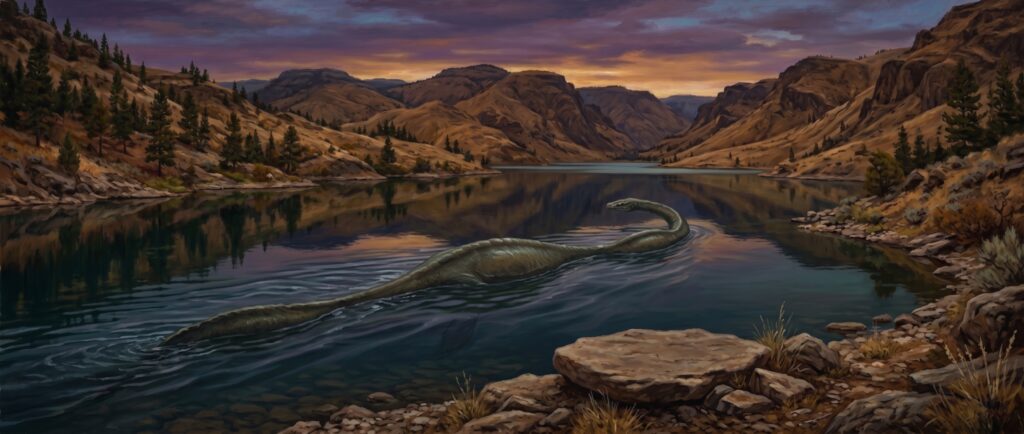
Okanagan Lake, 135 kilometers long and up to 232 meters deep, sits in the dry southern interior of British Columbia in a glacially carved trench. It is deeper than Loch Ness and connected to adjacent lake systems by both surface and potentially subterranean passages. The Syilx have lived on its shores for millennia. Europeans arrived in the 1850s. The creature’s Western name, Ogopogo, comes from a 1924 British music hall song performed in Vernon, BC, and many Syilx people today consider it a trivialization of their sacred tradition.
The Syilx Tradition
In Syilx cosmology, N’ha-a-itk is not a biological organism but a being of spiritual power. The lake is understood as a living, intentional presence, and the water demon is one of its expressions. Some Syilx accounts describe the entity as a shapeshifter that can appear as a horse-headed serpent, a large fish, or a mysterious wave pattern with no visible wind source. The tradition of making offerings before crossing reflects not superstition but a specific understanding of relationship: the lake’s guardian spirit is not inherently hostile, but it requires acknowledgment of its power and the human’s dependence on its goodwill.
The first documented European encounter dates to 1855, when Métis settler John McDougall was crossing the lake with horses tied behind his canoe, and the animals were pulled under the water. He had to cut the ropes to save himself. The first reported direct sighting by a settler was in 1872, when Mrs. Susan Allison, a well-respected community figure and published author, reported seeing what she described as a dinosaur in the lake near Squally Point.
The 1926 Mass Sighting
The most significant mass sighting in Ogopogo’s documented history occurred in the summer of 1926, when approximately thirty people at Okanagan Mission Beach simultaneously observed a large creature surface repeatedly over roughly twenty minutes. Witnesses included families, tourists, and local businesspeople: a broad demographic with no apparent shared motivation to collectively fabricate an encounter. The creature was described as dark, approximately six to ten meters long, with multiple humps rising above the water in vertical undulation. No conventional explanation for the 1926 event has been produced that accounts for the number of witnesses and the duration of the observation.
Modern Documentation
Okanagan Lake has generated more documented Ogopogo sightings over a longer period than any other North American lake, with over 200 reported sightings since 1872 and multiple video recordings. The videos range in quality from the ambiguous to the genuinely puzzling: dark, elongated objects moving through the water in ways inconsistent with boat wakes, logs, or known fish behavior. In 1989, Ogopogo was formally protected under the BC Wildlife Act, making it illegal to hunt or disturb the creature if it exists, reflecting the animal’s practical cultural status as a community asset regardless of its biological reality.
Kelowna, the major city on Okanagan Lake’s eastern shore, has integrated Ogopogo into its civic identity in a way that respects both the commercial opportunity and the Syilx tradition. Moccasin Trails, an Indigenous-led tour company, offers lake experiences that center the N’ha-a-itk tradition rather than the Western cryptid framing, providing visitors with a considerably richer understanding of what the creature actually means in its home landscape.
References & Further Reading
• Tourism Kelowna: The Legend of Ogopogo
• Tour Canada: Ogopogo Sightings and Science
• The Horror Collection: 100 Years of Sightings
For cryptids beyond North America, see our guide to the Cryptids of the World: A Global Guide to Hidden Monsters.
[…] boasts one of the world’s most famous lake monsters: Ogopogo of Okanagan Lake, a serpent-like creature that predates Nessie in the historical record. (Its southern cousins […]