The photograph was sent to a paranormal investigation group by a concerned parent: their teenager’s bedroom wall, covered in drawings. Were these satanic symbols? Should they be worried? The investigator looked at the images carefully. Several were from a popular video game. One was a Wiccan pentagram from a jewelry catalog. One was a band logo. The inverted cross the parent was most concerned about turned out to be the Cross of St. Peter, one of the oldest Christian symbols in existence.
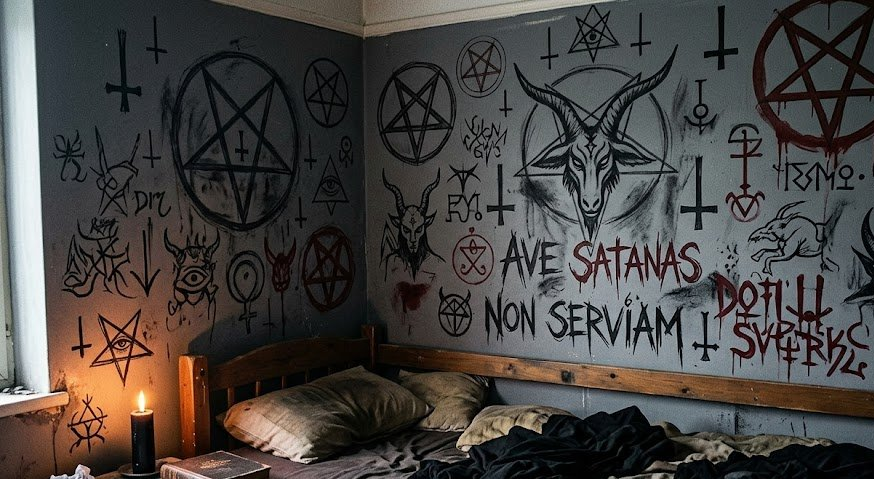
Demonic symbols represent one of the most consistently misidentified categories in paranormal concern. The fear attached to certain visual forms is genuine, but the knowledge base that informs that fear is frequently inaccurate. Understanding the actual history of the major symbols associated with demonology, their real origins, and their real meanings gives you a much more accurate framework for assessment.
The Inverted Pentagram
The five-pointed star drawn point-downward is among the most recognizable symbols associated with Satanism and, by extension, demonic activity. Its actual history is considerably more complex.
The pentagram in any orientation was used as a protective and magical symbol throughout medieval European occultism, appearing in grimoires, on church architecture, and in alchemical texts. The specific association of the inverted pentagram with darkness rather than protection developed gradually through 19th-century French occultism. The image of a goat’s head within an inverted pentagram, surrounded by Hebrew letters spelling Leviathan, was created by French occultist Stanislas de Guaita in 1897 for his book La Clef de la Magie Noire.
Anton LaVey, founding the Church of Satan in San Francisco in 1966, adopted de Guaita’s image as the Sigil of Baphomet and made it the official emblem of his organization. Prior to LaVey’s founding, this specific image was not the primary symbol of Satanism in Western culture. The upright pentagram, meanwhile, continues to be used as a protective and Wiccan symbol with no demonic association in those traditions.
The Inverted Cross
The inverted cross is probably the most frequently misidentified symbol in demonic concern conversations. It is almost universally called ‘the Satanic cross’ or ‘the cross of the Antichrist.’ Its actual origin is entirely different. The Cross of Saint Peter, an inverted Latin cross, represents the manner of Peter’s crucifixion: the apostle requested to be crucified upside down because he felt unworthy to die in the same position as Jesus. It is one of the oldest and most clearly documented symbols in Catholic tradition, used in papal iconography for centuries and present in the Vatican itself.
The inverted cross’s contemporary association with Satanism derives from its use in horror films from the 1970s onward, which borrowed it as a visual shorthand for anti-Christian imagery. This fictional use then fed back into cultural belief, creating a situation where a symbol of Christian humility is routinely identified as evidence of demonic activity.
The Sigil of Baphomet
Baphomet as a concept predates its visual representation. The name appears in the records of the Knights Templar trials of 1307-1312, where the Templars were accused under torture of worshipping an idol called Baphomet. The nature of this idol is unclear and the accusations were likely fabricated under coercion. The name re-emerged in 19th-century occultism when French occultist Eliphas Levi depicted Baphomet in his 1854 Dogme et Rituel de la Haute Magie as a seated hermaphroditic winged figure with a goat’s head: a symbol of the union of opposites in magical philosophy. Levi’s Baphomet was a philosophical concept, not a deity.
LaVey combined the goat-head-in-inverted-pentagram image with the Baphomet concept to create the Sigil of Baphomet as the Church of Satan’s emblem. The modern Satanic Temple uses a variant featuring a human Baphomet figure accompanied by children. Both organizations use the symbol as a philosophical statement about human nature rather than as an invocation of a literal supernatural entity.
Sigils and Demonic Seals
The grimoire tradition of European occultism, particularly texts including the Lesser Key of Solomon (Lemegeton), the Ars Goetia, and the Grand Grimoire, contains elaborate systems of sigils: geometric and symbolic designs associated with specific, named demonic entities. These sigils are drawn from various sources, including medieval Jewish magical tradition, Arabic astrology, and original invention by grimoire compilers, and they function within their original context as instruments for summoning and binding.
These historical magical sigils are frequently confused with decorative geometric patterns, corporate logos, and artistic designs in contemporary demonic symbol identification. The Starbucks logo, the Google Chrome logo, and numerous band logos have at various times been identified on social media as demonic sigils. The pattern of identification tells us more about the human tendency to find meaningful patterns in ambiguous visual information than about the actual distribution of demonic symbolism in commercial art.
What Symbols Actually Mean
A symbol means what it means within a specific tradition and context. The pentagram means protection in Wicca, materialist philosophy in LaVeyan Satanism, and a star shape in commercial design. The inverted cross means Petrine humility in Catholic iconography and anti-Christian provocation in horror film. The meaning is not inherent in the shape but in the tradition and intention of its use.
For anyone assessing whether symbols found in a specific context are genuinely demonological, the relevant questions are: in what tradition does this symbol operate, what is the intention of the person using it, and what is the actual documented history of this specific image? Most concerns about demonic symbols dissolve under these questions. The rare case where they do not, where a symbol genuinely operates within a demonological tradition and is being used with that intention, is worth taking seriously. The majority of cases where they seem to, the concern is based on misidentification fed by horror film aesthetics.
References & Further Reading
• Church of Satan: History of the Sigil of Baphomet
• American Occultist: Sigil of Baphomet Meaning
• ULC: Satanic Symbols and Their Meanings


[…] experience; they came from the leading questions of interrogators who had a framework of Satanic conspiracy and asked questions that filled that framework in. The mechanism is identical to the one that […]
[…] Demonic Symbols Meaning: Folklore, Misidentification, and Pop-Culture Fear […]
[…] a specific and terrifying place in Cherokee spiritual belief. Known as the Spirit of Madness, this demon‘s weapon was not physical violence but psychological devastation. A single direct glance from […]