In a small cemetery in Lafayette, Colorado, a modest grave marker bears a single striking word carved beneath a name: Transylvania. It belongs to Theodore “Todor” Glava, a Romanian coal miner who died in 1918. His grave has, over the following century, become the center of one of Colorado’s most persistent vampire legends.
A miner lost to the pandemic
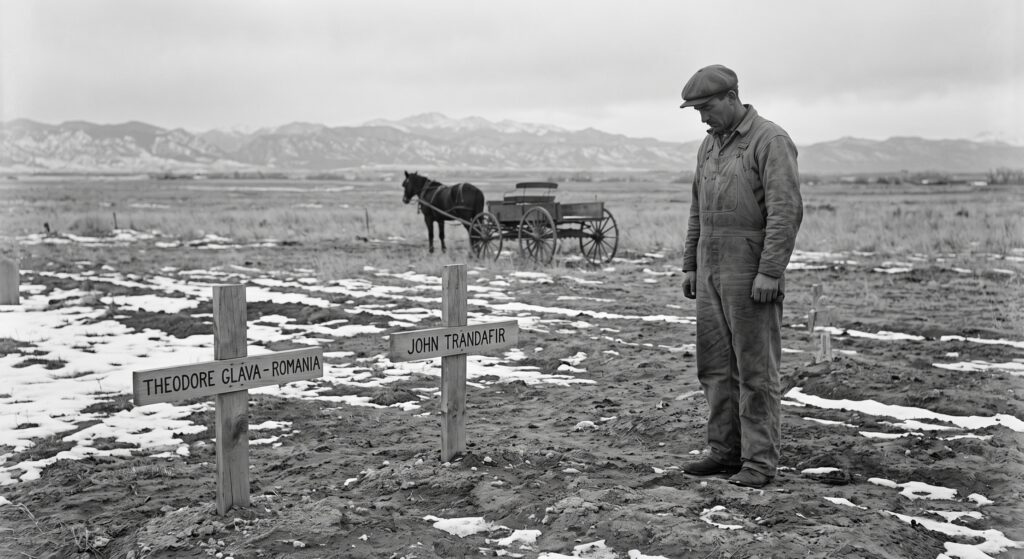
Glava’s actual story is straightforward and tragic in an entirely ordinary way. He was a Romanian immigrant working the coal mines around Lafayette when he died in 1918, one of the millions of victims claimed that year by the global influenza pandemic. He shares his grave with fellow Romanian immigrant and coal miner John Trandafir, who died of the same illness on the same day. The involuntary eternal roommates show how devastating that particular wave of the pandemic was among the immigrant mining communities of the Colorado Front Range.
How a headstone became a legend
The vampire legend centers on his grave marker’s “Transylvania” inscription, marking his birthplace, along with an actual tree growing from the center of the gravesite, which fuels the more dramatic version of the story. Frightened locals exhumed Glava’s body after his death and found his teeth abnormally long, his mouth marked with blood, and his nails still seemingly growing. So they drove a wooden stake through his heart to prevent him from rising, and a tree eventually sprouted from that very stake.
It’s a vivid story, but local historians are skeptical of most of it. There’s no contemporary record, no newspaper account, and no town record of any panic, exhumation, or staking that happened around the time of Glava’s death in 1918. The leading theory among Lafayette historians is that the legend actually took shape decades later, during the vampire pop-culture boom of the 1960s and 1970s, when a “Transylvania” headstone in a small Colorado cemetery proved too tantalizing a hook to leave alone. As for the supposed evidence of vampirism, elongated teeth, blood at the mouth, and nail growth are simply features of natural decomposition.
A legend that says more about us than about him
What makes the Lafayette vampire story worth telling isn’t really whether Glava was ever suspected of vampirism in his lifetime. The evidence suggests he almost certainly wasn’t. It’s how a real person’s grave, marked with an evocative word and a strange natural detail, got absorbed into a folklore narrative that had far more to do with pop culture than with 1918 Lafayette. Today, Glava’s grave remains a minor pilgrimage site for Colorado ghost-story enthusiasts and provides a quiet reminder that even a forgotten flu death can become a full-blown legend if the headstone reads just right.