You have been in haunted places before and this one feels different. The other locations you investigated had a quality of presence, something that left an impression and faded. This house has something that pushes back. You asked your most experienced colleague what the distinction was, and she said: a ghost wants you to know it is there. Something else wants something from you.
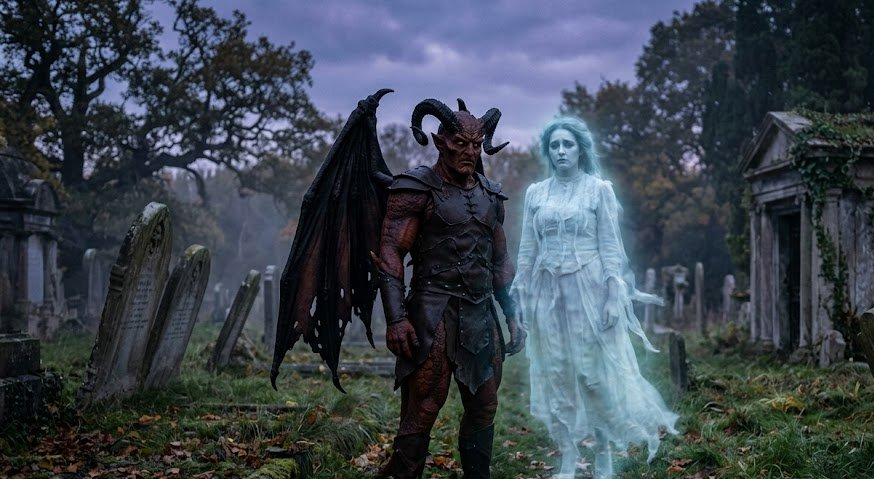
The distinction between ghost hauntings and demonic hauntings is one of the most discussed and least precisely defined categories in paranormal investigation. Here is a systematic comparison of how the two categories are described in folklore, religious tradition, and paranormal investigation practice, along with the skeptical framework that questions whether the distinction is meaningful at all.
Origins and Nature
Ghost Hauntings
A ghost haunting, in both folk tradition and paranormal investigation frameworks, involves a presence associated with a specific human individual who lived and died. The ghost may be residual, a recording of past events that replays without awareness of the present, or intelligent, a consciousness that appears to retain personality and the capacity for communication. The entity is understood to have been human, to have a specific history attached to the location, and to have recognizable motivations: unfinished business, emotional attachment to a place, or the desire to communicate something to the living.
Demonic Hauntings
A demonic haunting, in Catholic theology and in the broader paranormal tradition that draws from it, involves an entity that was never human. The demon is understood to be a fallen spiritual being with intelligence, will, and a specific agenda: the disruption, corruption, or destruction of the human beings in the affected space. It does not have grief or unfinished business in the human sense. Its interest in the household is predatory rather than relational.
Behavioral Patterns: What Each Type Does
Residual vs Targeted
Ghost hauntings, particularly residual ones, tend to be location-anchored and person-neutral. The apparition appears on the stairs regardless of who is standing there. The footsteps play out the same sequence regardless of who is listening. The activity does not vary based on who is in the house or what they are doing.
Demonic hauntings are consistently described as targeted. The activity focuses on specific individuals within a household, often the most psychologically or spiritually vulnerable. It follows people rather than simply occupying space. Multiple investigators have noted that in cases classified as demonic, the activity intensifies when specific individuals are present and diminishes when they leave, a pattern inconsistent with residual haunting and more consistent with an entity that perceives and responds to specific people.
Escalation vs Consistency
Ghost hauntings tend toward consistency. The same events, at the same times, in the same locations, across years or decades. A residual haunting of a staircase looks the same in 1990 as it does in 2020 because there is no intelligence maintaining or adapting it.
Demonic hauntings are characterized in both theological and paranormal accounts by escalation. Activity that begins with minor disturbances, sounds, smells, cold spots, builds over weeks or months to physical contact, sleep disruption, psychological effects, and in extreme claimed cases, physical attacks. This escalation pattern is the primary diagnostic criterion that experienced Catholic exorcists use to distinguish infestations (demonic activity in a location) from hauntings by human spirits.
Communication Patterns
Ghosts, in EVP and spirit box investigations, are typically described as communicating information: names, requests, historical facts, emotional states. The communication, when it occurs, tends to be bounded and specific.
Demonic entities, when communication is claimed, are described very differently: deceptive, manipulative, designed to establish a relationship that progressively demands more. Investigators who specialize in reported demonic cases uniformly advise against attempting direct communication, for this reason. The concern is that unlike a ghost, which may communicate because it wants to be understood, a demonic entity communicates because it wants to be engaged.
Physical and Psychological Effects
Ghost hauntings rarely produce consistent physical effects on residents. The experiences are primarily perceptual: things seen, heard, and felt. Residents typically report unease and disrupted sleep, but their health and psychology do not systematically deteriorate.
Demonic haunting reports, particularly in documented cases reviewed by Catholic diocesan exorcism teams, include systematic psychological deterioration in residents: increased aggression, depression, dissociative episodes, compulsive behavior, and in the most severe claimed cases, full personality changes. These are treatable psychiatric symptoms that warrant medical attention regardless of their cause.
Religious and Cultural Frameworks
Different religious traditions draw this distinction differently. In Catholic theology, the demonic is an ontologically distinct category from the human spirit, requiring different spiritual intervention. In Protestant Christianity, both categories may be addressed through prayer and spiritual authority. In Islamic tradition, jinn can produce effects that Western frameworks would classify as either ghost or demonic haunting, and the distinction is theological rather than purely behavioral. In secular paranormal investigation, some researchers collapse the categories entirely, arguing that the behavioral difference between a hostile human spirit and a non-human entity is not sufficient to justify a categorical distinction.
The Skeptical View
Skeptical investigators argue that the ghost versus demonic haunting distinction is not an empirical category but a theological one, imported from religious tradition into secular paranormal practice. The behavioral differences described, escalation, targeting, psychological effects, can all be produced by: severe mental illness in one or more household members, extreme stress and sleep deprivation, CO poisoning, elevated EMF, infrasound, and the powerful social contagion that occurs in a frightened household where everyone is interpreting ambiguous events through the same framework.
That skeptical position does not explain every documented case, but it does explain why the starting point for any investigation, whatever its eventual conclusion, has to be a thorough elimination of physical and psychological causes.
References & Further Reading
• Beyond Haunted: What Are Poltergeists and Demonic Hauntings


[…] Demonic Haunting vs Ghost Haunting: Key Differences in Paranormal Reports […]
[…] Demonic Haunting vs Ghost Haunting: Key Differences in Paranormal Reports […]