In 1830, zoologist Giuseppe Balsamo Crivelli unearthed a fossil at Perledo, a village on the eastern shore of Lake Como. He named the creature Lariosaurus.
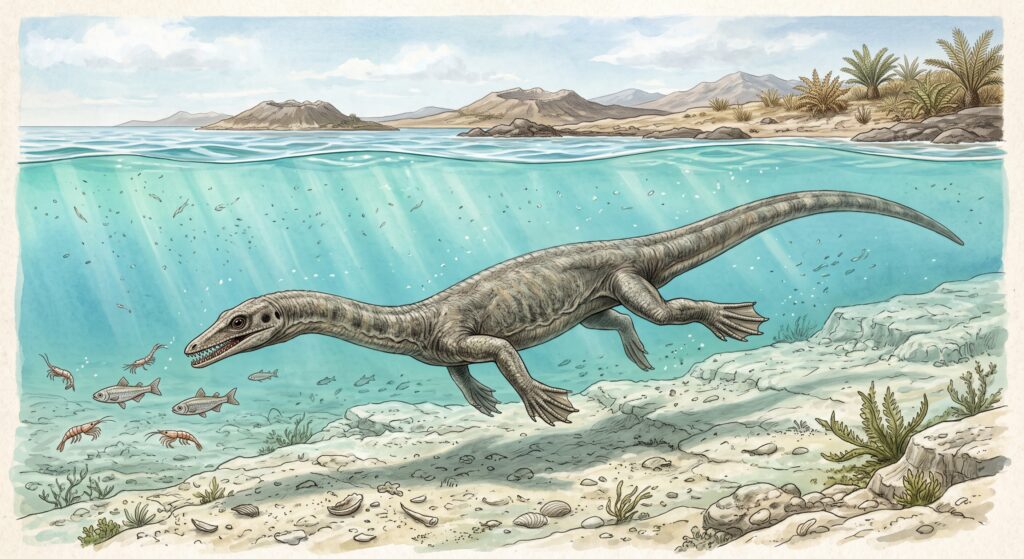
The animal was a nothosaur, a small semi-aquatic reptile that hunted along shallow coastlines during the Middle Triassic period. It had a long neck, sharp interlocking teeth, and limbs built more for paddling than for true swimming. It lived roughly 240 million years ago, long before the Alps rose into their current shape and long before any lake occupied the valley.
News of the find spread fast. Paleontologists and geologists from across Europe traveled to Perledo to examine the bones. They confirmed what local excavators had found: proof that the lake basin once sat on a fossil-rich seabed, over 200 million years old.
When Paleontology Becomes Folklore
That discovery changed how locals looked at their lake. Once people knew a prehistoric reptile had genuinely lived in the region, an unusual wave, a startled sturgeon, or a floating log stopped reading as ordinary. Each one became a possible glimpse of the Lariosauro, the living descendant of a fossil everyone already knew was real.
Psychologists call this kind of shift cultural priming. Give people a plausible, scientifically credible reference point, and their brains start fitting ambiguous sights into that frame automatically. Como’s fishermen were not lying when they reported something serpentine breaking the surface. They were interpreting a genuine but mundane event through a lens the fossil record had just handed them.
A Feedback Loop of Fossils and Folklore
The timeline tells the real story. Sightings of the Lariosauro cluster were after the 1830s discovery, not before it. That is the opposite pattern you would expect from an unbroken oral legend passed down since antiquity. Paleontology did not confirm a myth here. It created one, in real time, in front of witnesses who could read a newspaper.
That makes the Lariosauro a rare case among European water monsters: a legend with a documented birth certificate. Visitors walking the lakefront at Perledo today are standing exactly where a real Triassic reptile met a nineteenth-century shovel. That meeting quietly built a monster that still swims through local conversation nearly two centuries later.

[…] Bessie, the monster of Loch Lomond. Further south, Italy claims its own aquatic beast: the Lariosauro of Lake Como, a legend revived by the discovery of Triassic […]