Your smart speaker said a name. Not a word triggered by its wake word, not a response to anything you asked. Just a name, quietly, from the kitchen, at 3 a.m. You went and stood in front of it and it sat there, LED ring dark, waiting. And in the morning, the activity log showed nothing.
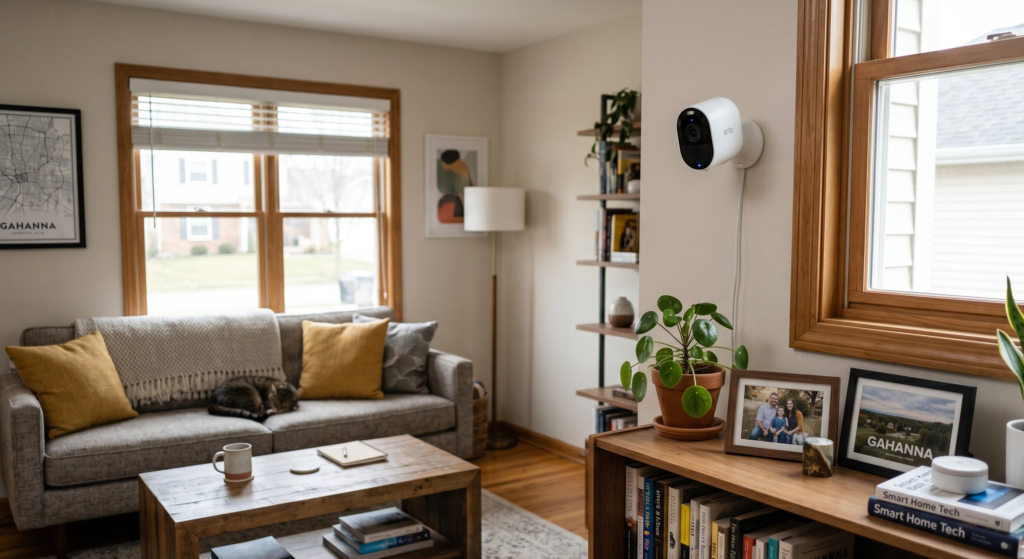
Smart home devices have created a new category of paranormal report that did not exist twenty years ago. Alexa speaking unprompted. Security cameras capturing moving shapes in empty rooms. Motion sensors triggering in sealed spaces. Smart bulbs flickering on no schedule. Door sensors registering openings that no one made. These experiences are genuinely unsettling, they are being reported in increasing numbers, and they have a rich and often mundane set of technical explanations alongside a genuinely interesting set of open questions.
The Technical Reality of Smart Home Glitches
Smart home devices are more technically fragile than their marketing suggests. Voice assistants including Google Home respond to phoneme sequences that match their wake words with an accuracy rate that is not 100 percent. Smart speakers are known to activate on many unintentional words, including ‘okay,’ ‘a laser,’ ‘election,’ and dozens of other partial phoneme matches. A device that speaks unprompted has almost certainly been triggered by an ambient sound, a television program in another room, a neighbor’s voice through a wall, or its own notification tone and responded to what it interpreted as a query.
Motion sensors have sensitivity ranges and response curves that are affected by temperature changes, which can produce apparent movement signatures from heated air masses, insect activity, and the settling of curtains in air currents. Security camera motion detection algorithms, particularly in lower-end devices, trigger on changes in ambient light as well as actual movement, meaning a cloud passing outside a window can register as motion in an empty room. Smart bulbs are susceptible to signal interference from other devices on the same Wi-Fi network, producing flicker patterns that have nothing to do with the bulb’s own programming.
Why These Experiences Feel Paranormal
Smart home devices are designed to respond to human intention. When they respond without one, the experience violates a deeply held assumption: that the device is a tool, that it does what it is told and nothing else. A device that speaks when no one spoke to it, that logs a door opening that no one made, or that activates its camera in a sealed empty room has apparently developed agency it was not supposed to have. The gap between what the device is supposed to do and what it appears to be doing maps precisely onto the gap between the natural world and the supernatural that ghost experiences exploit.
This is not a metaphor. The phenomenological structure of a smart home haunting and a traditional haunting are the same: familiar objects behaving in ways that violate expectation, producing evidence of presence where no presence should be. The only difference is the technological substrate. And for some people, that makes the smart home variant considerably more frightening: a ghost can be blamed on the unexplained. A device that logs specific behavior in a specific timestamp cannot.
The Cases That Are Harder to Explain
The smart home haunting accounts that resist technical explanation share specific features. The most compelling involve devices that produce activity that is semantically specific: not just a random word, but a name, a phrase, or a response that is contextually appropriate to what was happening in the room at the time. A camera that activates and records three seconds of audio containing a voice saying a dead person’s name in a room where no living person was speaking, with no identifiable external audio source, is a different category of event from a motion sensor triggering in response to a temperature change.
A smaller category involves smart devices producing activity that corresponds to significant dates or locations without any programmed trigger: a notification arriving at the exact time of a loved one’s death on the anniversary, an alarm activating with a specific piece of music that had no connection to any user-set schedule. These accounts are anecdotal, are difficult to investigate retrospectively, and do not constitute evidence in any scientific sense. They are, however, reported with enough specificity by enough people who have checked the technical logs to represent a genuinely interesting emerging category of paranormal claim.
How to Investigate a Smart Home Anomaly
- Pull the full activity log for any device immediately after an anomaly. Most smart home platforms store logs that record every activation, its trigger, and the audio that triggered it.
- Check whether a wake-word false positive is the most likely explanation before considering any other.
- Test motion sensors under controlled conditions: observe what triggers them in the specific environment, including light changes, temperature fluctuations, and air movement.
- Note whether anomalies cluster around specific times, specific devices, or specific locations in the home.
- If the logs show activity that has no technical explanation, the next step is a full Wi-Fi interference audit, which a technical specialist can conduct before a paranormal investigator is called.
Smart home technology has given paranormal investigation an entirely new category of potentially objective evidence: timestamped, device-logged, often audio-recorded. Whether that evidence will eventually produce something genuinely compelling, or whether every logged anomaly will eventually have a technical explanation, is one of the more interesting open questions in contemporary paranormal research.
References & Further Reading
• Higgypop: Ghosts and Technology



[…] For a deeper look at the mechanics of why smart home devices behave this way, our article on haunted smart home devices covers the full range of sensor and camera anomalies that investigators have […]
[…] Haunted Smart Home Devices: When Alexa, Cameras, and Sensors Feel Paranormal […]
[…] concluding a haunting is supernatural, consider whether your smart home devices might be malfunctioning or — in rare cases — being used to gaslight you. Some toxic mold […]
[…] consider the technology in your home. Haunted smart home devices are usually the result of glitches, hacked networks, or automated updates. In some disturbing […]