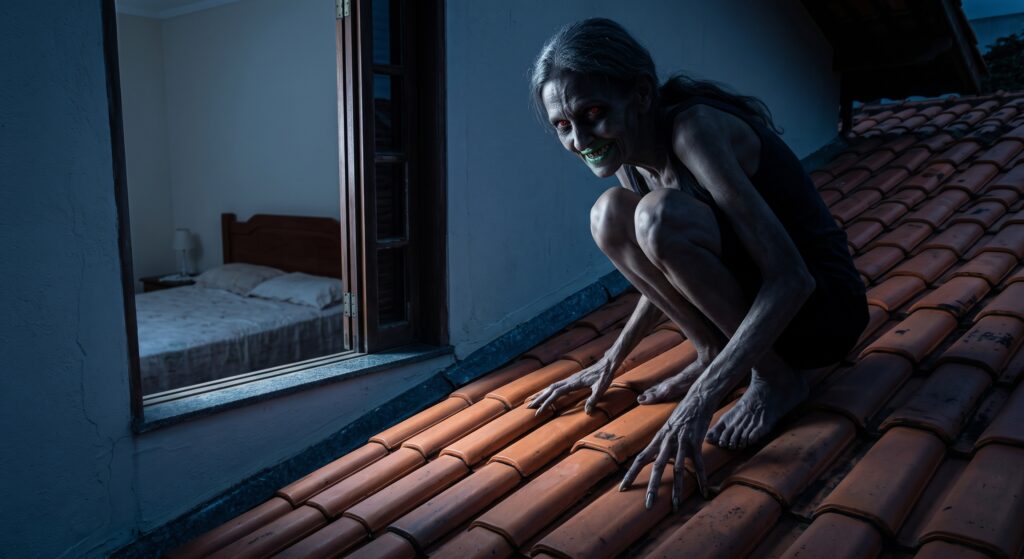
In Brazilian folklore, she waits above you. The Pisadeira crouches on the rooftops at night, peering down into houses, watching for the right victim. Her name means she who steps, or she who tramples.
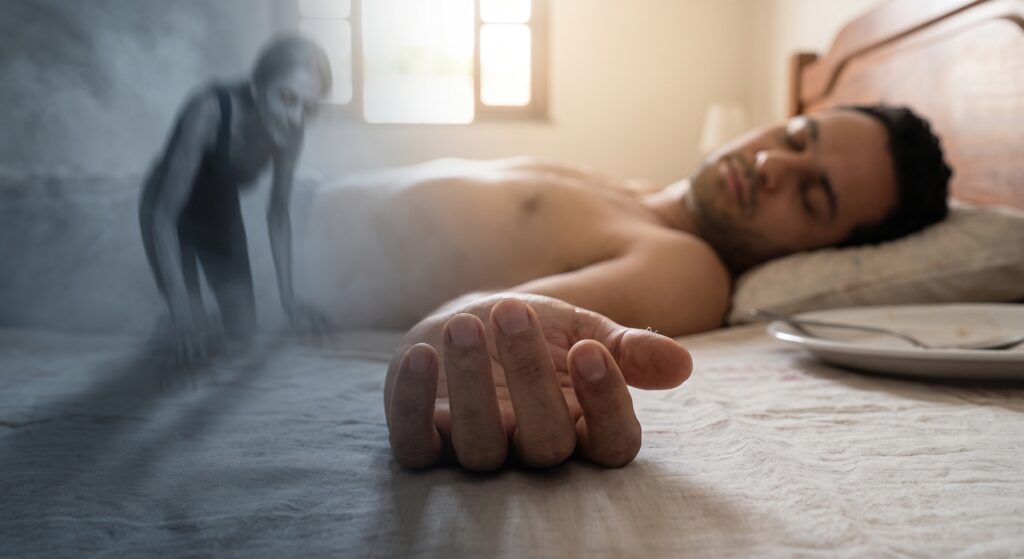
And she is picky about her prey. She hunts the sleeper who ate too much and lay down on their back. That detail is not random. It is folk medicine hidden inside a nightmare.
Please Note: This article is provided for informational and educational purposes only. It does not constitute medical advice and should not be treated as a substitute for professional diagnosis or care. If you regularly experience sleep paralysis, or if your episodes are frequent, distressing, or accompanied by other symptoms, please consult a qualified doctor or sleep specialist.
For a deeper dive on cross-culture sleep paralysis experiences, click here.
A portrait of pure menace
The Pisadeira is drawn in vivid, grotesque detail. She is gaunt and skeletal, with long dry fingers and filthy nails. She lives on the roof, a predator watching the interior of the home. When she chooses a target, she drops down, enters the room, and steps directly onto the sleeper’s chest or stomach with her full crushing weight.
Her eyes are red. Her teeth are greenish. Her laugh is high and mocking.
Frozen under the trampling
The victim is fully awake but cannot move. They feel the terrible pressure of her feet on the torso and the breath forced out. And they must lie there listening to her cruel, cackling laughter while she crushes the air from their lungs.
It is one of the most physically specific attackers in world folklore. Not a vague weight but a bony old woman, standing on you, laughing.
The dinner warning inside the demon
Here is the practical genius of the Pisadeira. She targets people who sleep on their back after a heavy meal. And that is genuinely a risk factor.
Sleeping supine with a full stomach presses the diaphragm and restricts breathing. It also raises the odds of REM disruption and the sleep-onset transitions that trigger paralysis. The lore encodes real advice: do not overeat before bed, and do not sleep flat on your back.
The trampling on the stomach is a perfect image for the sensation of a distended, overfull belly pushing up against restricted, paralyzed breathing. The folklore diagnosed the trigger centuries before sleep labs did.
Folklore frequently smuggles practical advice inside a scare. A frightening image is easy to remember and easy to pass on. The Pisadeira is a bedtime warning that outlived the science it anticipated.
From a Portuguese friar to a Brazilian hag
The Pisadeira has an ancestor. Her lineage traces back to Portuguese legend and to a figure called the Fradinho da Mao Furada, the little friar of the holed hand. Colonial migration carried these European night attackers across the Atlantic.
There the tradition transformed. The imported folklore fused with local storytelling and produced something new and distinctly Brazilian: the rooftop crone with red eyes and greenish teeth. She is a case study in how migration reshapes a myth.
Migration is a folklore engine. A belief crosses an ocean, meets new landscapes and new fears, and mutates into something local. The rooftop crone has European bones and Brazilian skin.
In Brazil the tradition transformed. Imported night demons fused with local storytelling. The result was a distinct new figure, the rooftop crone with red eyes.
Her rooftop perch is the local signature. She watches the household from above, choosing her victim, then drops down to stand on the sleeper’s chest.
Breaking her grip
The traditional defenses are almost entirely practical, which underlines the folk-medicine theory. Do not sleep on your back. Do not eat heavy, indulgent meals right before bed.
If she does catch you, tradition says to focus everything on a small movement. Wiggle the toes. Bite the thumb. That tiny act of motor control breaks the paralysis, exactly as modern clinicians now advise.
Panic is the enemy here. Fighting the paralysis hard only sharpens the fear and drags the episode out. Calm, plus one small deliberate movement, ends it faster.
A demon you can actually avoid
Most night attackers in this series are impossible to prevent. The Pisadeira is refreshingly different. Her lore is essentially a checklist of avoidable triggers.
Do not eat a heavy meal late at night. Do not lie flat on your back to sleep. Both increase the actual physiological risk of an episode. The crone targets exactly the behaviors that invite one to her.
This makes her almost a public-health figure in disguise. Her red eyes and greenish teeth are memorable packaging for practical bedtime advice. Fear does the work that a pamphlet never could.
If you follow her rules, she has no reason to visit, according to the logic of the folklore. Modern sleep hygiene reaches the same conclusion from the opposite direction.
The hag on the roof
The Pisadeira lasts because she is unforgettable and, quietly, useful. She is both a horror figure and a health warning, wearing the same greenish grin.
Eat a lighter dinner. Sleep on your side. In the language of folklore, do those things. Then the crone on the roof has no reason to climb down tonight.
References & Further Reading
Sleep paralysis in Brazilian folklore and other cultures (PMC, 2016)