An Arkansas couple checked into an Airbnb. At some point during their stay, they noticed something wrong with the smoke detector above the bed.
Inside it was a camera. Local station KATV reported the discovery, and the story joined a growing archive of similar findings across the United States.
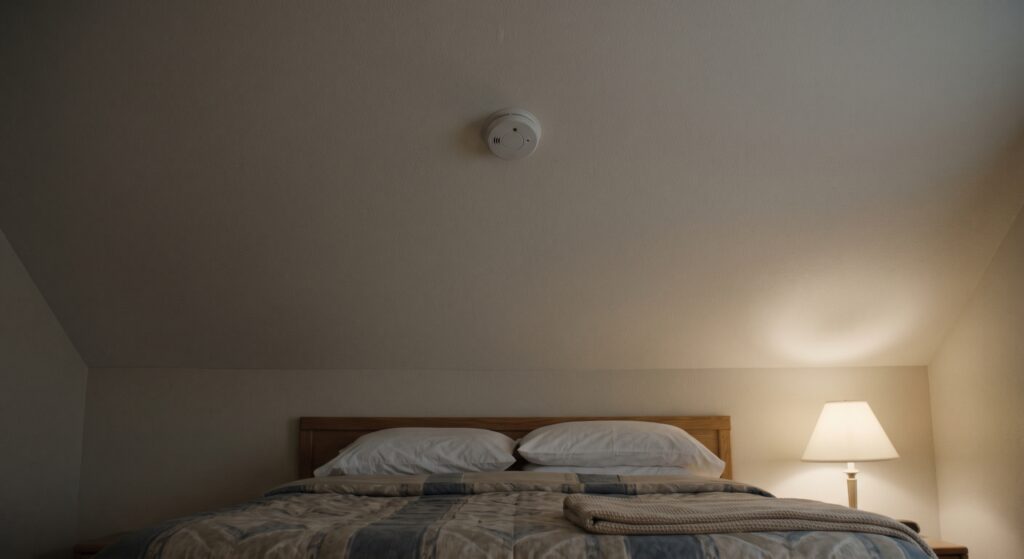
Now think about the last rental you slept in. Picture the ceiling. Picture the small white disc you never once examined. You cannot remember whether it had a lens, because you never looked, and nobody looks. That is precisely the design.
Why the Smoke Detector Specifically
Concealed cameras appear in clocks, chargers, picture frames, air purifiers, and vents. The smoke detector remains the favorite, and the reasons form an unpleasant little argument.
It mounts on the ceiling, which grants a clear downward view of an entire room. It faces the bed by regulation rather than by suspicion. It contains legitimate electronics, so wiring raises no questions.
Most importantly, it enjoys social immunity. A smoke detector belongs in a bedroom. Guests inspect strange objects. They do not inspect expected ones. Here’s what you can do to check it.
The Flashlight Test
Start with the simplest technique, because it costs nothing and catches a great deal.
Close the curtains. Turn off every light in the room. Let your eyes adjust for a minute.
Now take your phone’s flashlight and shine it at the smoke detector from several angles. Move the beam slowly, sweeping across the surface rather than holding it still.
Glass reflects differently than plastic. A lens returns a small, sharp, distinctly bright glint that the surrounding housing does not. Shallow angles work better than direct ones.
Repeat the sweep across clocks, decorative objects, vents, and anything in line of sight to the bed or bathroom door. Practitioners describe the target as a tiny catch of light in an area where nothing else should catch light.
The Infrared Test
Many concealed cameras include infrared LEDs so they can record in darkness. Human eyes cannot see infrared. Phone cameras frequently can.
Keep the room dark. Open your phone’s camera app and try the front-facing camera first, since many rear cameras include filters that block infrared light.
Point it at the smoke detector and watch the screen rather than the object. Active infrared emitters appear as small glowing dots, usually purple or pale white.
This test only detects cameras that are actively illuminating. A device recording in a lit room, or one that is switched off, produces nothing. A glow proves more than its absence.
Network and Radio Checks
If the property offers Wi-Fi, connect and scan the network for connected devices. Camera manufacturers often leave revealing model names in place.
This method has a real limitation. Hotels commonly enable client isolation, which prevents devices on the network from seeing each other. Some cameras store footage locally on an SD card and never join a network at all. Others use their own cellular data.
Radio frequency detectors, sold as handheld units, pick up wireless transmissions. Turn off the room’s routers, speakers, and televisions first, or the detector will simply find those.
None of these tools is decisive alone. Layer them. Physical inspection remains the backbone, and the flashlight test remains the highest yield technique per minute spent.
If You Find One
Do not touch it. Do not unscrew it. Do not remove the SD card.
Investigators may recover fingerprints or other forensic evidence from the device, and dismantling it destroys that possibility while also potentially destroying the recording that proves what happened.
Photograph the device in place. Photograph the object’s position relative to the bed. Note the time.
Cover it with a towel to stop further recording, then leave the room and contact local law enforcement. Report the finding to the platform through its messaging system, in writing, with specifics.
Recording people without consent in bedrooms and bathrooms is illegal in most jurisdictions and could carry both criminal charges and civil liability.
Trust Your Gut
Paranormal writing spends enormous energy on the sensation of being watched in an unfamiliar room. The prickling neck. The certainty that darkness contains attention.
We usually treat that sensation as a misfiring instinct, a vestigial alarm inherited from ancestors who had predators to worry about.
The hidden camera market was valued near two billion dollars in 2024, and forecasts expect it to more than triple within a decade. Somewhere in that figure sits a smoke detector, maybe in a room you have already slept in.
Your instinct was never vestigial. It simply had no vocabulary for a lens.
Sixty seconds with a flashlight before you unpack. That is the whole ritual. Do it every time.
The Cameras That Never Touch a Network
A great deal of hidden camera advice assumes the device connects to Wi-Fi. Much of it does not.
Some concealed cameras record to a local SD card, and the operator retrieves the footage physically after the guest departs. No network traffic exists that can be detected.
Others use a cellular data connection entirely independent of the property’s internet. Scanning the router reveals nothing.
Older analog units run coaxial cable to a small recorder hidden elsewhere in the property, which is why unexplained wiring near a ceiling fixture deserves attention.
This is the argument for physical inspection over gadgetry. A network scan interrogates one channel. A flashlight interrogates the object itself, and every camera, regardless of how it stores or transmits, requires a lens.
The Sixty Second Arrival Ritual
Turn this into muscle memory, and it stops feeling paranoid.
Walk directly to the bedroom. Note every object with an unobstructed view of the bed. Typically that means the smoke detector, an alarm clock, a decorative item on a dresser, and a television.
Kill the lights. Sweep each one with a flashlight at a shallow angle, watching for a sharp glint rather than a broad reflection.
Repeat in the bathroom, paying attention to vents and to anything mounted opposite the shower. Test any mirror by touching a fingernail to the glass. A gap between the nail and the reflection indicates ordinary glass. No gap suggests a two-way mirror.
Then unpack. The entire procedure costs less time than using the coffee maker, and unlike the coffee maker, you will never regret having done it.
See our other post on smart home tech abuse (SHOT) and what you can do about it.
References & Further Reading
Arkansas couple finds hidden smoke detector camera inside Airbnb (KATV)
How to Spot Smoke Detector Hidden Cameras (CCTV Camera World)