The death toll here depends entirely on which sign you happen to read.
A Prison Built for the Wrong Ground
Illinois opened its first state penitentiary in Alton in 1833, on marshy land too close to the Mississippi River. Public complaints over unsanitary conditions forced its closure in 1860, less than three decades later.
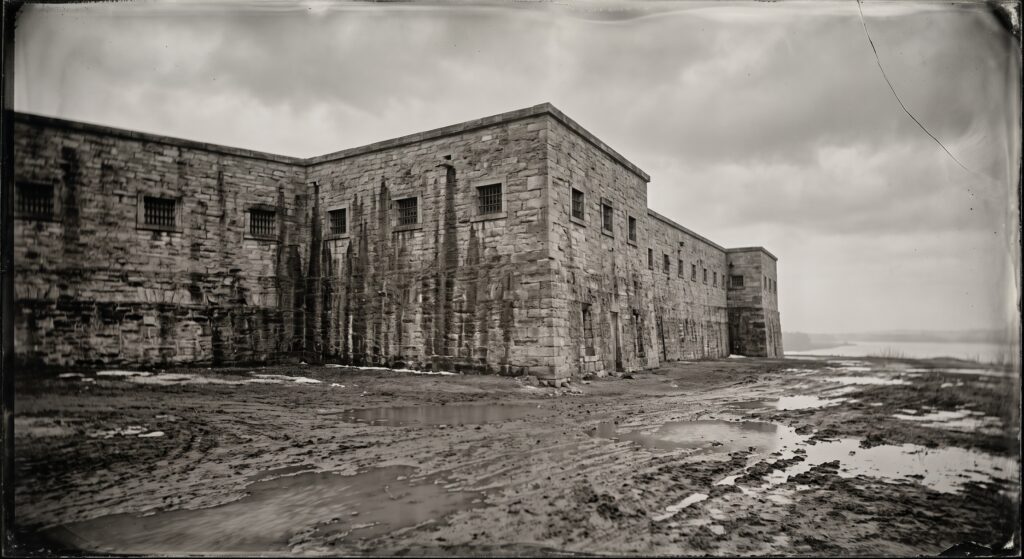
The building sat empty for barely two years before the war created a new demand nobody had anticipated. Military officials needed somewhere to hold the growing number of captured Confederate soldiers, and the abandoned penitentiary offered walls and cells already in place.
The Union reopened it in 1862, desperate for space to hold Confederate prisoners of war. Nearly twelve thousand men eventually passed through its cramped, four-foot by seven-foot cells during the three years it operated.
Overcrowding, poor nutrition, and brutal Midwestern weather combined to make Alton one of the deadlier prison camps of the Civil War. That was true even before factoring in the epidemic that followed.
One captured Confederate officer, writing directly to the Confederate Senate, described being exposed to nearly every disease circulating through the camp. He accused his captors of murdering his fellow prisoners through neglect rather than direct violence, a charge Union administrators disputed but never fully answered.
A Death Toll That Depends on the Source
Ask how many prisoners died at Alton, and the answer changes depending on where you look. A historical marker at the site cites two hundred sixty-six confirmed smallpox deaths on the quarantine island itself.
The Madison County Historical Society lists a total prison death count near thirteen hundred fifty-four, drawn from the names carved into the Confederate Cemetery monument. One widely shared article claims fifteen hundred deaths, and another puts the epidemic’s toll as high as five thousand.
That last figure would exceed the total number of men held at the prison at any given time. It likely conflates the smallpox epidemic with the prison’s entire mortality record or simply repeats an earlier writer’s exaggeration without checking the math.
The honest answer sits closer to the documented numbers. Roughly thirteen hundred prisoners died of all causes across three years, and a smaller, still tragic count died specifically during the smallpox outbreak on the island.
The Island That No Longer Exists
Sunflower Island, later renamed Smallpox Island by locals, sat in the Mississippi a short distance from the prison. Infected prisoners were rowed there and quarantined in a small, overcrowded building that survivors described as a living burial.
Those who died were buried on the island itself, since moving their remains back to the mainland was also risky. The island slowly eroded over the following decades, and lock and dam construction plowed over what remained in 1936.
That construction disturbed roughly three hundred graves. Workers used the disturbed soil, along with whatever remained of the men buried there, as fill material for a nearby embankment. A monument now marks the general area, though the island itself sits permanently underwater.
Few visitors touring Alton’s haunted sites today realize that detail. The dead were not simply forgotten. Decades after their burial, their remains were physically repurposed as construction material for a flood control project.
A monument now stands near the dam to commemorate what happened, added in 2002, more than sixty years after the disturbance took place. It offers a formal acknowledgment that arrived only after the island itself had already vanished beneath the water.
What Still Draws Visitors to Alton
The McPike Mansion remains the town’s most famous haunted address, built in 1869 by Mayor Henry Guest McPike. Photographs taken in its cellar regularly show floating lights and figures in windows, and the property also holds the graves of two of McPike’s own children.
The Mineral Springs Hotel adds its own layer of folklore. A jealous husband is said to have murdered a guest known as the Jasmine Lady. Cassandra is a girl rumored to have drowned in the building’s basement pool. Neither story carries the kind of documentation that supports the prison’s history.
That contrast matters. Alton earned its haunted reputation honestly, through a prison that killed real men in verifiable numbers and buried them on an island that no longer exists. The exaggerated death tolls and unverified drowning stories do not need to compete with a history that was already this heavy.
A Boy’s Story From the Ruins
One of Alton’s oldest ghost stories dates to shortly after the war ended. A group of boys reportedly canoed out to the abandoned island to search for excitement rather than history.
They claimed to encounter the spirit of an eyeless Confederate soldier, who warned them away from the grounds before vanishing. The boys fled, and the story spread through town for generations afterward.
Whatever wandered that island in the years after the war, it inherited a genuinely tragic setting. Alton did not need to invent a haunting there. It already had one, built from documented graves that a dam later erased from the map entirely.
That erasure is its own kind of tragedy, separate from the epidemic itself. A place holding the remains of hundreds of prisoners disappeared from the landscape. It vanished almost as thoroughly as the men buried there had already vanished from most historical accounts.
References & Further Reading
The Alton Military Prison, Madison County Historical Society
Smallpox Island Historical Marker
The Union’s Smallpox Island, Where Men Were Sent To Die, War History Online
Alton, IL, Most Haunted Small Town in America, Undead America


[…] the Moonville Tunnel is a classic example of a haunted, abandoned railway. Illinois is home to Smallpox Island in Alton, a grim reminder of the Mississippi River’s tragic […]