One of America’s most haunted houses shares its street with the country’s first psychiatric hospital.
A Capital Built for Show and Punishment
Williamsburg served as Virginia’s colonial capital throughout the 1700s, a carefully planned city designed to project order, authority, and British civic pride. Its wide streets and grand public buildings hosted everything from legislative sessions to public executions.
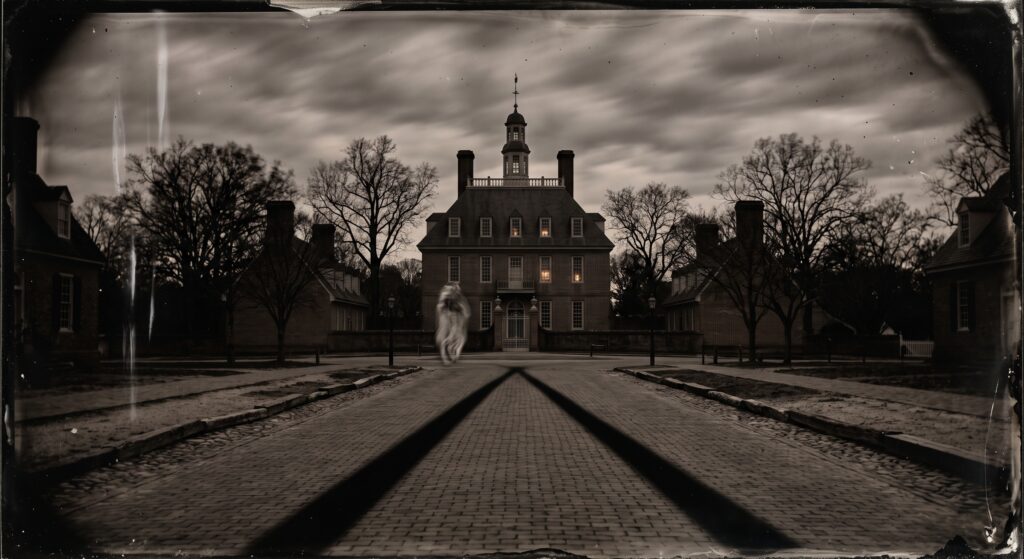
Piracy trials brought some of the era’s grimmest spectacle to town. Captured pirates, including members of Blackbeard’s crew following his death in 1718, faced trial and execution in Williamsburg. Their bodies were sometimes displayed publicly as a warning to other would-be raiders.
This combination of formal colonial governance and public violence gives Williamsburg a haunted reputation based on genuinely documented history.
Court records from this period survive in unusually complete form, giving historians a rare, detailed window into how colonial justice operated in practice.
Those records include detailed testimony from pirate trials, offering modern historians unusually vivid firsthand accounts of the these proceedings.
A Town Built to Be Remembered
Williamsburg’s careful colonial-era planning reflected deliberate ambitions toward permanence and prestige. Those same features ultimately made the later restoration project far more historically accurate than most similar efforts elsewhere in the country.
That commitment to accuracy extends to the difficult chapters of colonial life as well, including the system of slavery that supported much of Virginia’s colonial economy. Modern tours increasingly address this history directly rather than glossing over it in favor of more comfortable narratives.
The reconstructed Public Hospital now stands as a particularly sobering stop on any Williamsburg tour. It forces visitors to confront just how far psychiatric treatment has evolved since the colonial era’s harsh, restraint-based approach.
Williamsburg ultimately offers visitors something rarer than a simple ghost story. It offers an unusually complete window into colonial American life, violence, and institutional history, all within a single walkable historic district.
The Most Haunted House in America
The Peyton Randolph House has earned a reputation as one of the most haunted buildings in the entire country. That claim predates modern ghost tourism by generations. Randolph served as the first president of the Continental Congress, and his home hosted decades of prominent colonial and revolutionary-era guests.
Visitors and staff report that unseen hands physically touch them throughout the house, and they hear sudden bursts of heavy crying echoing from empty rooms. Cold spots appear and disappear without any clear draft or architectural explanation.
The house’s long, layered history of birth, death, and political upheaval likely contributes to its reputation as much as any single documented tragedy. Few colonial homes anywhere hosted this many consequential moments under one roof.
Paranormal investigators have studied the property for decades. No single explanation satisfies every reported experience, but the consistency of reports across generations has kept the house’s reputation firmly intact.
America’s First Asylum
Williamsburg also holds the distinction of housing the country’s first public hospital dedicated specifically to mental illness, opened in 1773. Treatment methods of the era relied heavily on restraint and isolation rather than anything resembling modern therapeutic care.
Patients endured conditions that later generations would recognize as inhumane, including chains, cold water treatments, and prolonged isolation intended to calm rather than heal. Many patients spent years, sometimes decades, confined within its walls.
The reconstructed facility now serves an educational purpose. It walks visitors through the evolution of psychiatric treatment, from harsh colonial origins toward the more humane approaches that eventually followed.
That history adds a somber layer to Williamsburg’s broader haunted reputation, one rooted in institutional neglect rather than sudden violence. Visitors touring the reconstructed facility today often describe the exhibit as more unsettling than any ghost story told elsewhere in town.
Pirates Still Walking the Cobblestones
Beyond the Randolph House and the old asylum, visitors report apparitions of Blackbeard’s captured crew still pacing Williamsburg’s colonial streets at night. Witnesses describe figures in period dress moving with purpose before vanishing near the old courthouse.
That sighting connects directly to documented history rather than invented legend. Trial records confirm pirates were tried and executed in Williamsburg following Blackbeard’s death, giving the haunting a factual anchor most ghost stories lack.
Williamsburg’s restored colonial district gives these stories an unusually immersive setting. Costumed interpreters and preserved architecture blur the line between historical reenactment and genuine haunting for many visitors.
Few American towns combine this much documented colonial violence with this level of architectural preservation, giving Williamsburg’s ghost stories a foundation most haunted destinations simply cannot match.
A Living Museum That Never Fully Closes Its History
Colonial Williamsburg operates today as one of the country’s most ambitious historical restoration projects. Costumed interpreters reenact daily colonial life across dozens of preserved and reconstructed buildings. That immersive approach blurs the line between education and atmosphere in ways few other historic sites attempt.
The Peyton Randolph House remains a centerpiece of guided tours, its interpreters balancing serious historical education with acknowledgment of the property’s separate haunted reputation. Staff generally let visitors draw their own conclusions rather than pushing either narrative.
That balance reflects Williamsburg’s broader approach to its own difficult history. Slavery, institutional mental health treatment, and public execution all appear here, none of it hidden or softened for visitors.
Williamsburg’s ghosts exist within one of the most historically documented settings in the country, whatever their true nature. Every reported encounter here carries an unusually rich factual backdrop most haunted towns cannot offer.
That factual grounding sets Williamsburg apart from destinations relying purely on invented atmosphere, giving every ghost story here a genuine historical anchor to stand on.
Visitors leave with something sturdier than a scare, a genuine sense of how colonial governance, punishment, and care for the mentally ill actually operated centuries ago.
Few haunted towns anywhere pair entertainment and education quite this thoroughly, and Williamsburg seems to have no interest in choosing between them.
That refusal to choose may be exactly what keeps visitors returning, generation after generation, to walk the same colonial streets.
Williamsburg proves that genuine history and genuine atmosphere can coexist, without either one needing to apologize for the other.
Visitors leave with both a history lesson and a genuine chill, a combination few other American towns manage to deliver quite so well.
That combination alone justifies a visit, regardless of whether any single reported encounter turns out to hold up under scrutiny. Few towns manage both so gracefully.
References & Further Reading
12 Most Haunted U.S. Towns for a Spooky Fall Trip, Best Life

[…] the legacy of the witch trials is bound up in the Corwin Curse of Salem, while Virginia’s Colonial Williamsburg hides the ghosts of pirate executioners and tragedy at the Randolph […]