Two different men get credit for the legend, and neither one’s timeline actually holds up.
A Lowcountry Retreat Built for Escape
Wealthy rice planters built summer homes on Pawleys Island starting in the early 1800s, seeking relief from the malaria that plagued their mainland plantations each summer. The island’s breezy, isolated position made it a natural refuge from both disease and the oppressive Lowcountry heat.
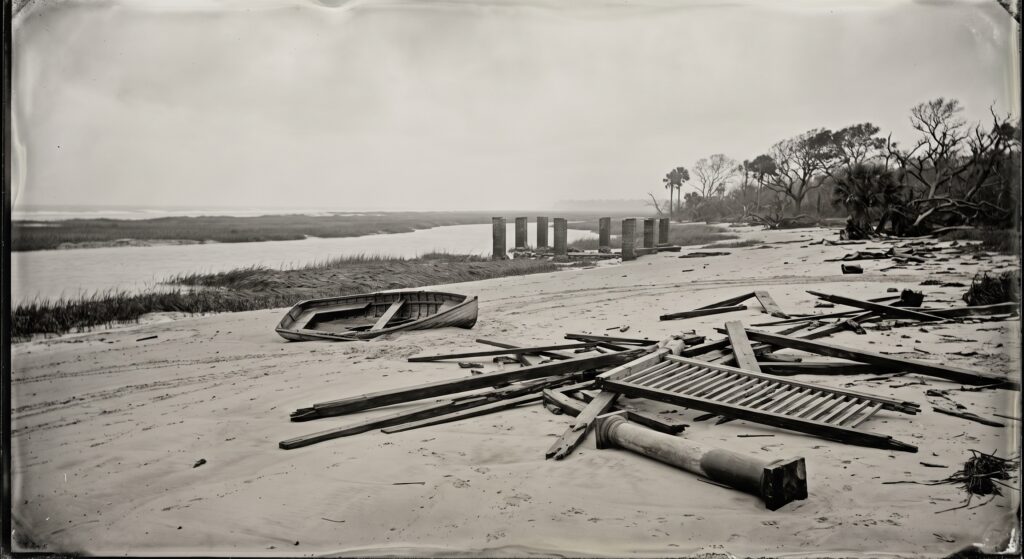
That same isolated position left the island dangerously exposed whenever hurricanes rolled in from the Atlantic. A massive storm struck the Carolina coast in 1822, killing roughly three hundred people and devastating the barrier islands along the Waccamaw Neck.
Survivors described entire structures vanishing overnight along the coastline, with families narrowly escaping rising floodwaters by boat in the storm’s immediate aftermath.
News of the disaster spread slowly given the era’s limited communication, leaving distant relatives waiting weeks for word on whether loved ones along the coast had survived.
That storm reshaped settlement patterns along the coast for decades afterward, discouraging development in some of the most exposed and vulnerable stretches of shoreline.
That single, catastrophic storm became the origin point for one of the Southeast’s most enduring ghost stories. The legend has outlasted the very houses it supposedly protects.
A Warning Passed Down for Two Centuries
According to the most common version of the legend, a young man was traveling to see his fiancée. He became trapped in marsh mud during the 1822 storm and drowned before he could reach her. His spirit later appeared to warn her family of a coming hurricane, and they evacuated just in time to spare their home from total destruction.
That same warning reportedly repeats itself before every major hurricane since. Residents describe a gray, cloaked figure appearing on the beach shortly before a storm’s arrival, always vanishing the moment anyone approaches or speaks to him.
Sightings have been reported before nearly every significant hurricane to threaten the area, including Hazel in 1954, Hugo in 1989, and Florence in 2018. Those who claim to have seen him and evacuated consistently report their homes survived relatively undamaged.
Local news outlets now treat a reported Gray Man sighting as genuinely newsworthy ahead of major storms. That coverage reflects how deeply the legend has embedded itself in regional storm culture.
Two Names That Don’t Quite Fit
Local storytellers have attached at least two specific identities to the Gray Man over the years, and neither one survives close scrutiny. One version casts him as a Confederate soldier who rode home just in time to warn his family before dying on a distant battlefield.
That version cannot be accurate. The first documented sighting dates to 1822, decades before the Confederacy existed as a nation at all.
A second version identifies the Gray Man as Plowden Weston, a wealthy rice planter who built the home now known as the Pelican Inn. Weston was born in 1819, making him a toddler at the time of the earliest reported sighting.
Even the inn’s own co-owner has acknowledged that timeline problem publicly. Both identity theories appear to be later additions, grafted onto a story that likely never had a specific named man behind it at all.
A Legend That Entered Print a Century Late
The Gray Man story did not appear in published form until 1946, when local historian Julian Stevenson Bolick included it in his book on Waccamaw plantation history. That means the legend circulated only through oral tradition for well over a hundred years before anyone wrote it down.
That gap helps explain why competing versions and conflicting identities have accumulated around a single simple warning. Each generation of storytellers had room to add new details, with no earlier printed account to check against.
None of that uncertainty diminishes the legend’s genuine cultural power along the Grand Strand. Residents still treat a Gray Man sighting as a serious signal worth heeding, regardless of who he actually was or whether he existed at all.
Whatever walks that beach before a storm, the story has done real work for two centuries. It encourages exactly the kind of early evacuation that saves lives when a hurricane finally arrives.
A Legend Meteorologists Have Learned to Respect
Local historians and even some meteorologists have noted the Gray Man’s practical value alongside its folkloric charm. A legend that reliably encourages early evacuation serves a genuine public safety function, regardless of its supernatural claims.
Two centuries after that catastrophic 1822 storm, Pawleys Island has turned genuine tragedy into an enduring piece of regional identity. It manages to feel protective rather than purely frightening.
That practical benefit may be the legend’s most enduring legacy, regardless of which version of his origin story a given resident happens to believe.
Pawleys Island residents seem entirely comfortable holding two ideas at once, respecting both the science of hurricane forecasting and the folklore that came long before it.
That comfortable coexistence between science and legend may be the real secret to how this particular ghost story has survived two full centuries.
Visitors who walk that same stretch of beach today may not realize it. They are taking part in one of the oldest continuously told ghost stories in the country. Few American legends have earned that kind of staying power through sheer usefulness alone, and Pawleys Island seems to know exactly how rare that is.
References & Further Reading
The Gray Man (ghost), Wikipedia
Who Is the Gray Man? Get to Know Hurricane Season’s Friendliest Ghost, Garden & Gun
Hurricanes, History and Hauntings, University of South Carolina News
10 Best Haunted Towns and Spooky Tours, Recipes Travel Culture