The instructions are always the same, wherever the ritual appears. Light a candle. Stand before a mirror in a darkened room. Speak the name. Wait. What varies is the name you speak, the number of times you speak it, and what the folklore promises you will see.
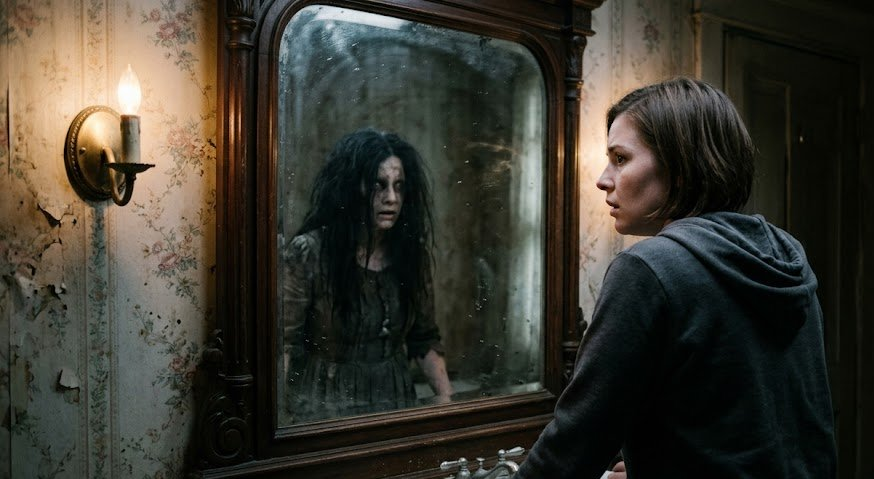
Mirror-gazing rituals for spirit contact are among the most widely practiced informal paranormal activities in the world. From Bloody Mary, the ritual most familiar to English-speaking audiences, to Catoptromancy, the formal practice of scrying with mirrors documented in ancient Greece, the connection between reflective surfaces and spiritual communication runs deep in virtually every culture that has encountered its own reflection. Understanding what these rituals are, what they actually do, and where the genuine risks lie gives you a much clearer picture of one of the oldest paranormal practices still in active use.
The History of Mirror Scrying
Formal mirror scrying, the practice of gazing into a reflective surface to receive visions or communication, appears in documented magical traditions from ancient Egypt, Greece, Rome, the Middle East, and China. The Greeks called the practice catoptromancy and used polished metal mirrors, pools of water, and obsidian stone. Renaissance magician John Dee used a polished Aztec obsidian mirror, now in the British Museum, in his attempts to communicate with angels through his assistant Edward Kelley.
The common element across these diverse traditions is the concept of the mirror as a threshold: a surface that reflects the visible world but implies a hidden world behind it. To gaze into a mirror in the right state of mind, at the right time, under the right conditions, was understood as a way of thinning that threshold enough to perceive what lay behind it. The specific conditions varied by tradition, but most required relative darkness, a relaxed or meditative state, a focused intention, and sufficient time for the visual system to begin generating the phenomena that the ritual was designed to produce.
Bloody Mary: The Modern Ritual
Bloody Mary is the most widely known mirror-gazing ritual in the English-speaking world, practiced predominantly but not exclusively by children and adolescents. The standard version involves standing before a bathroom mirror in a darkened room, often with a single candle, and repeating the name “Bloody Mary” three, seven, or thirteen times. The expected result varies by telling: some versions promise a vision of your own death, some promise the appearance of a terrifying female figure, and some promise a glimpse of the future.
Folklorists who have studied the Bloody Mary ritual note that its power is largely psychological and developmental. The ritual functions as a controlled encounter with fear in a context where the child retains agency: you can stop, leave, or turn on the light. The darkened room, the candle, the aloneness, and the deliberate invocation of something frightening create a state of heightened arousal that makes the inevitable perceptual distortions of extended mirror gazing feel supernatural. You did not imagine the face you saw. Your brain generated it from the altered visual input of staring at a familiar face in low light for two minutes. That is a real neurological event. It just does not require a ghost.
The Strange Face Effect
Extended mirror gazing at one’s own face in low-light conditions reliably produces a documented neurological phenomenon called the strange-face effect. Subjects who gaze at their own reflected image for extended periods begin to perceive distortions: features elongate or compress, the face takes on an unfamiliar quality, and other faces appear to overlay the reflection. These are not imagined. They have been replicated in controlled laboratory conditions. The strange-face effect arises because the brain’s face-processing system, working with reduced visual information (low light, a static image, or prolonged exposure), begins generating pattern variations that feel like external perception but are internally produced.
This is the mechanism behind most mirror-gazing ritual experiences. It is also, for what it is worth, genuinely strange. The face that looks back from the mirror is not quite you, and the brain knows it on some level it cannot fully articulate. The rituals that have grown up around mirrors are cultural responses to that genuine strangeness.
The Practical Safety Considerations
From a psychological safety standpoint, there are two genuine concerns with mirror-gazing rituals. The first is the triggering of dissociative experiences in people with pre-existing anxiety disorders or a vulnerability to dissociation. The disorientation of the strange-face effect can be destabilizing for some individuals, particularly in an already anxious state. The second is the reinforcement of delusional thinking in individuals who are already experiencing breaks from consensual reality. If you are working with young people or people with mental health vulnerabilities, mirror gazing rituals are not appropriate activities.
For everyone else, the honest assessment is you may see something surprising, and it will be your own brain, not a ghost. What you do with that experience is up to you.


[…] Mary Todd Lincoln, deeply superstitious, delivered a reading that still chills. The clear face meant he would survive his first term. The ghostly one meant he would win a second term but never finish it. For more on mirror folklore, see our other posts (post 1, post 2, post 3) […]
[…] the folklore that surrounds haunted mirrors more broadly, see our companion posts (post 1, post 2, post 3) on the […]
[…] The ancients built an entire divinatory art around an effect they could feel but not name. That is a kind of genius, even if the prophecy was really the mind meeting itself in the dark. For the modern folk version of this impulse, see our post on mirror gazing and the Bloody Mary ritual. […]