The Sons of Liberty planned a revolution inside this tavern, but the building tourists visit tonight is not the one they knew
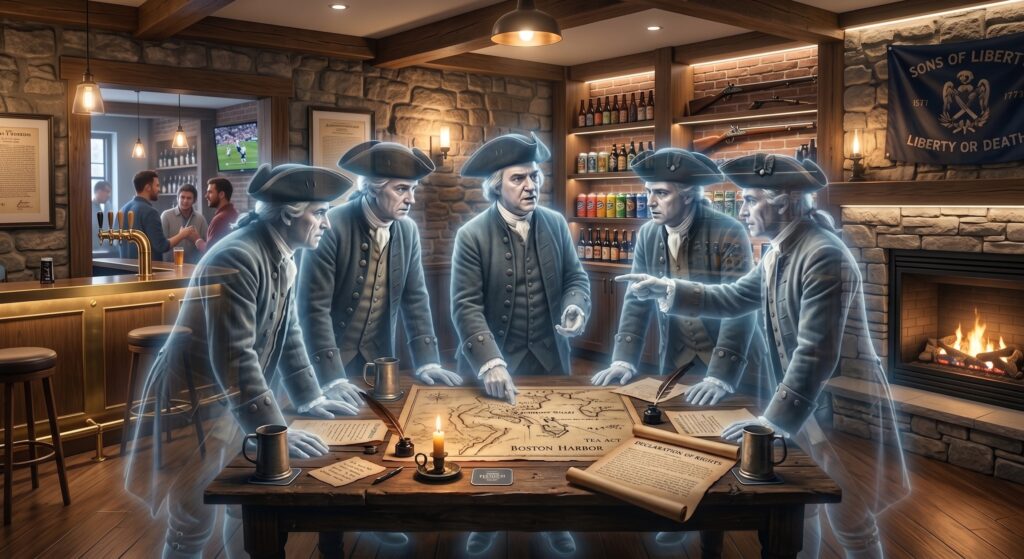
The Headquarters of the Revolution
Samuel Adams organized the Sons of Liberty, helped plan the Boston Tea Party, and pushed harder than almost anyone toward outright independence. Before politics consumed his life, Adams ran his family’s malt house with little success, and he lived for years on the modest income it produced. He found his true calling in taverns, where he built the political relationships that eventually powered a revolution.
His preferred meeting place was the Green Dragon Tavern, a public house near Boston’s Union Street dating back to 1654. The original building was one of the largest structures in the city, built primarily of brick with a copper dragon mounted above its entrance on an iron crane.
Daniel Webster later called it the Headquarters of the Revolution, and the nickname stuck. Behind locked doors upstairs, Adams, Paul Revere, John Hancock, and Joseph Warren plotted resistance to British rule. The tavern also housed the St. Andrew’s Masonic Lodge, giving its secretive reputation an extra layer of intrigue, since members swore oaths of confidentiality on top of whatever political secrets they already carried.
In April 1775, patriots at the Green Dragon learned of a British plan to seize colonial weapons at Concord. Members of the tavern’s own social club, a group of mechanics who watched British troop movements as a hobby turned wartime necessity, passed the intelligence along to Warren. That information sent Paul Revere on his famous midnight ride, the spark that ignited open war.
Adams himself was one of the two targets British troops hoped to capture that night, along with Hancock. Both men were hiding in Lexington when Revere’s warning reached them, and both escaped capture by mere hours.
Voices in the Empty Rooms
Visitors and staff describe hushed, urgent conversations drifting from locked upstairs rooms, as if a secret meeting is still underway. When someone checks, the rooms are always empty. The pattern has repeated for decades, according to long time patrons of the modern tavern.
The staircase leading to the upper floors draws its own share of reports. Countless witnesses describe the sound of multiple footsteps climbing or descending. Rustling clothing and a faint jingle of metal, perhaps coins or a sword hilt, often accompany the footsteps against a banister that no longer exists in its original form.
A tall figure in eighteenth century dress reportedly appears near the bar or in shadowed corners, carrying an unmistakable air of authority. Witnesses often connect the description directly to Adams, who was known for his commanding presence among the Sons of Liberty.
Some guests report something even stranger around key revolutionary dates. Translucent figures in colonial dress raise tankards in a silent toast, and witnesses swear they catch the phrase liberty or death carried on the air before the scene fades.
The Building You Are Standing In Is Not the Building They Knew
The original Green Dragon Tavern, the actual building where Adams and Revere plotted, was demolished in the 1830s. A commemorative plaque now marks the original site on Union Street, several blocks from today’s tavern.
The Green Dragon Tavern operating today sits at 11 Marshall Street and only opened its doors in the 1990s, borrowing the name and legacy of the original. Any ghost still pacing those specific eighteenth century floorboards would need to visit a completely different address.
That gap does not erase the story. If anything, it deepens the mystery. Either the patriotic energy of the Sons of Liberty has migrated with the name across two centuries. Or the modern tavern’s reputation simply grew from atmosphere and suggestion rather than any literal haunted floorboard. Both possibilities say something true about how legends attach themselves to a name rather than a physical structure.
Boston has demolished and rebuilt so much of its colonial footprint that this kind of relocation is more common than tourists realize. A commemorative plaque, placed by the Massachusetts Society of the Sons of the Revolution in 1892, still marks the true original location a few streets away. It is a quiet historical footnote, easy to miss between modern storefronts.
Adams Pacing His Own Grave
Adams is buried in the Granary Burying Ground, a short walk from both tavern locations. Visitors report his spirit pacing the cemetery paths near his headstone, sometimes alongside other patriots buried nearby. Given how many revolutionaries share this small plot of land, it would be a crowded afterlife if even half the reported sightings were real.
Adams outlived most of his fellow Sons of Liberty by decades, serving as governor of Massachusetts well into his seventies before retiring from public life. That long final chapter, spent largely out of the national spotlight, may explain why his reported hauntings feel more restless than triumphant. He seems to be a man still pacing rather than resting, generations after his political work was finished.
Visiting the Green Dragon and the Granary
Today’s Green Dragon Tavern operates as a working restaurant and bar at 11 Marshall Street in Boston’s North End, open to the public during normal business hours. The Granary Burying Ground sits on Tremont Street and is open daily to visitors during daylight hours as part of the Freedom Trail.
Both stops sit close enough together that visitors regularly combine them into a single afternoon walking through revolutionary Boston. Standing in the modern tavern, then walking a few blocks to Adams’s actual grave, gives a strange before and after experience. You can trace the same man from secret meeting to permanent monument in under fifteen minutes on foot.
Adams himself would likely have appreciated the symbolism, if not the ghost stories attached to it. He spent his life building institutions meant to outlast him, from the Sons of Liberty to the Massachusetts state constitution he helped draft. A tavern that keeps his memory alive through repeated legend, even in the wrong building, fits a man who understood the power of a story people wanted to keep telling.
References & Further Reading
The Ghosts of the Green Dragon Tavern – Ghost City Tours
Green Dragon Tavern – Wikipedia
In Boston’s Green Dragon Tavern, revolutionaries brewed their plans for resistance – GBH
Granary Burying Ground – The Freedom Trail
For more on this topic, see our complete guide to the The Most Haunted Places in America: A State-by-State Guide.

[…] heavily over Salem and the Corwin Curse, while Boston’s colonial history echoes through the Green Dragon Tavern and the Granary Burying Ground. Further west, the ghosts of Minute Man National Historical Park […]
[…] to the city. Samuel Adams, the fiery organizer of the rebellion, is still said to act as the sentinel of the Green Dragon Tavern. Nearby, the Granary Burying Ground holds the uncertain grave of John Hancock, where visitors […]