A Las Vegas museum draws crowds to Dracula’s haunted mirror, but the paper trail tells a very different story.
Behind the Black Curtain
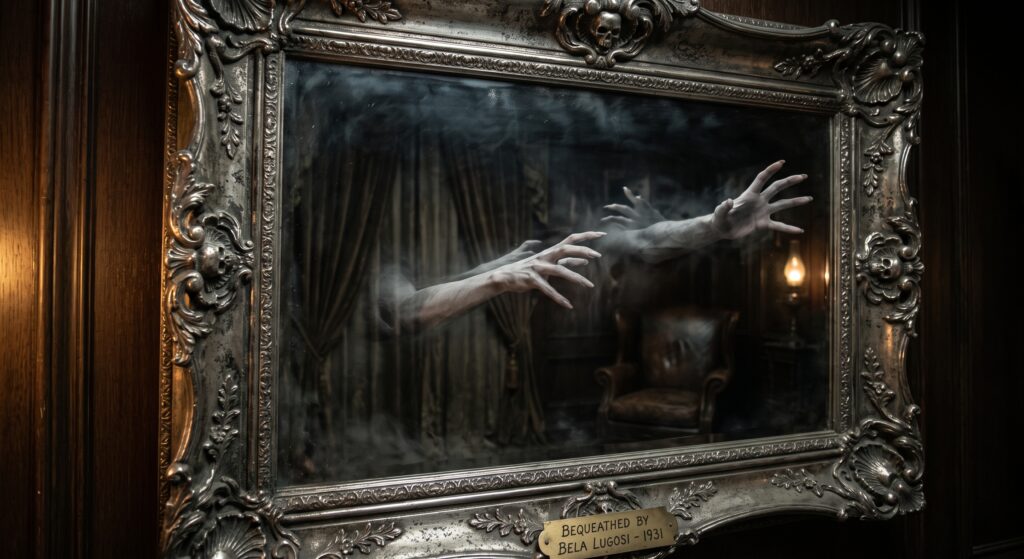
Deep inside Zak Bagans’ Haunted Museum in Las Vegas, a mirror hangs behind a heavy black curtain. Guides build the suspense, then open the drape for one guest at a time. About half the room usually leaves before the reveal.
The story attached to the glass is irresistible. It belonged to Bela Lugosi, the actor who defined Dracula in 1931. Lugosi supposedly used it for occult rituals. Later it hung in a house where a murder took place, and the dark energy soaked into the glass. Visitors report shadowy arms reaching out toward them.
It is a perfect haunted Hollywood tale. So perfect that it is worth asking a harder question. How much of it is true?
The mirror ranks among the museum’s headline attractions, one of the objects visitors come specifically to see. That fame gives its story real reach. Millions have heard some version of the Lugosi curse. Very few have heard what happened when someone actually investigated the claims.
The Chain of Ownership
The museum’s account runs like this. Lugosi owned the mirror. A screenwriter named Frank Saletri later lived in Lugosi’s former house, where the mirror stayed on the wall. Saletri was murdered there in 1982, in a killing that remains unsolved.
A woman named Cindy Lee, Saletri’s niece, came to own the mirror after his death. She reported terrifying experiences, and her family described figures reaching from the glass to attack them. She eventually brought the object to Bagans for his collection.
Bagans layers on the occult angle. He suggests Lugosi practiced scrying, the art of gazing into a reflective surface to contact spirits, perhaps to reach his late wife. If Lugosi opened a portal, the theory goes, the mirror captured the murder and held that energy.
What the Skeptics Found
Then an investigator actually checked. Writing for Skeptical Inquirer, a researcher traced the claims back to their source and found the foundation missing.
The Lugosi family had never heard of any of it. Contacted directly, they said they had no knowledge of Bela Lugosi practicing scrying, dabbling in the occult, or trying to contact a dead wife through a mirror. The investigation concluded the museum appeared to have invented details to strengthen the story.
The provenance frays further. There is no documentation that the mirror ever belonged to Lugosi at all. By the skeptic’s account, the object traces only to a home discarded by an unknown Los Angeles owner in 1966. The investigator even identified Bagans himself as the apparent origin of the occult claims.
Why the Weak Story Works Better
A disputed history sounds like a flaw. For a haunted object, it is a feature. The gaps invite the audience to fill them, and each visitor stitches the mirror into their idea of a cursed Hollywood.
The Saletri murder anchors the tale in something undeniably real. A man was killed, and the crime was never solved. That grim fact lends weight to everything built on top of it, even the parts with no evidence behind them.
Lugosi supplies the rest. A troubled star, a vampire role that swallowed his identity, and a lonely later life. The mirror lets us imagine him staring into glass and calling something back. The image is powerful precisely because we want it to be true.
History, Legend, or Both
So which is it, Hollywood history or cursed object? On the documentation, it is neither. The mirror has no verified link to Lugosi and no occult record behind it. The scary provenance appears to be a modern invention.
That verdict does not empty the museum. Guests still line up, still weigh whether to stay for the curtain, still feel the chill when it lifts. The mirror works as theater whether or not it worked as Dracula’s tool.
The honest version of the story is the more interesting one. It shows how a haunted legend gets manufactured in real time, from a real murder, a famous name, and a few confident claims that no records support.
The Theater That Sells the Fear
The mirror does not stand alone. It anchors a room engineered for dread, and the staging does most of the work. The black curtain, the single-file viewing, the guide’s slow build all prime the visitor to feel something before the glass is even revealed.
Ritual reinforces it. Guests may leave the room before the curtain lifts, and those who stay are told they do so at their own risk. That warning is not a deterrent. It is an invitation, and it turns a passive glance into a dare the visitor chose to accept.
By the time the drape opens, expectation has done its job. A cold draft, a trick of the light, a flicker of one’s own nervous reflection all read as evidence. The room has taught the eye what to see.
None of this requires a real ghost. It requires atmosphere, suggestion, and a willing audience, and the museum supplies all three with considerable skill. The scare is manufactured, but the feeling it produces is entirely genuine.
How a Modern Haunting Is Born
The Lugosi mirror is a case study in legend-making, and its stages are easy to trace. Start with a verifiable tragedy, the unsolved 1982 murder. Attach a famous name whose image already suggests darkness. Add an occult claim that no one bothers to check. Present the result inside a room built to unsettle.
Each layer lends credibility to the next. The real murder makes the occult claim feel plausible. The famous name makes the whole package memorable. Repetition across television and travel writing hardens rumor into accepted fact.
This is how many hauntings work, not through spirits but through storytelling. A tale that fits our expectations spreads faster than a correction ever could. The skeptic’s careful debunking reaches a fraction of the audience that the curtain reveal does.
Understanding that process is worth more than any single ghost story. It teaches you to ask where a claim came from, who first made it, and whether anyone checked. For more on the folklore that makes mirrors such natural vessels for these tales, see our haunted mirrors piece.
References & Further Reading
Skeptical Inquirer: A Closer Look at the Bela Lugosi Haunted Mirror
Mental Floss: The True Story Behind the Haunted Museum’s Cursed Object