A tarot reader wanted a drink. His host forgot to bring it. What followed, she claimed, was a curse that shattered her life over the next several years. That story anchors one of three Pacific Heights mansions where San Francisco’s Gilded Age wealth curdled into legend. Look past the ghost-tour patter, and each house reveals a documented tragedy stranger than its myth.
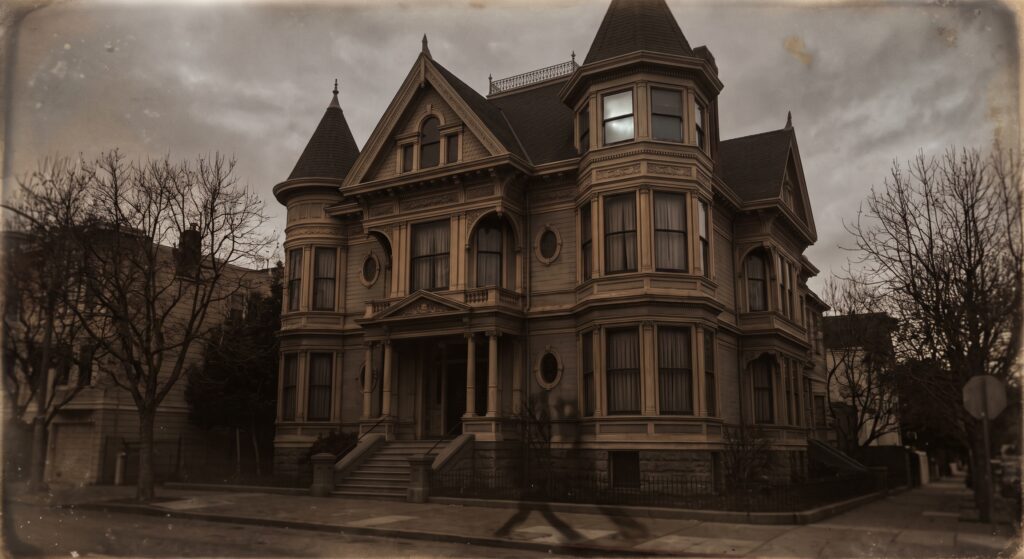
1000 Lombard Street: the party that would not end
Socialite Pat Montandon threw an astrology-themed party in 1967. Palmists, a crystal gazer, and a tarot reader entertained her guests at the bottom of the famously crooked block. When Montandon failed to bring the tarot reader his drink, he raged. In her 1975 book The Intruders, she quotes his parting words, a vow he would neither forget nor forgive.
Then her life unraveled. Freezing temperatures gripped the apartment even with the thermostat pushed to 90 degrees. Her dog barked at 2 a.m. and tore out his fur. Doors locked themselves. Burglars ransacked the place. A mysterious fire broke out during another party. Most chilling, a friend who stayed behind after Montandon moved out died in a fire that no official record ever explained.
What the tour skips at Lombard Street
Montandon blamed a Russian cemetery and old public hangings beneath the house. A local journalist who studies San Francisco’s forgotten graveyards looked into it. The Russian cemetery is located blocks away, near the top of Russian Hill, not under 1000 Lombard. The gallows story does not hold either. Yet the property does carry real sorrow. Several women who lived there died by suicide, including one before Montandon arrived. Neighbors recalled that woman playing a single song, “Mockin’ Bird Hill,” at all hours. Montandon’s own cousin said she kept hearing that same tune after she moved away.
The house sold in 2019 for $5.1 million, well under its list price. It sits quiet now. The curse, if it lived anywhere, seems to have moved on.
2220 Sacramento Street: the niece who never existed
The Chambers Mansion trades on one grisly image. A niece named Claudia, the story goes, was sawn in half in a farm accident or murdered by a deranged relative kept in the attic. Her ghost supposedly roams the halls, and lights flash in the upper windows. CBS News once ranked the house among the scariest in America.
City records dismantle the tale. No Claudia Chambers ever lived there. The builder was Robert Craig Chambers, a Utah mining tycoon, not the “Richard” of legend. He died in 1901 of appendicitis. His nieces, Harriet and Lillian, later sued the estate over an inheritance they believed they were promised, lost after years of appeals, and never lived in the house again.
The real haunting hides in the record
The genuine tragedy belongs to Eudora Chambers, Robert’s wife. In May 1893 she vanished from the Sacramento Street home. A week later a man found her wandering a beach near Mussel Rock, weak and disoriented, yet showing no signs of a week’s exposure. On New Year’s Eve that same year, a train engineer spotted a woman walking dangerously close to the tracks near Valencia Street. The San Francisco Call reported that Mrs. R. C. Chambers had tried to take her own life. She died in 1897 following further attempts.
The flashing window lights have a grounded source too. From 1977, the mansion ran as a hotel that staged magic shows and private concerts. Liberace once performed there. Flashing lights in the windows describe a stage act, not a specter. The myth invented a butchered niece while the documented anguish of a real woman sat untold.
2090 Jackson Street: the paint tycoon, the bounder, and the spies
The Whittier Mansion offers three suspects for one haunting. Paint tycoon William Franklin Whittier built the 30-room house in 1896, and it survived the 1906 earthquake intact. He lived there until his death in 1917. Some blame his restless spirit for the cold spots and the sense of a presence. Others point to his son, Billy, a hard-drinking wastrel whose ghost supposedly extends his party years in the wine cellar.
History adds a darker chapter. The German Reich bought the mansion in 1941, and it served as the German consulate during World War II. Visitors who feel shadowy presences in the servants’ quarters often read them as echoes of wartime espionage. Whether tycoon, bounder, or spy, the house gives its restless energy plenty of candidates.
The psychics, the photographs, and the sale
Montandon did not simply endure the Lombard Street haunting. She investigated it. In 1973 she sent two psychics into the house. They emerged with photographs that appeared to change over time and a bleak reading of the home’s spiritual condition. One investigator wrote her a summary afterward. The pair could not clear the property of its activity. Her former landlord later told her the building had a hex on it and called it a misfortune he was glad to be rid of.
The aftermath followed Montandon for years. Her marriage failed. The press mocked her. Her son later wrote a scathing memoir about the family and San Francisco high society. Whatever gripped 1000 Lombard, it seemed to trail her long after she left the address. The house itself finally changed hands in 2019 and reportedly sits quiet, its story now the property of the next owner.
Small footprint, staggering density
These three houses sit within a short walk of each other. That closeness is the point. In a district where real estate is the ultimate currency, families rose and fell inside the same ornate walls, and their sorrows stayed behind. Strip away the invented nieces and phantom cemeteries and you still find suicide, litigation, sudden death, and war. Pacific Heights did not need to invent ghosts. Its own records supplied them.
References & Further Reading
KQED: The Haunted House on Lombard Street That Left a Trail of Tragedy
The Real Deal: Lombard Street Mansion’s Haunted Past
CAENLUCIER (Sotheby’s): Landmark #119 and the Murder Mystery
Inside Guide to San Francisco: Haunted Places (Whittier Mansion)