The corner is empty. You have checked it twice. There is no draft, no unusual smell you can detect, and no mouse behind the skirting board. The dog is not frightened; it is focused. Alert. The low, sustained growl of an animal that has identified something specific and is monitoring it. Your cat is on the highest shelf in the room, its gaze tracking the same corner, pupils wide. This is the third night this week.
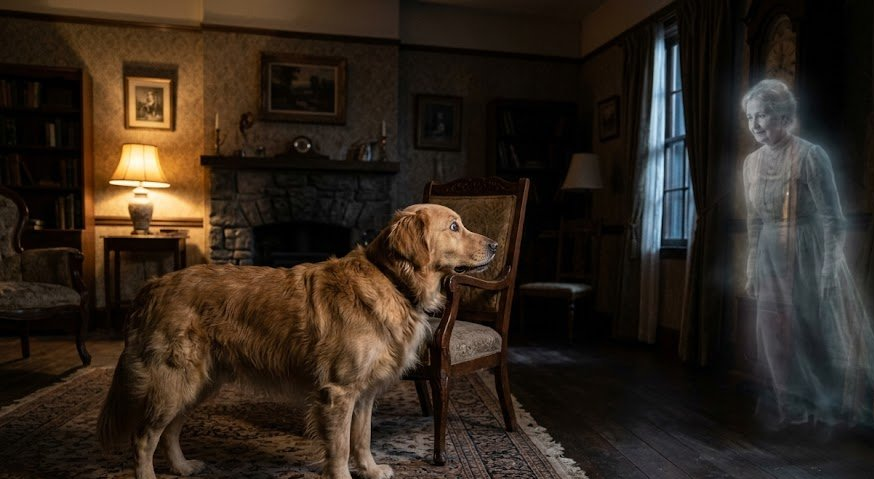
Pet owners reporting inexplicable animal behavior in supposedly haunted locations is one of the most consistent features of residential paranormal accounts. Ghost hunters include animal reactions in their evidence assessment. The question is, what is actually triggering these behaviors? has both a rigorous scientific answer and, potentially, a remainder that science has not yet fully addressed.
The Sensory Range Humans Cannot Access
Dogs hear in the frequency range of approximately 40 Hz to 65,000 Hz, compared to the human range of 20 Hz to 20,000 Hz. Cats hear up to approximately 79,000 Hz. Both species detect infrasound at lower frequencies than most humans. In any environment where human investigators are experiencing the classic indicators of a haunted space, unease, a felt presence, and visual disturbances and where infrasound is a contributing mechanism, the dog or cat in the same room is detecting the infrasound source directly, as a genuine sound. They are not responding to a ghost. They are responding to the fan, the HVAC resonance, or the structural vibration that the human investigators are experiencing only indirectly through its neurological effects.
Dogs also have a sense of smell estimated at 10,000 to 100,000 times more sensitive than human olfaction. Old buildings contain layered chemical histories embedded in wood, plaster, and textile materials. The scent profile of a century-old house contains information about previous occupants and previous events that a dog can access in ways humans cannot. An animal focused intently on an empty corner may be processing scent information about something that happened there that has left a chemical trace invisible to everyone else in the room.
Magnetic Field Sensitivity
Research has demonstrated that dogs have magnetoreceptor cells capable of detecting magnetic fields, a sense used for orientation and navigation. Paranormal investigation theory proposes that certain hauntings correlate with specific EMF conditions. If both propositions are true simultaneously, if anomalous activity correlates with electromagnetic conditions and if dogs can detect those conditions, then a dog responding to a reported haunting may be responding to an electromagnetic environment rather than to a spirit directly. This does not resolve the question, but it opens a more specific investigative framework: does the animal respond to locations that also show consistent EMF anomalies and not to control locations with similar spatial and acoustic properties?
The Confoundment You Cannot Ignore
Behavioral scientists who study anomalous animal responses make an important point: pets are extraordinarily sensitive to their owners’ emotional states. An anxious human in a supposedly haunted location generates a rich stream of subtle physical cues, changed breathing, muscle tension, and altered movement that a well-bonded dog or cat detects and responds to. The animal may not be sensing a ghost. It may be sensing you sensing a ghost. Any serious investigation of pet responses to paranormal environments needs to account for this confound explicitly, which means assessing the animal’s behavior before the human investigators have formed any impression of the space.
Historical and Cultural Contexts
The belief that dogs can detect spirits is ancient and near-universal. Aztec tradition held that dogs could see ghosts and guide the souls of their masters through the underworld. Ancient Egyptian mythology connected cats to spiritual protection and the boundary between the living and the dead. Medieval European folklore attributed to dogs the ability to sense death approaching, their howling at night interpreted as a signal that a spirit had passed nearby. These traditions converge on the same intuition: that non-human sensory ranges give animals access to information that humans cannot process directly. Whether that intuition reflects a genuine capability or a universal anthropomorphism of animal alertness is a question that has not been satisfactorily resolved in either direction.
A Checklist Before Drawing Conclusions
- Rule out pests: mice in walls produce ultrasonic sounds that cats and dogs respond to strongly, while humans hear nothing.
- Rule out infrasound: if the behavior correlates with a specific appliance or HVAC cycle, that is likely the source.
- Assess your own emotional state: if you are anxious or expectant, your pet may be mirroring you.
- Note whether the behavior is localized or diffuse: an animal tracking something in a specific corner is more anomalous than one that is generally unsettled.
- Record the behavior on video and note the timestamp, location, and duration for comparison with other events during the same investigation.
Parapsychologist Loyd Auerbach makes a point worth holding: if ghosts are not physical phenomena detectable by the standard senses, then some form of non-sensory perception would be needed to detect them. Animals’ extraordinary sensory ranges account for a great deal of apparently anomalous behavior. Whether there is a remainder, cases where animal responses cannot be attributed to any known sensory input, is an open question that deserves better investigation than it has received.
References & Further Reading
• Popular Science: Can Dogs Sense Ghosts?
• TVI Show: The Science of Haunted Animals



[…] Pets Reacting to Ghosts at Night: Instinct, Sound, Scent, or Something Stranger? […]
[…] Pets Reacting to Ghosts at Night: Instinct, Sound, Scent, or Something Stranger? […]
[…] Pets Reacting to Ghosts at Night: Instinct, Sound, Scent, or Something Stranger? […]