The Willard Hotel bans smoking everywhere, on every floor, in every corner. So when the lobby suddenly fills with the rich aroma of a burning Cuban cigar, staff stop what they are doing and look around.
They never find the source. The scent lingers, then fades, and nobody can explain it.
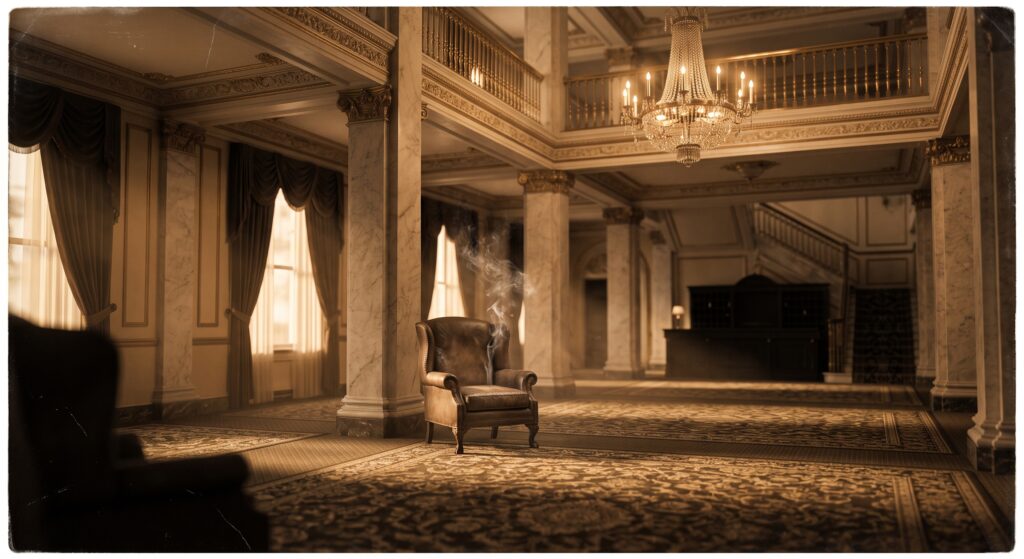
Long-time employees have a theory. They think the eighteenth president never stopped visiting his favorite chair. The Willard shelters many upper-crust ghosts, but Grant’s may be the most active of them all.
To see why he would return, you have to understand how badly he needed that seat in the first place.
An Escape Two Blocks From the White House
Grant led the Union to victory, then inherited the exhausting machinery of the presidency. Running the executive branch drained him in ways commanding armies never had. The paperwork, the favor-seekers, and the endless demands wore on a man built for the field.
Every evening, he found the same relief. He walked two blocks from the Executive Mansion to the Willard. He sank into a leather chair in a corner of the lobby, lit a cigar, and sipped brandy while he read the paper.
For a few minutes, nobody needed anything from him. The great general could simply sit and breathe.
Those minutes never lasted. Word of his routine spread fast, and favor-seekers began crowding the lobby to press their agendas. They surrounded his chair, pitched their causes, and refused to let a tired president rest.
Popular legend credits Grant with a name for these pests. As he waved them off through the smoke, the story goes, he called them lobbyists, and the word stuck to American politics forever.
Setting the Record Straight on ‘Lobbyist’
The Grant origin story is delicious, and it is probably too neat. The White House Historical Association traces the word much further back, to petitioners who once gathered in the lobby of the British House of Commons. The term crossed the Atlantic and evolved over decades before Grant ever sat down.
That correction does not erase his role. Grant made the Willard lobby the beating heart of Gilded Age power brokering. Whether or not he coined the word, he lived it nightly, fending off men who wanted a piece of his influence.
This kind of tangle is exactly why the Willard fascinates people. History and legend braid together here until you cannot pull them apart. The hotel hosted Lincoln before his inauguration and watched Julia Ward Howe write the Battle Hymn of the Republic.
Grant’s corner belongs to that same rich tradition. The cigar smoke, real or spectral, is part of the building’s living memory.
The Aroma of the Unseen Cigar
Guests and workers report the same phenomenon again and again. Late at night, when the lobby empties, the smell of cigar smoke drifts through the air with no burning cigar anywhere in sight. The scent draws attention precisely because the hotel forbids it.
Some witnesses report more than a smell. They describe a distinguished, transparent figure moving through Peacock Alley, the hotel’s grand promenade. In life, this corridor was where Washington’s elite strutted to be seen. In death, one of its most famous patrons apparently still strolls it.
Other accounts add stranger details. A few claim to see wisps of smoke curling upward beside his old favorite chair, as though an invisible hand still holds a lit cigar. Occasionally a partly filled brandy snifter appears on the side table, then vanishes before anyone can examine it.
The pattern fits the man. Grant found genuine peace in that corner, away from the crowds and the pressure of the office. If any president would refuse to leave a spot he loved, it is the weary general who fought so hard for a moment of quiet.
The Man Behind the Cigar
It helps to remember who Grant actually was. Before the presidency, he saved the Union as its greatest general, second only to Lincoln in the public imagination of the era. The country made him the highest-ranking general since George Washington.
That fame came at a cost. Grant carried the weight of enormous battlefield losses and the endless second-guessing of critics who called him a butcher. He was a private, weary man thrust into the most public job in the nation.
The cigar was practically part of him. Grant smoked heavily, and admirers sent him boxes of cigars by the thousands after newspapers reported his habit during the war. The scent that lingers at the Willard is, in a sense, his signature.
Understanding that context deepens the haunting. The ghost is not a caricature. It is the shade of an exhausted hero who found one small corner of calm in a life of relentless duty.
A Hotel That Collects Presidents
Grant is not alone at the Willard, which may be why his story feels so at home there. The hotel’s guest list reads like an American history syllabus, and its ghost roster is nearly as crowded.
Jane Pierce reportedly walks the upper floors in mourning. A young bellboy who died in a 1903 elevator accident is said to linger near the lifts. Guests describe figures in top hats and tails moving through rooms that have hosted senators, generals, and kings.
Against that backdrop, Grant fits right in. He was, after all, one of the hotel’s most devoted patrons in life. It makes a certain poetic sense that he would remain its most devoted patron in death.
So the next time you pass through the Willard lobby, glance toward the quiet corners. History gathers here, and if the stories hold any truth, some of it never checked out.
Sharing a Drink With History
There is something almost tender about this haunting. Grant’s ghost does not rattle chains or frighten children. It sits, it smokes, it enjoys a drink in peace, doing in death exactly what it loved in life.
Perhaps that is the whole point. The lobbyists are gone now, and the constant demands died with the man. What remains is the reward he chased every evening, finally granted without interruption.
Book a room, wander the lobby after midnight, and breathe deep. That whiff of Cuban tobacco in a smoke-free hotel might be the closest you ever come to sitting beside a president.
Just do not crowd him. Approach gently and give him room. After a lifetime of people who wanted something, the general has earned his quiet corner. He never did care for lobbyists.
References & Further Reading
• The Willard Hotel (White House Historical Association)