The tour guide pauses in front of it every single time. Not because the script says so, but because the guests stop moving on their own. Something about this mirror, framed in ornate gold and hanging in the grand hallway of the Myrtles Plantation in St. Francisville, Louisiana, holds people in place. They lean in. They scan the glass. Some reach out as if they might touch it, then think better of it. And then, sometimes, someone at the back of the group quietly asks the guide to move on.
What they are reacting to is one of the most documented paranormal objects in the American South, an antique mirror said to be home to the spirits of a mother and her children, sealed inside by an act of grief, an act of oversight, and the weight of more than 150 years of accumulated belief. If you have never heard the story of the Myrtles mirror, you are about to understand why people who visit rarely forget it.
A Plantation Built on Grief
The Myrtles Plantation was built in 1796 by General David Bradford, a figure connected to the Whiskey Rebellion, and it passed through several hands before the Woodruff family took ownership in the early 19th century. Clark Woodruff ran the estate, and it was during his tenure that the events surrounding the mirror are said to have taken place.
According to the legend woven into the plantation’s history, an enslaved woman named Chloe was caught eavesdropping on her master and punished severely, losing part of her ear for the transgression. What followed, the lore claims, was an act of desperation or revenge, a birthday cake baked with oleander leaves, a plant whose toxicity is well-documented in Southern horticulture. Sara Woodruff and two of her children died. Chloe, according to the story, was executed by her fellow slaves.
The Woodruff household plunged into mourning. And here is where the mirror enters the story, not as a curiosity, but as a catastrophe of ritual.
The Ritual That Was Supposed to Protect Them
In 19th-century America, particularly in the South, the death of a family member triggered a precise sequence of mourning customs. Clocks were stopped at the moment of death. Curtains were drawn. And every mirror in the house was covered with black cloth or crape.
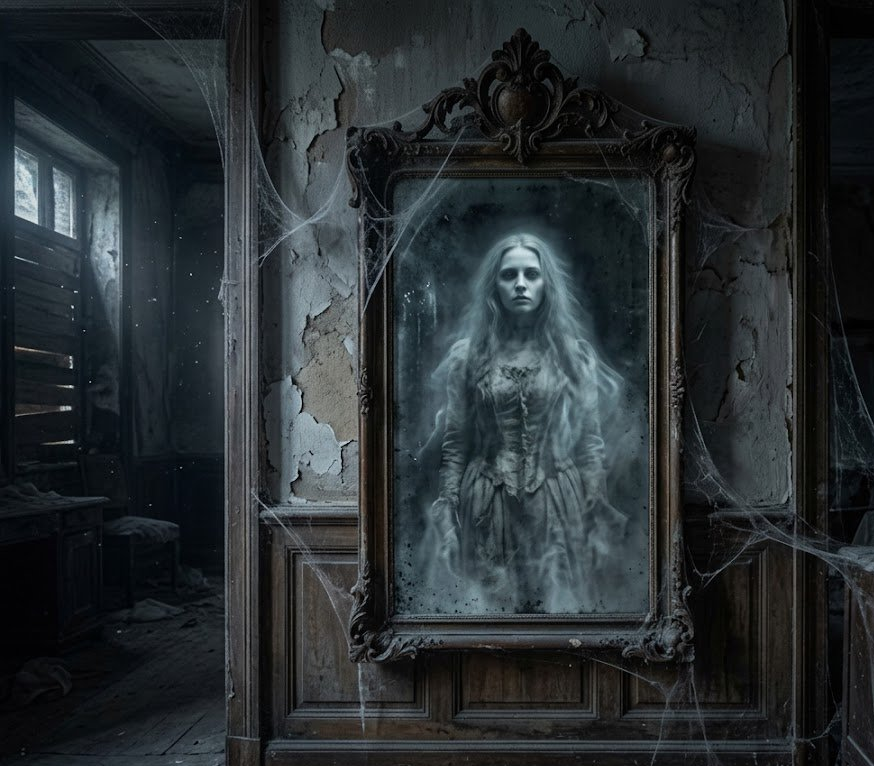
This was not mere superstition for the sake of it. As documented by Friends of Oak Grove Cemetery’s historical overview of Victorian funeral customs, mirrors were covered with crape or veiling to prevent the spirit of the deceased from becoming trapped inside the glass. The belief was rooted in the understanding of mirrors as liminal objects, thresholds between the living world and something else entirely.
This custom ran deep across multiple cultures. Funeral.com’s cross-cultural analysis of mirror-covering traditions traces the practice through Victorian England, Scotland, Ireland, and Jewish shiva observances, each tradition carrying the same core belief: a mirror left uncovered after a death creates an opening. The soul, disoriented and unmoored from the body, might see its reflection and mistake it for the living world, becoming anchored there instead of passing on.
In the Woodruff household, someone covered every mirror. Every mirror except one.
The One That Was Missed
The grand hallway mirror, ornate and European, imported from across the Atlantic in the 1830s, was overlooked. Whether through oversight, panic, or the sheer chaos of triple grief pressing down on a household at once, no black cloth was draped over its surface.
The legend holds that Sara Woodruff and her two children, denied the protection of the covered glass, became trapped inside the mirror. Not metaphorically. Not as a lingering emotional impression. Literally sealed within the reflection, able to see out but unable to leave.
What has made this story remarkable is not just its persistence but the consistency of what witnesses describe more than a century and a half later. As The Haunted Walk’s documentation of Myrtles Plantation phenomena notes, visitors consistently report seeing Woodruff’s children appearing in the mirror near the room where they died. And then there is the detail that stops researchers cold: each time the mirror is replaced or re-silvered, the same handprints reappear, as if the presence inside refuses to acknowledge that anything has changed.
What Visitors Have Seen
The reports have accumulated across generations of guests, investigators, and staff. The mirror does not behave the way a mirror should.
People describe handprints materializing on the inside of the glass, visible against the surface but impossible to wipe away permanently. The smudges return within hours of cleaning. Others report seeing faces in the reflection that do not belong to anyone standing in the hallway. A sorrowful expression, just visible at the edge of the glass. The outline of small figures, child-sized, hovering in the depths of the reflection.
One of the most striking documented cases comes from a guest in 2010, reported by US Ghost Adventures, who photographed the mirror and captured something that stopped the analysis: the wallpaper visible inside the mirror’s reflection was not the same wallpaper on the actual walls of the hallway. A different room, or a different time, visible only through the glass.
The area surrounding the mirror also registers as physically distinct from the rest of the hallway. Visitors report a drop in temperature that does not correspond to vents or drafts and a persistent sensation of being observed, of something in the mirror watching back.
The Mirror Has Been Investigated
The Myrtles Plantation has drawn serious paranormal investigation over the decades. The Ghost Adventures team, led by Zak Bagans, visited the property in 2014 and documented unusual audio recordings and unexplained physical events during their examination, as reported by US Ghost Adventures. The TAPS team of Ghost Hunters also visited in the early 2000s and concluded the location carried genuine paranormal activity.
National Geographic recognized the Myrtles as one of America’s most haunted homes, as noted by The Haunted Walk. That designation is not handed out casually, and the mirror is consistently identified as the focal artifact of the property’s paranormal record.
The concept framing much of the ongoing research is what investigators call imprinted energy. The idea, as explored by The Horror Collection’s analysis of Myrtles Plantation phenomena, is that the emotional weight of death, of grief, and of ritual performed incompletely in a household struck by triple loss can leave a residue. Not a ghost in the traditional sense, but something closer to a recording, a presence encoded into the object itself by the sheer intensity of what surrounded it.
The Mirror as a Doorway
There is a reason mirrors occupy a specific and recurring role in ghost lore across almost every culture. They are not treated as passive objects. They are treated as surfaces that see.
Victorian tradition, as documented by mirror superstition research from Umarbwn, held that a soul in the moments after death was confused and searching and that a mirror offered a portal it might step into, mistaking the reflection for the world it had just left. The Victorians treated this as a real and present danger, not a literary flourish. They covered the glass because they genuinely believed something terrible would happen if they did not.
At the Myrtles, the covering did not happen. The mirror was left open.
The plantation today operates as a bed and breakfast, and guests who book overnight stays in the rooms closest to the hallway mirror sometimes report waking in the night with the specific sensation that something in the house is aware of them. Some leave before morning. Others stay, drawn back to the hallway before checkout to look one more time into the glass, to see if anything looks back.
Why This Mirror Is Different
There are haunted objects all over the American South. The Myrtles mirror stands apart because of what it asks of the person standing in front of it.
Most haunted locations ask you to listen. To feel. To wait for something that may or may not arrive. The mirror asks you to look directly into it, knowing that whatever is described inside might be looking back at the same moment. That is a different kind of encounter. It puts you inside the experience rather than beside it.
The handprints are what linger longest in the accounts of people who have stood in front of it. Small handprints, pressed from the inside of the glass outward. Whether Sara’s children are reaching toward the living or simply marking where they are, those prints communicate something that no amount of rational framing has been able to fully dissolve.
If you find yourself in St. Francisville, the plantation is open for tours and overnight stays year-round. The hallway is part of every tour. The mirror is always there.
Stand in front of it long enough, and you will understand why the tour guide always pauses.
References & Further Reading
The Myrtles Mirror: Louisiana’s Most Haunted Reflection, Lair of Mythics
The Haunting of the Myrtles Plantation, The Haunted Walk
Myrtles Plantation: A Southern Haunting, US Ghost Adventures
Myrtles Plantation: The Historic Louisiana House Said To Be Haunted, All That’s Interesting
Victorian Funeral Customs and Superstitions, Friends of Oak Grove Cemetery
Covered Mirrors After a Death: Meaning and Modern Mourning, Funeral.com
Mirror at Night Superstition: Beliefs, Rules and Science, Umarbwn
The Myrtles Plantation Haunting: Real Ghost Encounters, The Horror Collection

[…] The Myrtles Plantation Mirror: What Has Been Seen Cannot Be Unseen […]
[…] The Myrtles Plantation Mirror: What Has Been Seen Cannot Be Unseen […]