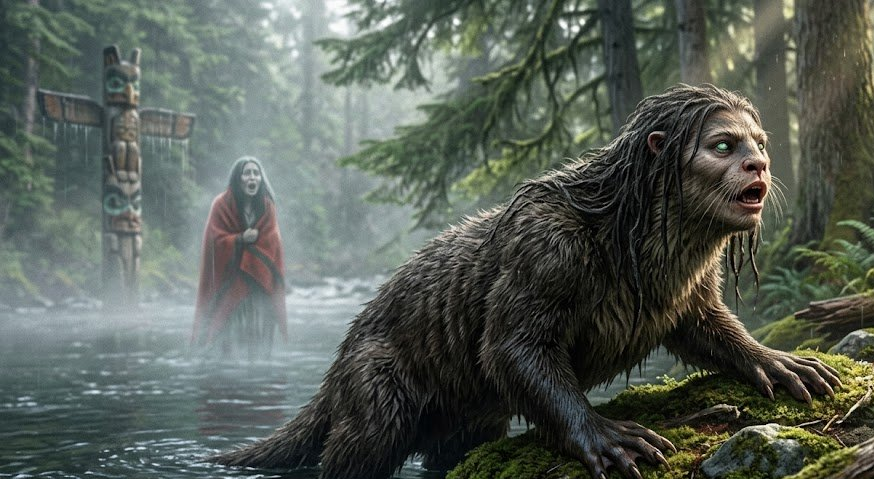
The Tlingit people of the Alaskan and British Columbia coast have maintained a tradition about the Kushtaka, the Land Otter Man, for as long as the oral tradition reaches. The Kushtaka is a shapeshifting being, either a land otter that has taken human form or a human that has been taken by otters and transformed, that haunts the coastal margins, riverbanks, and tidal flats of the Southeast Alaska and northern British Columbia coast. It mimics the cries of people in distress, particularly children, to lure the unwary to the water’s edge. Those who follow the sound and are caught by a Kushtaka are transformed into Kushtaka themselves.
This article treats the Kushtaka with the care that an active, living tradition deserves. The Tlingit cultural tradition is not extinct, is not confined to the historical past, and contains perspectives on the Kushtaka that outsiders should approach with respect rather than with the framework of secular cryptid culture. This article presents the tradition as folklore and cultural history, not as an invitation to seek Kushtaka encounters.
The Tradition
The Kushtaka’s most distinctive behavior is its mimicry. It reproduces the sound of a person screaming or a child crying with enough accuracy to draw people toward the water, where the transformation occurs. This feature, the use of mimicked human vocalizations to lure prey, connects the Kushtaka to a broader coastal tradition of dangerous shapeshifting beings that exploit human emotional responses, particularly the response to a child in distress.
In some Tlingit accounts, the Kushtaka is not inherently malevolent but occupies a liminal moral space: it sometimes rescues drowning people, transforming them into Kushtaka to save them from death, which is simultaneously rescue and loss. The transformees are mourned by their families because they are no longer fully human, even though they are alive. This moral ambiguity is characteristic of the richer Tlingit spiritual tradition, which does not map easily onto Western binary good-evil frameworks.
The Coastal Environment
The Southeast Alaska coast is one of the most ecologically rich and physically demanding environments in the world: a maze of islands, fjords, tidal passages, and river mouths threading through dense temperate rainforest. River otters are common and genuinely large in Alaska, reaching four feet in body length and moving between fresh and salt water with ease. They are intelligent, highly vocal, and occasionally display the bold, curious behaviour around humans that makes them feel almost uncannily aware. The Kushtaka tradition grows from close observation of real animals in a real landscape over a very long period of time.
References & Further Reading


[…] So approach the Qalupalik as more than a green-skinned scare. It is a piece of living Inuit knowledge, a warning stitched from love and fear. It reminds us that the oldest way to keep a child safe is a story they never forget. For more Alaskan coastal folklore, check out the Kushtaka. […]
[…] disappearances in this region long before 1972. Some accounts fold in the Tlingit legend of the Kushtaka, a shapeshifting otter being said to lure travelers to their deaths. The land carried unease well […]
[…] of the far north gives rise to terrifying Inuit legends like the Qalupalik and the shape-shifting Kushtaka of […]