
Why Northeast Ohio, and Why Portage County
Ohio is not a state that typically comes to mind in conversations about Bigfoot. The Pacific Northwest, with its dense old-growth forest and established research culture, dominates the popular imagination on the subject. But Ohio consistently ranks among the top states for reported Bigfoot encounters in databases maintained by the Bigfoot Field Researchers Organization (BFRO), and Portage County sits at the heart of the state’s most active reporting region.
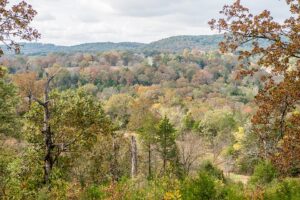
Portage County occupies the northeastern corner of Ohio, a landscape of glacially carved terrain, wetlands, river bottoms, and significant forest cover in the Cuyahoga River valley corridor. It borders Summit and Geauga counties to the west and north, areas that also generate consistent reports. The combination of water sources, forest connectivity, and relatively low population density in key areas appears to be the common factor in Ohio’s Bigfoot geography.
Historical Context: Reports Before the Term Existed
Accounts of large, hair-covered, upright-walking creatures in the Ohio wilderness predate the word Bigfoot entirely. Nineteenth-century newspaper accounts from the Western Reserve (the historical name for the northeastern Ohio region) describe encounters with what settlers variously called wild men, gorilla-men, or simply large creatures moving through the forest. These accounts are fragmentary and difficult to verify, but they establish that the tradition in this region is not a product of twentieth-century media.
Notable Modern Reports From Portage County
The BFRO database contains multiple Class A reports (direct sightings) from Portage County, with additional Class B reports (indirect evidence such as sounds, tracks, and environmental disturbances) from the same area. Several come from the Ravenna and Kent areas, along creek corridors and near agricultural land bordering wooded sections.
Common elements across Portage County reports include encounters near water, sightings in the early morning or at dusk, and descriptions of a large bipedal figure moving quickly through brush or crossing roads. The Cuyahoga River watershed, which passes through the county, is cited in multiple accounts as a consistent corridor.
The Grassman: Ohio’s Regional Bigfoot Tradition
Ohio reports are sometimes associated with a regional variant name: the Grassman. The term appears in accounts from the late nineteenth and early twentieth century and refers specifically to the creature’s apparent use of tall grass fields and wetland margins, which are common features of the Ohio landscape. The Grassman designation is used primarily by Ohio researchers and distinguishes the regional tradition from the coastal Bigfoot accounts, though the described creature is consistent with Bigfoot reports elsewhere.
How to Research Portage County Reports
The BFRO maintains a searchable database of reports organized by state and county, making it possible to read the original submitted accounts from Portage County with location descriptions, witness details, and investigator notes. The Ohio Bigfoot Organization is a regional research group that has conducted field investigations in northeast Ohio and maintains its own documentation. Local historical societies in Ravenna and Kent hold newspaper archives that can surface older accounts not captured in modern databases.
A Note on Evidence Standards
Bigfoot research operates in a landscape where the evidence is almost entirely testimonial, with occasional physical traces (tracks, tree structures, hair samples) that have not yielded definitive biological verification. This does not make the accounts worthless: consistent, independently gathered reports from a geographically specific area are meaningful data points regardless of what they ultimately represent. They reflect genuine encounters with something. What that something is remains the question.

[…] Bigfoot Sightings in Portage County, Ohio: Local Legends and Reports […]
[…] relict ape, a frontier ghost story, and a creature that may predate Bigfoot […]
[…] The hairy, bipedal hominid is the king of North American cryptids. While the Pacific Northwest claims the classic Bigfoot, nearly every heavily wooded region on the continent has its own local variant. In the Appalachian mountains of Virginia, locals speak of the Wood Booger, a localized wildman legend with deep roots in mountain culture. Further west, the dense woods of the Buckeye State hide the Ohio Grassman, while Portage County has recorded its own distinct cluster of Bigfoot sightings. […]
[…] Bigfoot Sightings in Portage County, Ohio: Local Legends and Reports […]
[…] Bigfoot Sightings in Portage County, Ohio: Local Legends and Reports […]
[…] Bigfoot Sightings in Portage County, Ohio: Local Legends and Reports […]
[…] Bigfoot Sightings in Portage County, Ohio: Local Legends and Reports […]
[…] Bigfoot Sightings in Portage County, Ohio: Local Legends and Reports […]