An unseen companion who appears at the edge of death, a poet’s famous mistake, and the science of the sensed presence.
At the very limit of human endurance, survivors report someone walking beside them who is not there. This unseen presence guides and comforts them through the impossible. It even earned its name from a small error in a famous poem.
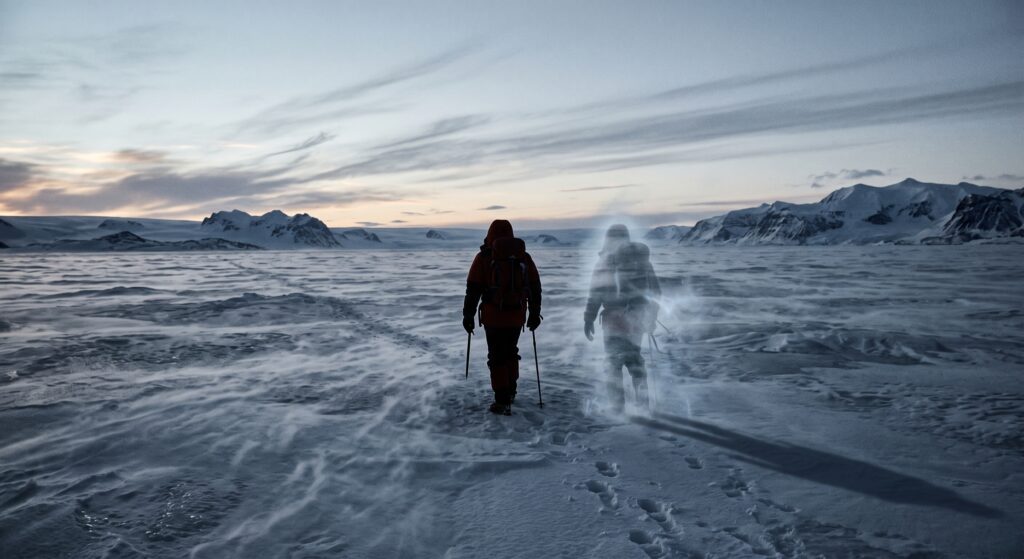
Explorers, climbers, and disaster survivors describe it with eerie consistency. Is it a guardian, or a trick the mind performs to keep you alive? The answer may be both.
Shackleton’s Fourth Man
The most famous case belongs to Ernest Shackleton. After his Antarctic expedition’s brutal trek across South Georgia, he wrote that it often seemed the party numbered four, not three. His two companions, Tom Crean and Frank Worsley, later admitted feeling the same presence.
Here is the twist behind the name. Shackleton described a fourth presence among three men. T.S. Eliot referenced the account in The Waste Land but changed it to a third who walks always beside you. The Third Man Factor is named after a poet’s arithmetic error.
More Famous Cases
Author John Geiger gathered the phenomenon into a single study, his 2009 book The Third Man Factor. He found the experience far more common than anyone assumed. It appears across extreme environments and eras.
Climber Frank Smythe felt a companion high on Everest. A trader named Ron DiFrancesco described a guiding presence as he escaped the World Trade Center. Divers, polar travelers, and mountaineers report the same benevolent, unseen helper at the brink.
The Spiritual Perspective
For many survivors, the presence feels sacred. Some name it a guardian angel or a spirit guide. William James, writing on religious experience, placed such encounters in the realm of the spiritual.
This reading gives the experience meaning that matches its power. People emerge changed, often describing the presence as the reason they survived. Whatever its source, its effect on them is undeniable and profound.
The Psychological Perspective
Science offers grounded explanations. Extreme stress, exhaustion, cold, hunger, and isolation can all generate a sensed presence. Researchers Peter Suedfeld and John Mocellin studied this effect in harsh environments.
Other models add depth. The phantom-limb analogy frames the presence as a projected phantom self. Julian Jaynes’s controversial bicameral-mind theory suggests stress can revive an older mode of hearing one’s own thoughts as an outside voice. Michael Persinger explored temporal-lobe activity as another route. The brain, pushed to the edge, conjures a companion.
Why a Brain Would Do This
Geiger pushed past cataloging cases toward a bolder idea. He suggested the sensed presence may serve an evolutionary purpose, a built-in coping mechanism that appears exactly when a person most needs the will to continue.
That framing bridges the two camps. The presence can feel like grace and still arise from neurology. Under extreme monotony, isolation, and stress, the mind generates a companion that offers encouragement, direction, and calm. Whether you credit a guardian or a survival circuit, the effect helps people live. That is a remarkable thing for a brain to build.
A Testament to Resilience
Guardian or glitch, the Third Man Factor reveals something remarkable. At the moment of greatest danger, the human mind can summon exactly the encouragement it needs to take one more step.
Whether you see it as grace or neurology, it shows the astonishing lengths we go to survive. The unseen companion is, in the end, a portrait of human endurance.
References & Further Reading
Third man syndrome, EBSCO Research Starters
The Third Man Factor, Goodreads