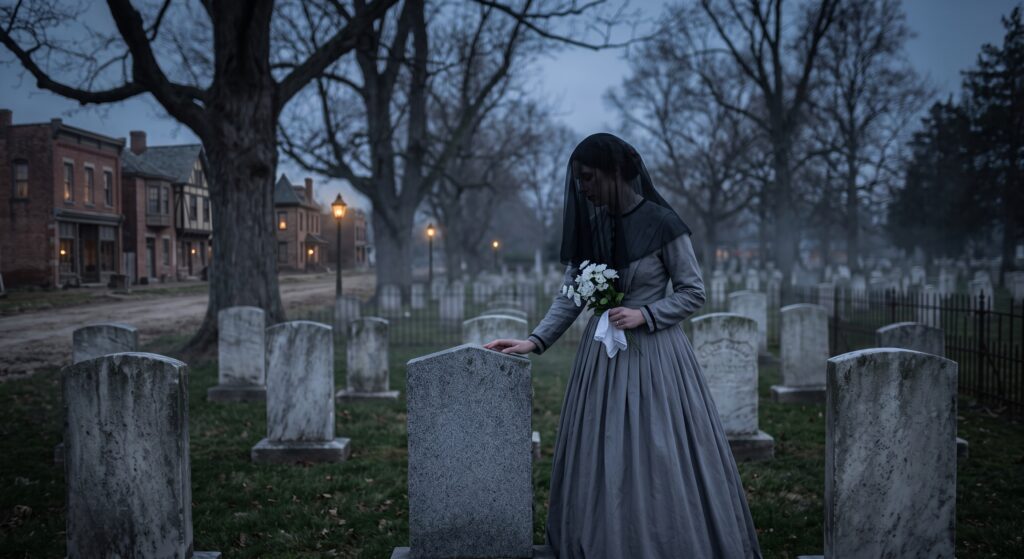
Visitors describe her the same way across a century. A young woman in gray, a handkerchief in her hand, drifting between the headstones and weeping. Approach her and she vanishes. The legend says she searches for a lost love. The truth is quieter and more human, and it involves a real Columbus woman whose name we know.
A prison camp turned burial ground
Camp Chase began in 1861 as a Union training camp, named for Salmon P. Chase. It became a Confederate prisoner-of-war camp, and conditions there turned brutal. Overcrowding and disease spread fast. A smallpox outbreak in the winter of 1863 to 1864 killed hundreds in a single month.
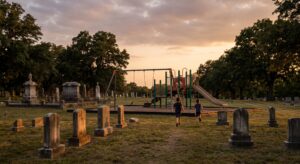
More than 2,000 Confederate prisoners died at the camp. The cemetery on Sullivant Avenue is the only part that survives, surrounded now by the Hilltop neighborhood.
The woman behind the ghost
Most accounts identify the Lady in Gray as Louisiana Ransburgh Briggs, a Confederate sympathizer who lived in Columbus after the war. She visited the cemetery to lay flowers on Southern graves. Because that sympathy drew scorn, she wore gray or a veil to avoid recognition.
Witnesses long reported fresh flowers appearing at the grave of Benjamin Allen of the 50th Tennessee. The romantic version claims Briggs was his grieving fiancee. That engagement detail is folklore, not documented fact, layered onto a woman who genuinely mourned the dead.
How many are buried here
Even the numbers spark debate. The stone monument beneath the memorial arch reads 2,260 Confederate soldiers. Department of Veterans Affairs records list closer to 2,122 gravesites with an estimated 2,168 bodies. The gap reflects the chaos of wartime burials, where wooden markers rotted and records failed.
A monument that still stirs conflict
In 2017, during a national wave of Confederate monument removals, someone beheaded the soldier statue atop the arch. It was replaced in 2019. That modern chapter reminds us the site is not a frozen ghost story. It is contested ground where history stays raw.
Visit with respect. The Lady in Gray endures because a real woman refused to let forgotten men lie unmourned. That act of stubborn compassion, not a phantom romance, is the story worth carrying home.
References & Further Reading
Camp Chase Confederate Cemetery, Ohio Exploration Society