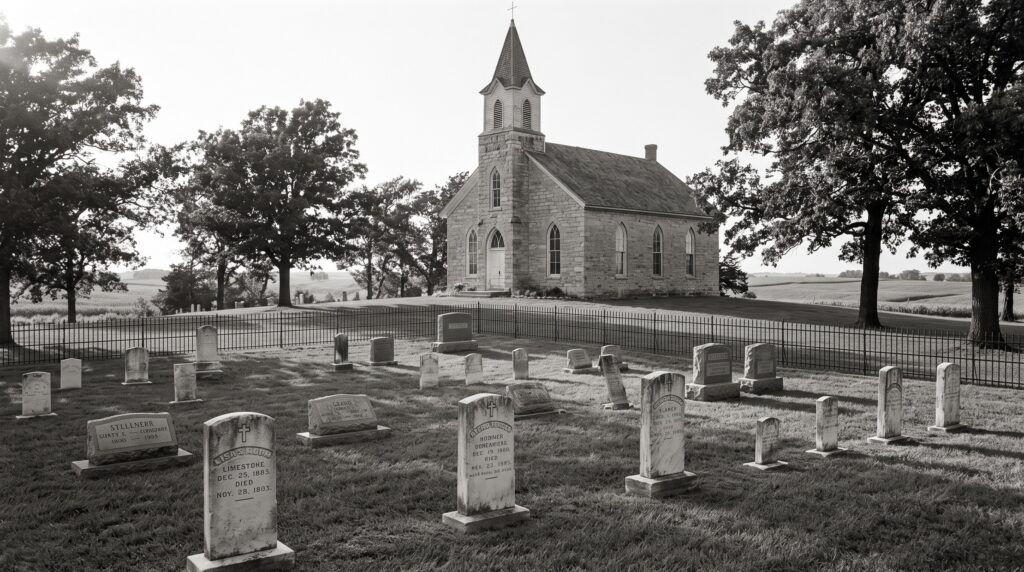
An ordinary country churchyard
Stull is a tiny unincorporated community in Douglas County, Kansas, west of Lawrence. Its cemetery sits on a low hill beside the ruins of an old stone church. German immigrants settled the area in the 1800s and named it after an early postmaster. For most of its history, Stull was an unremarkable rural churchyard, quiet and tended by descendants of the settlers.
Nothing about its founding suggests horror. The families buried there farmed, worshipped, and raised children like their neighbors across the county. The graves hold ordinary people who lived ordinary lives. The transformation from country graveyard to alleged gateway to hell happened suddenly, and we can date it almost exactly.
The 1974 article
In 1974, the University of Kansas student newspaper ran a piece about Stull’s spooky reputation. It described claims that the Devil appeared there twice a year and that the site was one of two gateways to hell on Earth. The article spread the legend far beyond the county. Before it, the stories were local whispers at most, if they existed at all.
The tale grew with each retelling. People added a witch hanged from a tree, a stairway to hell beneath the church, and a child of the Devil buried on the grounds. None of it appears in any historical record. The legend even claimed the Pope refused to fly over Stull, a rumor with no basis whatsoever. Each new detail traveled faster than any correction could.
The timing helped the legend spread. The 1970s saw a national wave of interest in the occult and Satanism, fueled by films and paperback books. Stull arrived at the perfect cultural moment. A vague campus rumor became a fixed point on the map of American horror, cited in books and later across the early internet.
The cost to a real community
The legend brought trespassers, especially around Halloween and the spring equinox, when the Devil supposedly appeared. They vandalized graves, damaged the church, and disturbed a community’s ancestors. Residents grew furious, and rightly so. These were real people’s grandparents and children lying under stones that strangers came to desecrate for a thrill.
The damage was serious. Vandals broke headstones, spray-painted the ruins, and left trash across the sacred ground. The small community had to fight to protect a place that had been peaceful for over a century. The legend imposed a real and ongoing cost on people who never asked for fame.
The old stone church, already in ruins, was demolished in 2002. Some blamed the damage and liability the legend created. The county now enforces no-trespassing rules firmly, and the cemetery closes at night with patrols. We stress this point because the human cost of the legend outweighs its entertainment value.
Visiting with respect
Stull Cemetery is private and patrolled, and night visits invite arrest. There is nothing to see that justifies disturbing the dead or breaking the law. The gateway to hell exists only in a student newspaper and the retellings that followed.
If you research the site, do it through Douglas County historical records, which tell the honest story of a German farming settlement. The families of Stull deserve to be remembered as neighbors and pioneers, not as props in a horror story invented in 1974.