Generations of Ohio teenagers have parked near a set of stone ruins and listened for the screams of burning children. It is a chilling ritual. It also rests on a fire that never occurred.
The true history of the Gore Orphanage is messier, sadder, and in some ways more haunting than the legend. Start by unlearning the name itself.
The Local Folklore
The story goes like this. Near Vermilion, an orphanage burned to the ground. Trapped children died screaming, and their spirits still cry out along the road. A cruel figure, sometimes called Old Man Gore, presides over the horror.
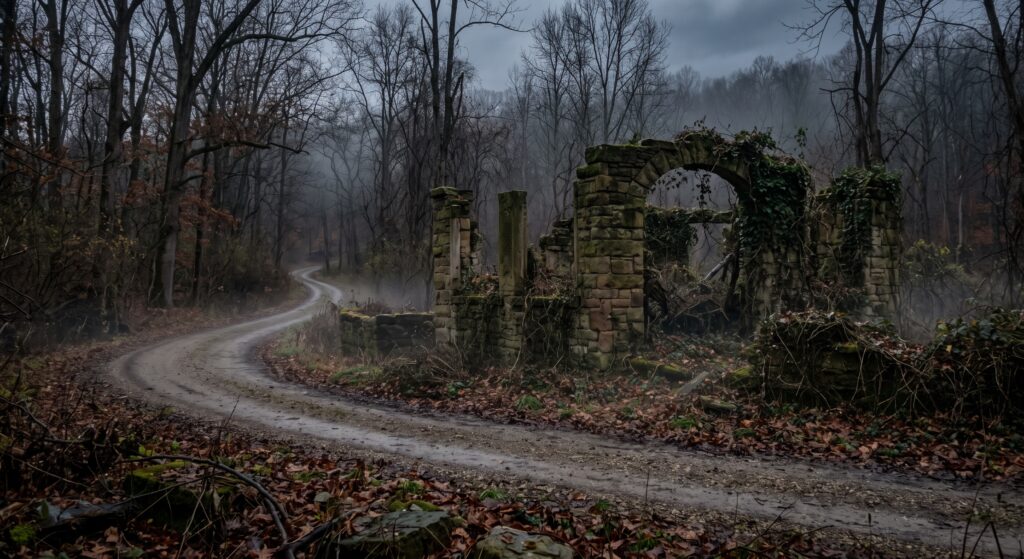
Visitors point to crumbling foundations and stone pillars in the woods as proof. The overgrown ruins and the lonely road do most of the storytelling. It feels true, which is often enough.
Where the Name Comes From
Here is the first correction. There was never an institution called the Gore Orphanage. Gore is a survey term. A boundary error once left a thin, wedge-shaped strip of land, resembling the gore of a dress. Surveyors added that strip to the county. The road took the name from it.
The actual orphanage was the Light of Hope, founded in 1902 by Reverend Johann Sprunger. He had relocated from Indiana after accusations of abuse and neglect followed him. The place had real problems. A mass child-killing fire was not among them.
The Fire That Was Not
Historical records are clear. During its roughly thirteen years of operation, the orphanage never burned, and no children died there from fire. A blaze did strike in 1910, but it destroyed the printing office, not the dormitories, and killed no one.
So where did the screaming children come from? Blame a second building. On the same land stood the abandoned Swift Mansion, called Rosedale, built in the 1840s. It burned in the 1920s, likely at the hands of trespassers. People confused its ruins with the orphanage.
The Real Abuse Investigation
The genuine dark chapter had nothing to do with fire. State authorities investigated Light of Hope over its treatment of children. At the time, Ohio had little power to regulate orphanages, so little came of it directly.
The publicity still hurt. Families pulled children out, and after Sprunger died the institution slid into financial ruin, closing around 1915 or 1916. A place already marked by hardship simply failed. That quiet collapse, not a screaming inferno, is the orphanage’s true ending.
The Spiritualism Thread
The Swift Mansion carried its own eerie history. The Wilber family, who lived there, practiced spiritualism and held seances. Rumors claimed their children could speak with the dead. Real family grief and genuine period beliefs seeded the haunted reputation.
That is a striking irony. The site’s authentic ghostly associations belong to a mansion of spiritualists, not to a burning orphanage. The legend attached to the wrong building.
Why the Myth Endures
Ruined foundations, dark woods, and a name like Gore make a perfect legend engine. The public appetite for tragedy did the rest, and the invented fire proved more marketable than the true story.
The reality involves an abusive reverend, a mislabeled ruin, and a family of spiritualists mourning their dead. Truth is rarely as cinematic as legend. Sometimes, as here, it is quietly stranger.
References & Further Reading
The History of Gore Orphanage and Swift’s Hollow, Vermilion Historical Society