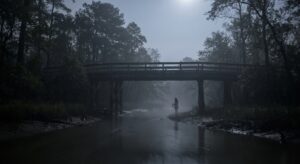
In 2010, a trench behind the bleachers unearthed seven coffins. The spectators had been there all along.
There is a spectator in the bleachers at Lee Williams High School who never buys a ticket. Witnesses describe a man in a bowler hat, seated among the crowd, watching football games and graduation ceremonies from the stands. He has been there, in a sense, longer than the school itself.

In 2010, a construction crew proved exactly why. Digging a trench near the field, they hit seven coffins. The town’s oldest urban legend had just been confirmed in the worst possible way. What generations had whispered about turned out to be literally, provably true.
Most haunted-stadium stories run on rumor and atmosphere. This one runs on excavation records, a burial map, and human bone. It may be the most honest ghost story in American high school sports.
The cemetery under the end zone
From 1900 to 1917, the land served as Kingman’s Pioneer Cemetery, the primary burial ground for miners, townspeople, and railroad workers. When a newer cemetery opened in 1917, families who could afford it paid to move their dead. Many bodies, especially those in unmarked graves, were simply left behind. The cemetery was formally abandoned in 1944.
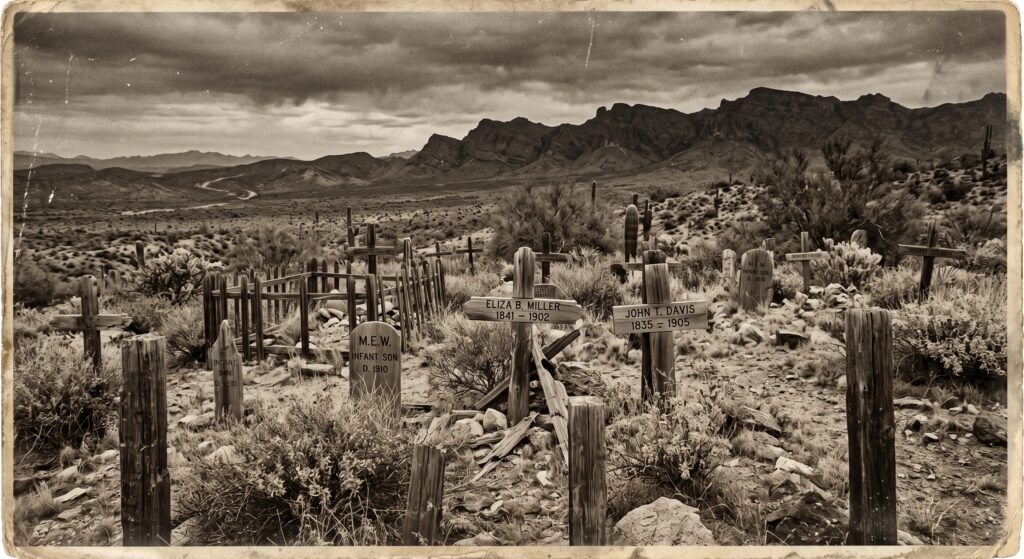
The people left behind were the ones no one claimed. The poor, the forgotten, the nameless. Their graves went unmarked, their records incomplete or lost. When the cemetery was abandoned, they stayed exactly where they had been buried, waiting under the desert soil.
Then the schools came. A junior high, then a high school, then finally Lee Williams, rose over the old graves. Part of the football field and a section of bleachers sit directly on top of the Pioneer Cemetery. A burial map later suggested that only about ten percent of the graves were ever relocated, leaving more than a hundred bodies still in the ground.
The math is what unsettles people most. This was not a case of one or two overlooked graves. Ninety percent of the cemetery, by that estimate, stayed exactly where it was while schools rose overhead. Generations of students have walked, studied, and played above a nearly intact pioneer burial ground. The field is not haunted by a single restless soul. It sits atop an entire forgotten community.
The day the legend came true
For generations, longtime residents had known the field sat on a cemetery. It was local knowledge, half legend and half fact. In 2010, during work tied to the new high school, crews digging a sewer trench near the field unearthed human bones, coffin fragments, and what looked like a brass casket handle.
Seven coffins came up behind the bleachers, along with personal items like cuff links and jewelry. Small, human artifacts of people who had lived and dressed and been buried with care. The medical examiner was called, and work stopped as required by law.
This was not even the first such discovery on the grounds. Remains had surfaced during earlier campus construction in 1959 and again in 1972. The land kept giving up its dead every time someone put a shovel in it. The legend was not a legend at all. It was a recurring fact that the town kept rediscovering.
The bowler hat and the little girl
The hauntings match the history with unsettling precision. Spectators and graduates report figures in pioneer-era clothing, prairie gowns and old suits, appearing at games and graduation ceremonies. These are not modern ghosts. They dress for the era of the cemetery beneath them.
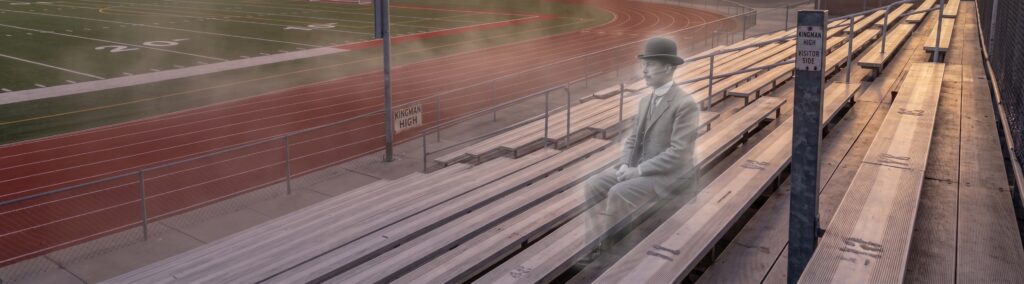
Two figures stand out from the rest. The first is the man in the bowler hat, watching quietly from the bleachers like a fan who wandered in from another century. He does not menace anyone. He simply sits and watches the game, as though he never stopped being a resident of the town.
The second is a little girl, heard asking people to go out and play. That detail lands harder than any scream. A child, still wanting a playmate, calling out across a hundred years. Sudden temperature drops, disembodied voices, and floating light orbs round out the reports. For a haunting confirmed by literal coffins, the details feel almost gently, heartbreakingly domestic.
The most honest haunted stadium in America
Picture the scene. Stadium lights blaze over a Friday night game. The band plays, the crowd cheers, and teenagers chase a football across the grass under a desert sky. A few feet below that grass lie the residents of Pioneer Cemetery, most of them nameless, most of them never moved.
That is what makes Lee Williams so striking among haunted venues. Many such stories rely on rumor, vibe, and the occasional cold draft. This one rests on documented excavations, a dated burial map, and remains recovered by a medical examiner. The evidence is not spectral. It is physical.
The bowler hat man may or may not be real. The bodies beneath the bleachers unquestionably are. That certainty gives the place a weight that pure folklore never achieves. You do not have to believe in ghosts to feel uneasy standing on that field. You only have to believe in the coffins.
The living and the dead share this ground, and only one group knows it. Teenagers graduate here, cheer here, and grow up here, mostly unaware. The other residents just keep watching the game, in their bowler hats and prairie gowns, from a cemetery that was never fully emptied. At Lee Williams, the home crowd has been there the whole time.
The recurring discoveries raise a hard question the town has never fully answered. What is owed to people buried under a football field? Each time remains surface, work stops, a medical examiner arrives, and the process starts again. Relocating every grave would mean tearing up the school. Leaving them means playing games above the forgotten dead. Kingman has mostly chosen to build and move on, marking the graves with legend rather than headstones. The bowler hat man, in that sense, is the closest thing the pioneers have to a monument.
References & Further Reading
Kingman Tours, Pioneer Cemetery
Las Vegas Review-Journal, Discovery of human remains delays construction project in Arizona
Kingman Daily Miner, Construction work disturbs old cemetery