From a Melbourne curtain call to a Paris chandelier, the world’s stages keep their dead
The theatre ghost is not a London or New York invention. It is a global species, and its stories shift shape to fit local history, local grief, and local drama. A benevolent baritone guards a Melbourne dress circle. Scholars linger in a Beijing opera hall built on old graves. Beneath the Paris opera, an underground lake still hides in the dark. Wherever performers pour concentrated emotion into a room night after night, something appears to stay behind.
What follows crosses continents, yet the same threads keep reappearing. Sudden death mid-performance. Ground disturbed by construction. Traditions built to honor the departed rather than banish them. One Australian story opens the tour, and it may be the most extraordinary curtain call ever recorded.
Princess Theatre, Melbourne: The Final Curtain of Frederick Federici
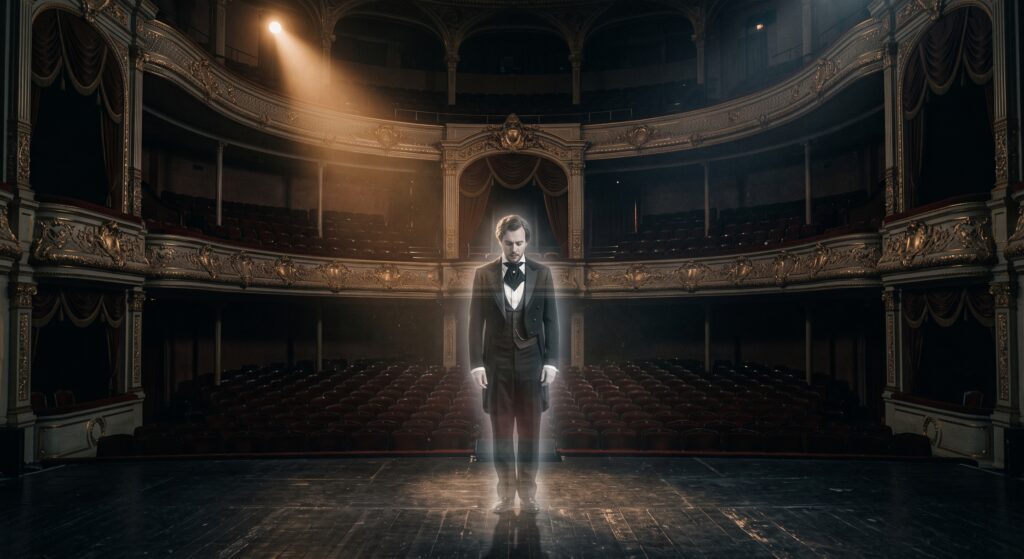
On March 3, 1888, the British bass-baritone Frederick Federici sang Mephistopheles in Gounod’s Faust. The opera climaxes as Mephistopheles drags Faust down through a trapdoor into hell. As the trap lowered Federici into the cellar, he collapsed from a fatal heart attack. He died backstage within minutes.
Then the impossible happened. The entire cast swore Federici stood beside them for the curtain call, taking his bows, even as his body lay lifeless below the stage. Audiences agreed they saw him. Ever since, his benevolent spirit has watched over the dress circle, and the theatre keeps a strict, century-old tradition of leaving a third-row seat empty for him on opening nights. Staff regard his appearance as a sign of supreme good luck.
Modern encounters keep the legend breathing. Cleaners describe unseen hands touching their hair and shoulders in the closed, empty building. A fireman once attended a false alarm, opened the roof for air, and reportedly saw a translucent figure standing statue-still on the stage. Staff who have felt his presence describe warmth rather than dread, and the theatre’s team calls him family, going so far as to name its bistro after him. A man who died descending into a staged hell now blesses the room from a saved chair, which may be the gentlest ghost story theatre has ever told.
Huguang Guild Hall, Beijing: Scholars and Opera Spirits
Established in 1807 as a gathering place for scholars and merchants from Hunan and Hubei, this magnificent complex helped birth Peking Opera. It also rose atop an old cemetery, and local folklore blames blood-curdling screams in the courtyard on the ground’s former life. Visitors and staff report spectral scholars and opera artists still enjoying performances, as if the hall’s intellectual and creative history refuses to fade. The dead here do not menace the living. They keep attending the show.
The hall illustrates a pattern that repeats across cultures. Build a temple of performance on disturbed earth, then fill it for generations with music, poetry, and applause, and two layers of memory begin to overlap. The grief of the buried ground meets the joy of the living stage. Beijing’s guild hall does not frame its spirits as threats to escape. It presents them as continuity, a cultural inheritance where scholarship and artistry persist long after the individuals who practiced them have gone.
Opéra Garnier, Paris: The Real Inspiration for the Phantom
Gaston Leroux invented the Phantom in his 1910 novel, yet he built the fiction on real tragedy woven through the Palais Garnier. The truth beneath the legend is stranger than the story most people know.
The Chandelier That Fell
On May 20, 1896, a counterweight supporting the grand chandelier tore loose and crashed through the ceiling during a performance. It killed a woman in seat number 13. Leroux lifted that catastrophe almost directly into his plot, and the number alone gives the tale a shiver.
The Disfigured Pianist
Legend tells of a pianist disfigured in the 1873 fire that destroyed the old Salle Le Peletier. Having lost his ballerina fiancée, he retreated into the dark, vaulted underground of the newly rising Palais Garnier and lived there until his death. A masked musician haunting the cellars of an opera house sounds like fiction, yet it predates and seeds the novel that made him famous.
The Underground Lake and the Bones
Architect Charles Garnier built a massive brick-vaulted reservoir to manage rising groundwater, and that underground lake genuinely exists. Paris firefighters still train in it today. Darker still runs the fabled love triangle whose loser, Boismaison, reportedly bequeathed his bones to the opera house, where they allegedly served as stage props. Truth and theatre blur together beneath the Garnier until you can no longer find the seam. Leroux needed to invent very little. He simply gathered the building’s real horrors and gave them a mask, and audiences have struggled ever since to separate the novelist’s phantom from the opera house’s genuine ghosts.
North American Regional Theatres
Cincinnati Music Hall in Ohio stands over a former “Pest House” hospital and a potter’s field, and major construction keeps unearthing bones. Staff report whispering in elevators and elegant apparitions seated in the audience. In Cleveland, the ruined Variety Theater closed after a 1984 Motörhead concert reportedly cracked the ceiling, and caretakers count up to 19 spirits, including a red-eyed Shadow Man.
Georgia’s Springer Opera House holds a benign, rumpled young man in a tweed suit who walks beside personnel and mimics their gait before vanishing. Maine’s Bangor Opera House, raised where an 1882 theatre burned, hosts a firefighter shadow in the balcony and a young girl who plays with actors’ devices, nudging volume dials and switching songs. Even in small-town America, the stage seems to hold onto its own.
One Craft, Many Ghosts
Cross enough borders and the pattern becomes undeniable. Theatres worldwide sit on disturbed ground, survive fires, and stage death so convincingly that death sometimes answers. The cultures differ, the names differ, the rituals differ. The underlying truth holds steady. A stage concentrates human feeling until the room itself seems to remember, and the people who gave everything to that room find it hard to leave. Wherever the lights go up, someone from the past may already be watching.
References & Further Reading
Only Melbourne, Federici: Princess Theatre Ghost. https://www.onlymelbourne.com.au/federici
Stage Whispers, Ghosts of Theatre Past. https://www.stagewhispers.com.au/history/ghosts-theatre-past
Lantern Ghost Tours, Story of Federici. https://www.lanternghosttours.com/post/story-of-federici-the-princess-theatre-ghost
Into Horror History (J.A. Hernandez), Princess Theatre, Melbourne. https://www.jahernandez.com/posts/princess-theatre-in-melbourne-victoria-australia
Theatricalia, Princess Theatre, Melbourne. https://theatricalia.com/place/2mb/princess-theatre-melbourne-victoria