Two altered states people constantly confuse, the clues that tell them apart, and where the experts disagree.
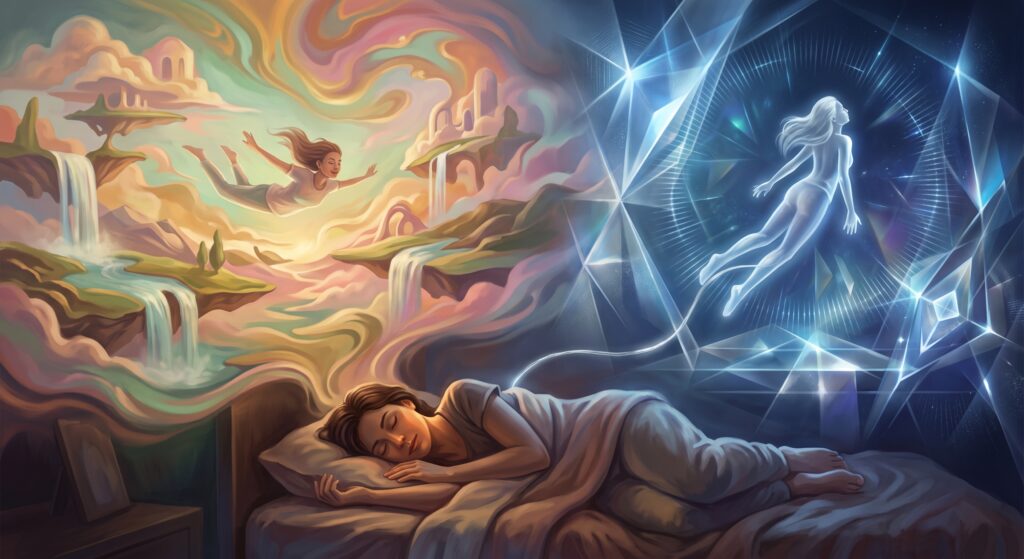
Both experiences begin the same way, with your body asleep and your mind awake. From there, people insist, they diverge completely. The trouble is that even seasoned practitioners argue about where one ends and the other begins.
Here is a clear beginner’s map. It covers what each state is and how to tell which one you are in. It also flags the one debate you should know about before you start.
Lucid Dreaming
Lucid dreaming means being aware that you are dreaming while still inside the dream. The moment you realize it, you can often steer the experience. You might change the scenery, fly, or converse with dream figures.
The key feature is authorship. Your subconscious builds the environment, so it responds to your thoughts. In a lucid dream, you are the director. The world bends because it is made of your mind.
Astral Projection
Astral projection, also called an out-of-body experience, is described very differently. Practitioners say consciousness separates from the physical body and moves through an external plane. You are a traveler, not a creator.
The reported quality differs too. Many describe the astral environment as more real than real, with a crystalline clarity, and as resistant to thought-based control. You cannot simply reshape it the way you reshape a dream.
Key Differences to Watch For
Several signs help you tell them apart. Astral projection usually begins in a waking, deeply relaxed state. It often includes a vibrational stage, a buzzing or electrical sensation. Surveys link that sensation to a majority of out-of-body reports. Lucid dreams arise from within sleep, marked by a sudden flash of recognition.
Control is the clearest test. Try to change the environment through thought. In a lucid dream, it shifts easily. In astral projection, it resists. Some traditions also describe a silver cord linking the traveler to the body, symbolizing the connection home.
Techniques People Actually Use
Both practices share entry methods. The Wake-Back-to-Bed approach wakes you after several hours of sleep, keeps you up briefly, then sends you back with clear intention. It catches the brain near REM, when awareness and dreaming overlap most easily.
From there the paths diverge. Lucid dreamers use reality checks and the MILD method to trigger awareness inside a dream. Projectors often use a wake-initiated approach, holding consciousness from waking straight into the vibrational stage. Robert Monroe and Robert Bruce both describe testing the environment as the surest way to tell which state you entered.
Where Experts Disagree
This is the debate to know about. Sleep researcher Stephen LaBerge, who pioneered lucid-dream science, treats astral projection as a variety of lucid dreaming, all generated within the mind. Practitioners like Robert Monroe and William Buhlman insist the two are fundamentally different states.
The two experiences can also blur into each other. A lucid dream may deepen into what feels like a projection, and a projection can fade back into ordinary dreaming. That fluidity is exactly why people confuse them and why the argument endures.
Start With a Dream Journal
For both practices, the first step is the same: keep a dream journal. Write down everything you recall the moment you wake. Better recall builds the self-awareness that triggers lucidity and supports projection attempts.
One caution before you dive in. If you have a history of anxiety, dissociation, or similar concerns, approach intensive practice carefully and consider speaking with a professional first. These techniques are tools, not a substitute for care. Start gently, and let the journal lead the way.
References & Further Reading
Astral Projection Complete Guide, Thalira
Astral Projection vs Lucid Dreaming, Magickal Spot
The Difference Between Lucid Dreaming and Astral Projection, Liza’s Dreamy Journal
Astral Projection vs Lucid Dreaming: Key Differences, Thalira