Picture a north Alabama hollow at dusk. The cicadas cut out. Something pale shifts at the tree line, then holds still. Your gut instinct tells you to run before your brain even identifies the shape. That prickle of being watched is where the White Thang lives, and it has lived there for almost a century.
Strangely, the creature in the oldest first-hand accounts looks nothing like the eight-foot, red-eyed white Bigfoot you see online today. The earliest witnesses described something smaller, closer to the ground, and strangely calm. The monster grew. This post traces how and why that matters.
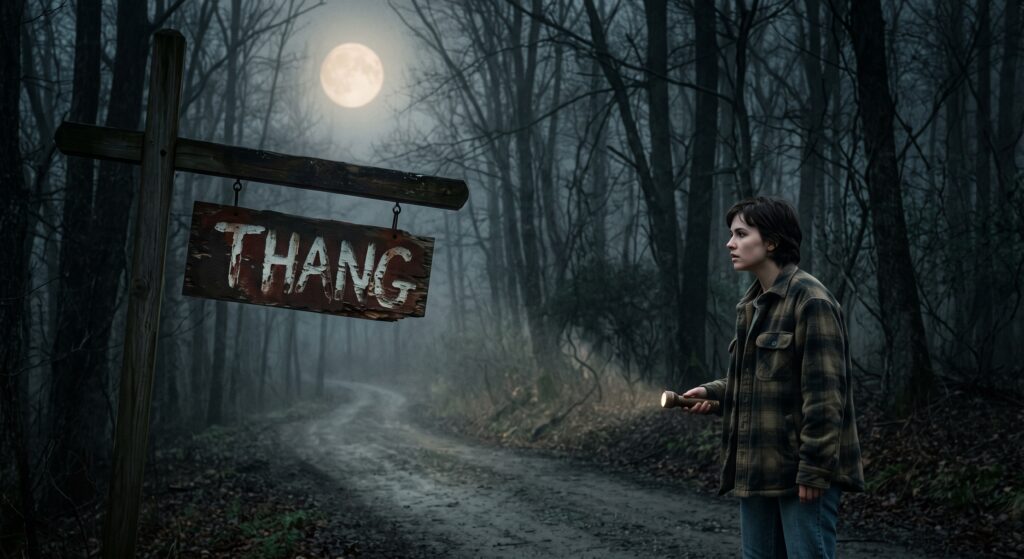
That growth is the real mystery. Cryptids are supposed to be fixed points, the same beast glimpsed again and again. The White Thang breaks that rule. Follow its paper trail and you watch a modest local haunt swell, decade by decade, into a headline monster. The trail starts in a single Alabama county, so that is where we begin.
What People Claim to See
Modern descriptions cluster around a familiar image. Witnesses report a towering figure, seven to eight feet tall, wrapped in shaggy white fur. Red eyes glow. A scream cuts the dark, likened to a woman wailing or a baby crying. The thing moves fast, sometimes upright, sometimes dropping to all fours.
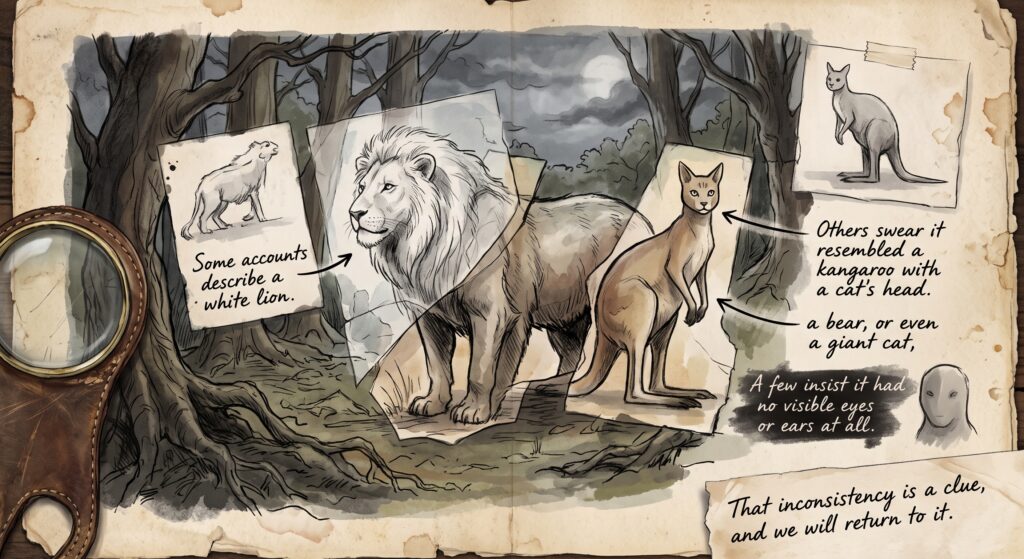
Yet the details refuse to settle. Some accounts describe a white lion. Others swear it resembled a giant cat, a bear, or even a kangaroo with a cat’s head. A few insist it had no visible eyes or ears at all. That inconsistency is a clue, and we will return to it.
One trait stays constant across the decades. The White Thang rarely attacks. It watches, it screams, and it leaves. Witnesses walk away shaken but unhurt, which makes the legend feel less like a predator story and more like a haunting.
Where the Sightings Cluster
Geography gives the legend a home. Most reports fall inside a rough triangle between Morgan, Etowah, and Jefferson counties in north-central Alabama. That is hill country, thick with hardwood ridges, creek bottoms, and old logging tracts.
Specific spots recur in the stories. Witnesses name Walnut Grove, Moody’s Chapel, and a wooded pocket locals call Happy Hollow. The Wheeler National Wildlife Refuge, a sprawling expanse of forest and wetland along the Tennessee River, shows up often too.
The range does not stop there. Reports drift into Huntsville, where people attach the “White Thing” name to an eyeless, pale figure. Witnesses there place it in caves and drainage ditches around Jones Valley and Monte Sano Mountain. Sightings even bleed into neighboring states. A legend with this much territory is really just many local fears sharing one convenient name.
The Oldest Accounts Tell a Quieter Story
Genealogist Peter J. Gossett collected White Thang memories from Winston County for his local history site. His aunt, Feneda Martin Smith, never saw it herself. She simply repeated what her neighbors described, and their versions land far from the towering giant of today.
Take old man George Norris. He reportedly saw the creature in the Enon graveyard and described it as lion-like, saying it was “betwixt a dog and a lion.” He described white, slick, long hair and a bushy tail. Then the story turns almost tender. Norris fell asleep against a tree, and the creature lay down beside him until sunrise, watching, offering no harm.
Other Winston County accounts follow the same low, four-legged pattern. Arthur Martin and Jessie Thomas said they saw it grazing “like a cow” beside Enon Road. Nathan Thomas described a heavy “poomp, poomp” sound chasing him to a hickory tree, which the creature then gnawed through the night before wandering away at dawn.
Notice what is missing. No eight-foot frame. No glowing red eyes. No upright ape. The earliest storytellers pictured a strange animal that grazed, loped, and lay down, not a hominid stalking the pines.
A Skeptic Once Thought It Was a Dog
The most grounded account comes from Ottis Thomas. Sometime in the late 1930s, he and his brother Edward played on an old sawdust pile near Brown’s Creek. Edward suddenly screamed, “There’s ol’ white thang!” Ottis bolted barefoot across the glades without looking back.
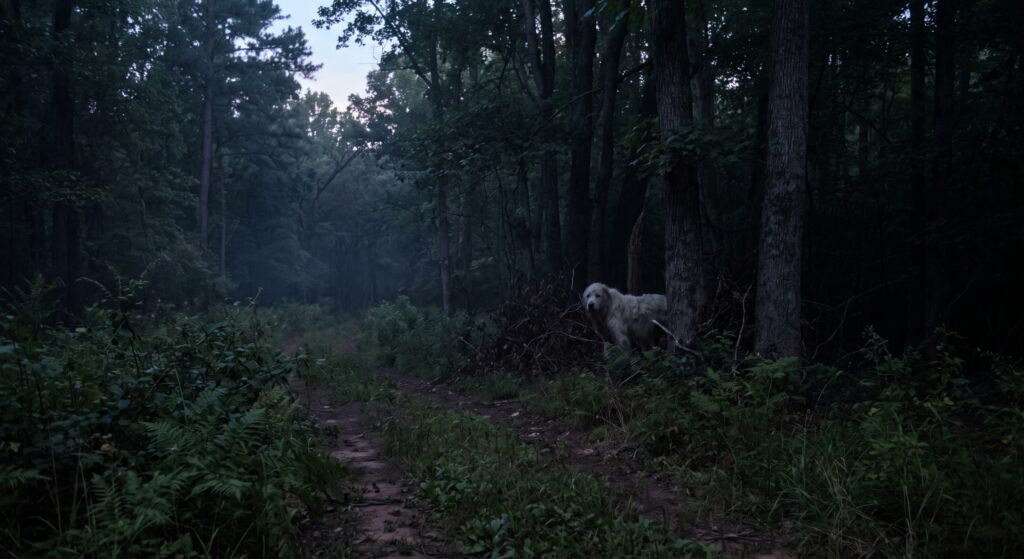
When he finally stopped and turned, he saw nothing. Years later, he offered a plain explanation for the panic. He figured it had been an old white fox hound. Here is the deal: even a firsthand witness suspected an ordinary dog. The terror was real. The monster may not have been.
Courtland’s “Slough Thing” Backs Up the Small Version
Drive west into Lawrence County, and the legend changes names. Around Courtland, folks call it the Slough Thing, born of a slough on Big Nance Creek. Locals treat it as a point of pride, and their descriptions matter here.
Most accounts put the Slough Thing at roughly five feet standing, able to drop and run on all fours. Courtland Mayor Linda Peebles shared a family memory that anchors the timeline. Her mother, a small girl outside Courtland in the early 1930s, lived in a dogtrot home on the creek with no indoor plumbing.
One night the girl crossed the yard and met it face to face. She said it stood on two legs, solid white, about the size of a midsized person. It looked at her for a couple of seconds, then turned and slipped back into the slough. Again, the scale is human, not monstrous.
The Courtland community treats the Slough Thing with affection, not dread. Some residents argue it is the same creature as the White Thang. Others swear it is a separate species entirely. Either way, the two share a striking checklist: white fur, screams like a woman or an infant, and a habit of leaving people alone.
The Trail Into the Modern Era
The stories never fully stopped. Sightings ran through the mid-1900s, and one widely cited encounter surfaced around 2002. A camper posting to an Alabama forum described spotting the thing at Guntersville State Park during a family trip.
His account is telling. He compared what he saw to a white tiger feeding on a deer. That is a big cat image, not a shaggy ape, and it echoes the old lion-like descriptions far more than the modern Bigfoot template.
The legend now lives online as much as in the hollows. A dedicated Facebook community swaps fresh reports and old family tales. YouTube expeditions tramp through the Bankhead National Forest hunting footage. Each new post keeps the creature current, and each one quietly reshapes it a little more.
So How Did the Legend Grow Eight Feet Tall?
Once Sasquatch dominated American cryptid culture, ambiguous “white thang” reports had a template to snap onto. A grazing, lion-like animal became “an albino Bigfoot.” The height crept upward. The red eyes appeared. Writers began calling it the Bigfoot of the South, and each retelling nudged it closer to the famous silhouette.
Memory does the rest of the work. Each retelling drops the boring details and sharpens the frightening ones. A five-foot shape becomes seven feet, then eight. Plain dark eyes become glowing red ones. Nobody lies on purpose. The story simply optimizes itself for the next campfire, keeping whatever makes a listener lean in.
A 2019 AL.com feature by Leada Gore captured the payoff of that convergence. It highlighted a survey naming the White Thang as Alabama’s favorite mythical creature. National attention rewards the biggest, scariest version of a story, not the modest one about a dog-sized shape in a graveyard.
The shape-shifting theory fits this pattern too. People insist the thing can look like a lion, a bear, a kangaroo-cat, or a giant ape. What they are really describing is a legend absorbing every stray sighting in the region. One flexible monster is easier to believe than a dozen unrelated ones.
What the Name Really Carries
The plain-spoken name does a lot of quiet work. Calling something “the white thang” is not a zoological label. It is what you say when you have seen something you cannot name or willfully leave unnamed.
That vagueness gave the legend staying power. A precise creature can be disproven. A “thang” cannot. It stretches to cover a startled dog, a pale deer, a trick of moonlight, or a genuine unknown. The word itself is a container for rural dread, passed hand to hand across generations.
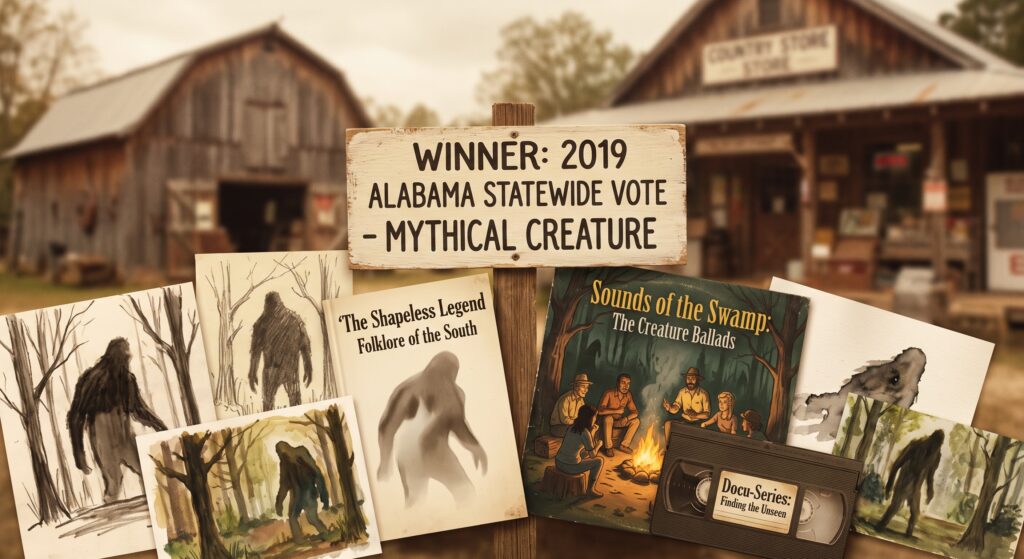
The creature has since grown a real cultural footprint. It has inspired books, songs, documentaries, and a steady stream of art. In 2019 it even won a statewide vote for Alabama’s favorite mythical creature. Not bad for a shape that most early witnesses could barely describe.
The Death Omen That Never Quite Fits
Older residents sometimes said the White Thang appeared near funeral wakes or during hog-killings. That detail reframes the creature as an omen or a spirit drawn to death, not a flesh-and-blood beast.
Read gently; the omen tradition makes sense. Rural communities kept vigil over their dead at home, often through long nights in the woods. Grief sharpens the senses and fills the dark with meaning. A pale shape glimpsed during a wake would have a significance that a daytime sighting could not.
A Pale Cousin in a National Family
The White Thang does not haunt Alabama alone. White or albino Bigfoot reports surface across the country, from Pennsylvania woods to the Pacific Northwest. The color itself seems to grip the imagination harder than the usual brown or black.
There is a reason for that pull. A dark shape hides in the dark woods. A white one glows. It catches headlights and moonlight, and it reads instantly as wrong, as something that does not belong among the trees. Pale animals have carried ominous weight in folklore for centuries, long before anyone said the word Bigfoot.
Seen that way, the White Thang occupies a middle ground. It is part Southern cryptid, part ghost, and part old European superstition about white beasts and death. The Bigfoot label is only the newest coat of paint on a much older fear.
What Could It Actually Be?
Strip away the Bigfoot overlay and the mundane candidates line up quickly. An albino or leucistic deer, bear, or big cat would appear as a pale, uncanny animal in low light. A mangy coyote or a large stray dog, like Ottis Thomas’s fox hound, could scatter children in seconds.
Alabama also has room to hide surprises. The state ranks among the most biodiverse in the country, with millions of acres of forest and vast, barely explored cave systems. That does not prove a monster. It does explain why a “there could be something out there” story survives so easily here.
The screams have their own plain suspects as well. A bobcat or a fox in the dark can sound uncannily like a woman screaming or a baby crying. Layer that sound over a pale animal only half-seen, and a legend writes itself.
Why the Small Version Is the Better Story
The bottom line is simple. The eight-foot White Thang is fun, but it is largely a modern costume stitched onto an older, stranger tale. The original thang was smaller, quieter, and harder to explain away, which is precisely what makes it worth remembering.
A giant ape screaming in the pines is a jump scare. A pale, lion-like creature that lies down beside a sleeping man and simply watches him until dawn is something else entirely. It lingers. It resists tidy answers. It feels as if the woods themselves are watching you.
The eyewitnesses were not fools, and they were not all seeing the same escaped dog. They met something in the dark that felt wrong enough to name and then hand down for ninety years. The pale animal in the graveyard remains unexplained, which is exactly the point.
References & Further Reading
Gossett, Peter J. – “The White Thang”: Animal or Ghost? (Free State of Winston)
Gore, Leada – Alabama’s ‘most mythical creature’ is one you’ve probably not heard of (AL.com, 2019)
Legendary ‘Alabama White Thang’ and Courtland’s ‘Slough Thing’ (Moulton Advertiser, 2023)
Alabama Cryptids & Folklore: White Thang, Metal Man (Folk Bestiary)
Cryptids of the South: The White Thang of Alabama (East Tennessean, 2024)
Exploring Alabama’s “White Thang”: Bigfoot’s Albino Cousin (Vocal Media)
Is the Alabama White Thang Real? Sightings, Theories & Evidence (The Horror Collection)