He swore he would clear his name or never leave the house. He never cleared his name.
Three years after John Parkman’s death, the household staff at Sturdivant Hall started noticing something. Footsteps where no one should have been walking. Doors that opened after they had just been closed. The servants had a simple explanation: “Old Mr. John” had come home. According to generations of visitors, he has never really left.
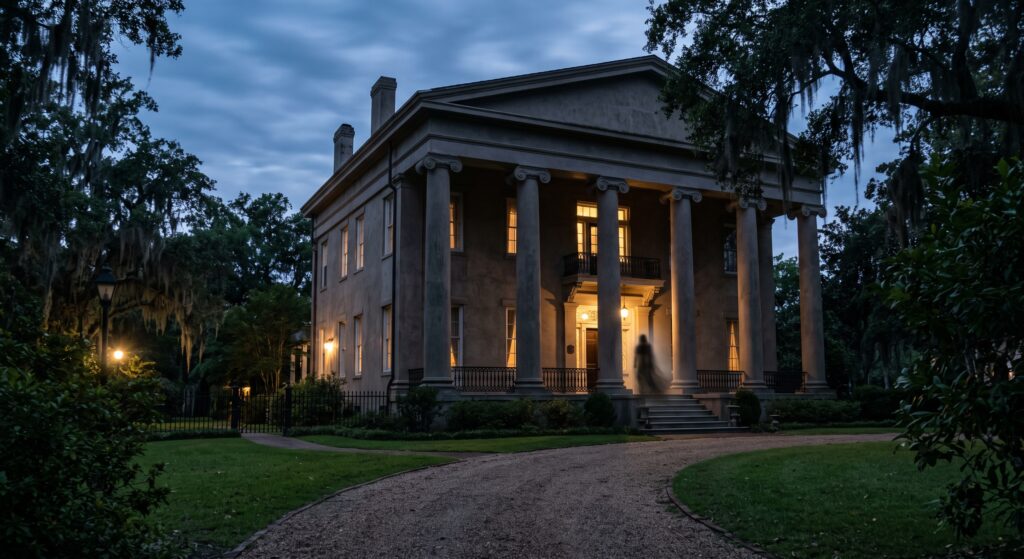
Sturdivant Hall stands on Mabry Street in Selma, a Greek Revival mansion completed in 1856 and now operating as a museum dedicated to the man whose reckless final years gave the house its enduring reputation.
A Banker’s Fall During Reconstruction
John Parkman purchased the mansion in 1864 and went on to become president of the National Bank of Selma during the turbulent years following the Civil War. Reconstruction-era Alabama placed the state’s banks under close federal scrutiny, and Parkman’s institution engaged in cotton speculation that produced massive losses. Federal authorities under military governor Wager Swayne seized the bank and arrested Parkman for the missing funds.
Held at the county jail in Cahaba, Parkman attempted an escape in 1867. He was shot and killed during the attempt, dying before he ever had the chance to clear his name in court. According to the story that followed him, Parkman had vowed he would never leave Sturdivant Hall until his reputation was fully restored. Death, apparently, did not count as leaving.
A Story Windham Made Famous
Sturdivant Hall’s haunting gained wider recognition through Kathryn Tucker Windham’s book 13 Alabama Ghosts and Jeffrey, which included Parkman’s tale under the title “The Return of the Ruined Banker.” Windham’s retelling helped cement Sturdivant Hall alongside Bill Sketoe and the Boyington Oak as one of the anchor stories in Alabama’s ghost folklore canon, introducing Parkman’s story to readers well beyond Selma.
What Visitors Report Today
As a working museum, Sturdivant Hall gives staff and visitors regular opportunities to encounter whatever remains of its most famous resident. Heavy footsteps continue pacing the second-floor corridors, audible enough that staff say they can predict roughly where the sound will move next based on decades of pattern. Doors open and close without explanation, and small objects reportedly shift position between visits with no one responsible.
Parkman’s full apparition has been reported inside the house, most often on the upper floors, matching the areas where the footstep reports concentrate. Outside, his figure has also been seen near the rear corner of the property, where a historic fig orchard once stood, a detail that suggests whatever draws him back extends beyond the walls of the house itself.
A separate, sadder set of reports involves the ghosts of the Parkman children, often described staring out from a second-floor window, watching whatever activity happens on the grounds below. Unlike Parkman’s own restless pacing, the children’s reported presence is consistently described as quiet and still.
A Story About Reputation, Not Just a House
Parkman’s haunting stands out among Alabama’s antebellum ghost stories for its motive: not grief over a lost love, but an unresolved dispute over honor and reputation, financial rather than romantic. That distinction matters. Reconstruction-era Alabama destroyed plenty of reputations along with plenty of fortunes, and Parkman’s inability to let go of his mirrors a broader anxiety about how quickly a respected man’s name could unravel during that period.
The House Itself Tells Part of the Story
Architect Thomas Helm Lee designed Sturdivant Hall for Colonel Edward T. Watts, and its scale and detail reflect the wealth concentrated in Black Belt Alabama before the Civil War dismantled that economic system entirely. Parkman purchased the home for $65,000 in 1864, a staggering sum at a time when the Confederacy’s currency and credit were already collapsing, a detail that hints at how disconnected Parkman’s financial decisions may have been from the reality closing in around him even before the bank scandal broke.
Museum curators maintaining the property today have preserved much of the home’s original interior, giving visitors an unusually intact sense of the space Parkman actually inhabited, rather than a reconstruction. That authenticity matters to serious paranormal investigators, who generally consider unaltered historic interiors more reliable settings for evaluating reported activity than heavily renovated properties.
A Family Story, Not Just a Banker’s
It is worth remembering that Parkman was not the only member of his household whose story attached itself to the house. His children, whose presence visitors report at the second-floor window, lived through their father’s arrest, his death during an escape attempt, and whatever disruption followed for a Reconstruction-era family suddenly stripped of both income and reputation. Their quiet, watchful haunting reads less like a footnote to Parkman’s story and more like its own separate grief, playing out in parallel within the same walls.
Planning Your Visit
Sturdivant Hall offers scheduled guided tours throughout the week, led by museum staff well versed in both the architectural history of the home and the details of Parkman’s story. Selma’s broader historic downtown, including sites central to the civil rights movement, sits within easy walking distance, making Sturdivant Hall a natural addition to a fuller day exploring the city’s layered history.
Advance reservations are recommended for groups, though individual visitors can typically join a tour with same-day notice. Staff are generally candid about the reported activity when asked directly, treating it as part of the museum’s history rather than a marketing angle.
Visiting Sturdivant Hall
Sturdivant Hall operates as a museum maintained by the City of Selma, offering guided tours of the mansion and grounds. Staff are generally happy to point out the areas most associated with Parkman’s continued presence for visitors curious enough to ask.
The Bottom Line on Sturdivant Hall
Parkman’s haunting endures because it taps into a fear more universal than any single ghost: the fear of dying with your name still in question. Sturdivant Hall gives that fear a physical address, complete with pacing footsteps and a banker who, more than 150 years later, is apparently still waiting for Selma to admit he might have been telling the truth. Whether or not visitors believe in the footsteps, the underlying anxiety about reputation and ruin translates easily across any century.
References & Further Reading
Rural Southwest Alabama: Sturdivant Hall at Selma, AL
Encyclopedia of Alabama: Sturdivant Hall Museum
Alabama Pioneers: Kathryn Tucker Windham Tells the Ghost Story of John Parkman
American Ghost Stories: The Haunting of Sturdivant Hall Museum
[…] Alabama offers a strange mix of the tragic and the bizarre, from the Dead Children’s Playground in Huntsville to the Bear Creek Swamp. Visitors also report strange activity at Cry Baby Hollow, Consolation Church Cemetery, the Boyington Oak, and the elegant but restless Sturdivant Hall. […]