You review the footage from the investigation, and there it is: a bright white sphere drifting across the frame. Or a translucent shape in the doorway that was not visible to any of the investigators in the room. Or a face in the window that no one was looking at when the photograph was taken. Your finger hovers over the share button.
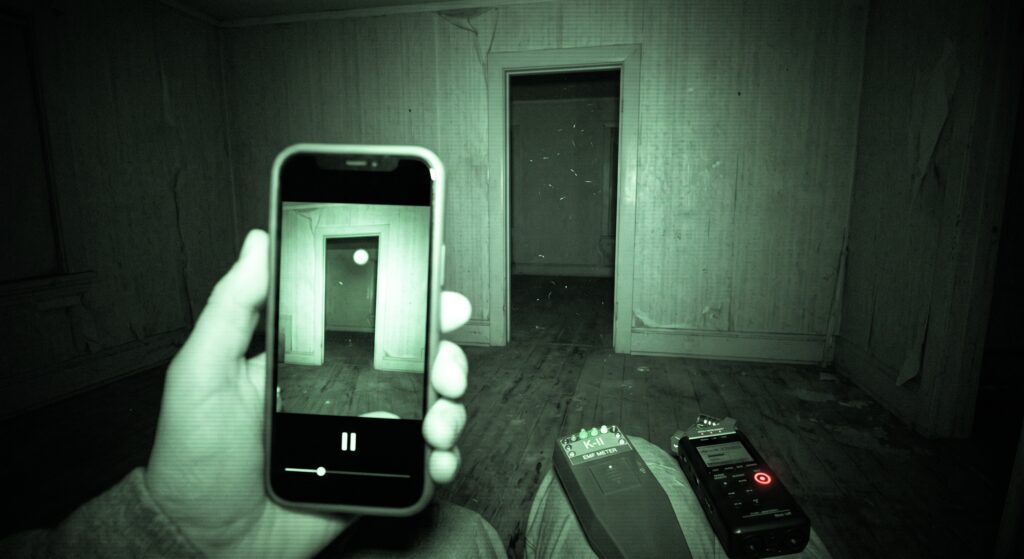
Camera anomalies are the most commonly submitted form of paranormal evidence and also the category with the highest rate of mundane explanation. Understanding the specific mechanisms that produce ghost-like images in photographs and video will not ruin your experience of investigation. It will make the genuine anomalies, the ones that survive this knowledge, considerably harder to dismiss.
Orbs: The Most Misunderstood Anomaly
The orb, a circular light anomaly in photographs and video, is almost always a particle photographed out of focus at close range. The physics are straightforward: a camera lens produces a circular blur, called a circle of confusion, for any object that is out of focus. A dust particle, moisture droplet, or small insect within a few inches of the lens, illuminated by the camera’s flash or an ambient light source, produces a bright circular image that appears to be floating in the scene. The characteristic features of a non-paranormal orb are a perfectly circular shape, slight transparency in some areas, and an apparent position within the scene that is inconsistent with its actual physical location relative to the lens.
Experienced paranormal investigators treat orbs with considerable skepticism for this reason. The environments most commonly investigated, old buildings with disturbed dust, high humidity, and sometimes active insect populations, are precisely the environments most likely to produce orb artifacts. The minority of orb-like anomalies worth attention are those captured in controlled conditions with clean, dry lenses; that show internal structure inconsistent with a simple out-of-focus particle; or that appear in the same location across multiple photographs taken at different distances and angles.
Vortexes and Camera Straps
The ‘vortex’ anomaly, a tubular or elongated light form often reported as evidence of a portal or spirit form, is almost universally a camera strap that is partially in frame and illuminated by the camera’s flash. The solution is to remove wrist straps and neck straps before photographing or to tape them securely to the camera body. This single precaution eliminates an entire category of reported anomaly.
Misting and Breath
White misting or smoky forms in photographs are frequently interpreted as ectoplasm or spirit manifestations. In the majority of cases, they are the visible breath of the photographer or an investigator near the camera, made visible by the flash in cold air. The practical test: photograph the same location immediately after, holding your breath. If the mist disappears, it was breath.
Motion Blur and Long Exposure
In low-light conditions, cameras automatically extend their exposure time to gather sufficient light for a usable image. During a long exposure, any movement produces blur that can appear as a translucent shape, a streak of light, or, in the case of a person moving partially through a frame, an apparently transparent human figure. Smartphone cameras in night mode are particularly susceptible to this artifact. The practical test: was anyone moving during the exposure? Was any light source moving? Was the camera itself moving? A long-exposure figure that has no identifiable source of movement in the scene at the time of capture is worth documenting.
Reflections and Double Exposures
Reflections from windows, polished surfaces, glossy paint, and metallic objects can produce face and figure shapes in photographs that appear to be in the scene but are actually reflections of objects outside the frame. When photographing in an environment that contains multiple reflective surfaces, systematically identify every surface that could produce a reflection in the camera’s field of view. An anomaly that resolves to a reflection is not paranormal. An anomaly in a room with no plausible reflection source, captured with a clean, stationary camera, under conditions that rule out breath, movement, and lens artifacts, is worth investigating further.
References & Further Reading
• Skeptical Inquirer: Ghost Orbs and Camera Artifacts
• Ghost Hunters Equipment: Camera Anomalies and False Positives

[…] have rational explanations. For instance, visual anomalies in photographs are rarely spirits. A ghost camera anomaly is almost always caused by dust, motion blur, reflection, or low light. Similarly, hearing your […]