The dress has been in the family for three generations, stored in a cedar chest in the attic. The story passed down with it is that the woman who wore it first died six months after her wedding. And that every woman who has worn it since has had her marriage end in tragedy within five years. Your cousin wants to wear it. You find yourself, against your rational instincts, looking for a way to talk her out of it.
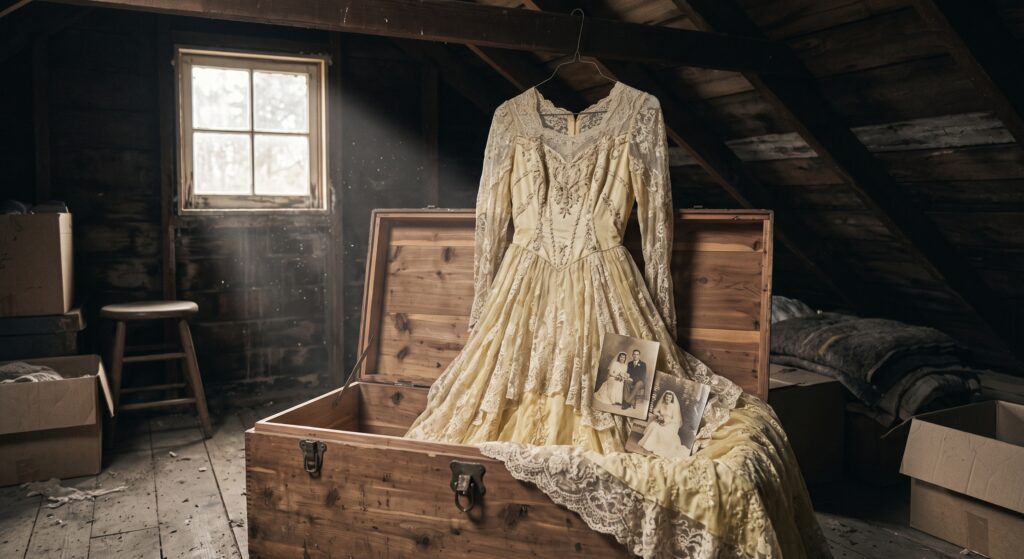
Cursed wedding dress stories form one of the most emotionally resonant categories of haunted object folklore precisely because the garment is so charged with meaning. A wedding dress is worn at one of the most emotionally significant moments of a person’s life, associated with love, hope, vulnerability, and the future. When that future turns dark, the dress becomes the repository of everything that went wrong. And in some cases, the stories that accumulate around a specific dress have enough documented history to make even skeptical observers pay attention.
The Psychology of Cursed Garments
The extended self theory in psychology proposes that people incorporate their possessions into their sense of identity. Garments worn during high-emotion events, particularly those of maximum personal significance, carry an unusually dense psychological charge. When a wedding dress is inherited, the inheritor receives not just the object but also the accumulated emotional associations of everyone who wore it: the joy, the hope, and the specific grief of whatever ended the marriages it witnessed.
This accumulation is real even without any paranormal mechanism. Wearing a garment you know was worn by someone whose marriage ended badly creates a psychological context that can genuinely affect the wearer’s emotional state, their relationships, and their behavior. The curse may not be supernatural. But a powerful enough psychological belief, acted on consistently over years, can produce outcomes that look remarkably like the fulfillment of a curse.
Anna Baker’s Wedding Dress
One of the most specifically documented cursed wedding dress cases in American history involves a gown in the Blair County Historical Society’s collection in Hollidaysburg, Pennsylvania. The dress belonged to Elizabeth Van Horn, purchased in 1849, but the legend attaches to Anna Baker, the daughter of iron magnate Elias Baker, who fell in love with a man her father considered below her station. Elias Baker forbade the marriage. Anna never married. The dress was purchased but never worn by her. According to accounts from the Blair County Historical Society, the dress has been observed moving within its sealed display case, swaying as if worn by a body, though it has no mechanical explanation. Staff and visitors have reported the phenomenon consistently enough that it has become part of the museum’s official history.
The Rose Dress of Carterhaugh
Scottish and English folk tradition contains numerous accounts of cursed wedding and betrothal garments, typically associated with betrayal or violent death. The ballad tradition preserves several stories of women whose wedding finery was connected to their deaths and whose ghosts were subsequently reported wearing the same garments. This phenomenon is a specifically textile form of the broader haunted object tradition: the object most saturated with the emotional content of its wearer’s significant experiences becomes the focus of their residual presence.
What to Do With an Inherited Wedding Dress That Feels Wrong
The practical answer varies by belief framework and by the garment’s specific history. If the dress has a documented history of misfortune attached to it, that history is worth knowing in full before making any decisions. Research what you can. If the dress was simply associated with someone who died or whose marriage failed, that is not the same as a documented pattern of misfortune across multiple wearers.
If you decide you would rather not wear the dress but want to preserve it, storage is a neutral option that does not require any ritual intervention. If you want to cleanse the garment’s associations before wearing it, every folk tradition performs textile cleansing, from saltwater washing to smoke cleansing to formal blessing. If you simply do not want the dress in your life, you are not obligated to keep it. An heirloom that consistently produces anxiety is doing something real to you, and practical decisions about object proximity are not the same as superstition.
As if the dress weren’t already a problem, see our other post on haunted jewelry.
References & Further Reading
• Robinson’s Jewelers: Haunted Jewelry and Object Folklore