How one witness, one afternoon, and one illustrated book built a dinosaur legend on the Likouala-aux-Herbes River
A Legend Built on One Voice
Some cryptids arrive with mountains of testimony behind them. Others arrive on the word of one person, standing in one village, describing one moment on one afternoon. The mbielu-mbielu-mbielu belongs firmly in the second group, and that fact alone makes it one of the most instructive cases in Congo cryptozoology.
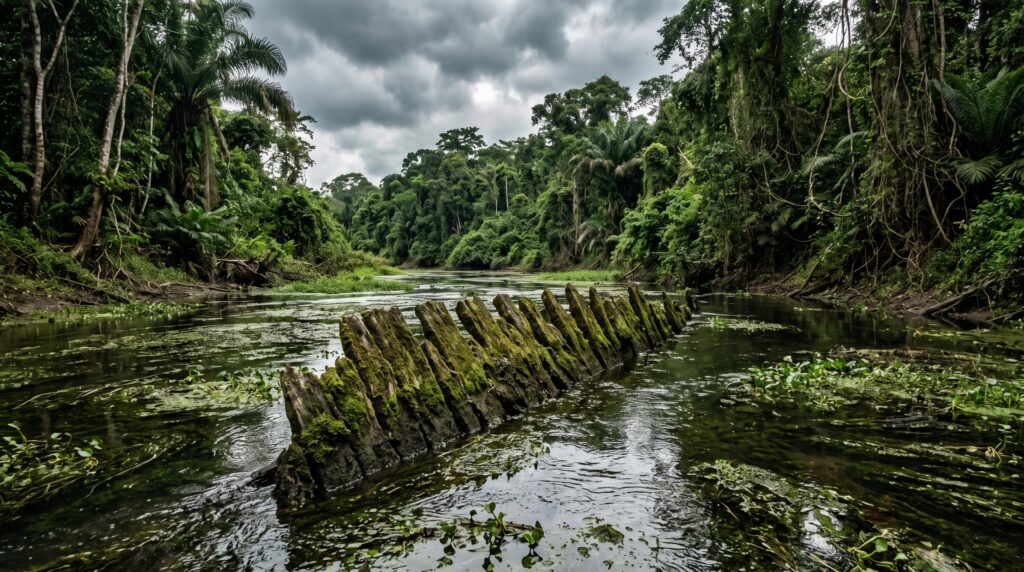
The name translates roughly to the animal with planks growing out of its back. Locals have repeated three variations of that same word in sequence for generations, as if one repetition could not capture how strange the sighting felt. Reports place it in shallow, algae-choked waters near the villages of Bounila and Elebo, along the Likouala-aux-Herbes River. Witnesses describe large, flat ridges rising vertically from the creature’s back, coated in thick green growth. Almost nobody has seen the head, legs, or tail. The animal stays submerged except for that single row of ridges breaking the surface.
The Woman Who Pointed at a Stegosaur
During his 1980s Congo expeditions, biologist Roy Mackal collected an account from a young woman named Odette Gesonget, from Bounila. She described a semiaquatic animal with plank-like structures on its back. Mackal wanted a firmer identification, so he showed her illustrated books containing pictures of various animals, including dinosaurs. Without much hesitation, she pointed to a Stegosaurus.
That moment became the foundation of the stegosaur hypothesis, and it deserves closer scrutiny than it usually receives. Showing a witness a curated set of illustrations before asking what she saw is not neutral. It hands the witness a finite menu of answers, drawn entirely from Western paleontology, rather than letting her describe the animal in her own terms first. A picture book of prehistoric creatures makes a prehistoric creature the easiest thing to point to. That holds true whether or not it matches what she actually saw in the water.
This is not an accusation of dishonesty. Gesonget almost certainly saw something real and described it as best she could. The concern lies with the interview method, not the witness. Researchers investigating vague accounts have long noted this same pattern across multiple African cryptid cases. Explorers arrive with dinosaur books already in hand, and local informants, eager to be understood, select the closest available image rather than the closest available description.
A Fish That Already Looks Prehistoric
The stegosaur theory also runs into basic anatomy. Stegosaurus and its relatives were land animals with small feet poorly suited to swimming. No fossil evidence shows a stegosaurid family adapting toward an aquatic lifestyle, unlike some other dinosaur groups. A creature spending most of its life submerged, as every witness describes, would need a body plan built for water. A heavy-plated grazer designed for dry ground does not fit that mold.
A far more grounded explanation exists in the same rivers. The bichir, a primitive and remarkably ancient fish genus, carries a series of sail-like dorsal finlets running down its back. These finlets can look strikingly like small planks when they break the surface, especially once coated in river algae. Bichirs already look prehistoric to untrained eyes, with thick armored scales and an air-breathing lung system found in almost no other modern fish.
A large bichir, or a cluster of them surfacing together, could easily produce the plank-like silhouette that witnesses describe. Some bichir species grow to several feet in length, far larger than the aquarium varieties familiar to most readers. Their finlets stand tall enough to catch algae growth in slow-moving water. This explanation requires no new species and no surviving dinosaur lineage. It simply asks people to notice that some living fish already look like something out of a storybook, without needing to become one.
A Recurring Flaw in the Method
This pattern shows up elsewhere in the same expedition records. When investigating reports of a horned creature called the Ngoubou in nearby Cameroon, one researcher showed local informants a binder full of illustrations, including a triceratops. The informants said the animal only looked similar to the triceratops picture, yet the researcher later concluded the creature probably was a styracosaur regardless. Handing someone a picture menu and then treating their nearest guess as confirmation is a recurring flaw in this entire branch of cryptozoology. The mbielu-mbielu-mbielu sits close to the center of it.
A Small Story Asked to Carry a Big Theory
Skeptical researchers have also raised a more basic problem with the entire case. The mbielu-mbielu-mbielu rests on remarkably little testimony compared to related Congo cryptids like the Mokele-mbembe or the Emela-ntouka. A handful of villagers near two neighboring settlements make up nearly the entire evidentiary record. That scarcity does not prove the story is false. It does mean the mbielu-mbielu-mbielu is a useful case study. A small, ambiguous report can grow into a full dinosaur theory once the right expedition arrives with the right set of pictures.
None of this diminishes the value of the original sighting. Something with ridged, algae-covered structures apparently surfaces in those waters near Bounila. Local families have talked about it long enough for the story to earn a name. The mystery is not whether people saw something. The mystery is how confidently that something became a stegosaur, based on one witness, one afternoon, and one illustrated book.
What the Story Actually Tells Us
Treat the stegosaur label as folklore layered onto a genuine but poorly documented sighting, not as settled fact. The plainer identity, a large surfacing fish with prehistoric features of its own, asks for far less imagination and fits the physical evidence just as well. Central Africa’s swamps do not need a dinosaur to stay strange. A river full of armored, air-breathing fish that have barely changed in millions of years already makes for a fairly remarkable place.
The broader lesson extends well beyond this one creature. Cryptid investigations often collapse two separate questions into one. The first question asks what a witness actually saw. The second question asks which category a Western researcher wants that sighting to belong to. Those questions deserve separate answers. Odette Gesonget saw ridged shapes covered in algae moving through shallow water near her village. That much is a straightforward, plausible, and locally consistent account. Whether those shapes belonged to a dinosaur, a fish, or something not yet catalogued is a far bigger claim. It should rest on more than a single afternoon spent flipping through someone else’s picture book.
References & Further Reading
Karl Shuker’s detailed account of Odette Gesonget’s testimony from Bounila
Overview of the Stegosaurus identification and the picture-book interview method
Cryptid profile summarizing sighting locations and the stegosaur versus fish debate

[…] the “elephant killer”, a heavily armored beast often compared to a ceratopsian, and a stegosaur-like cryptid that defies standard […]