From the war’s opening shots to its final surrender, spectral echoes remain on both grounds
The War’s First Shots and Its Final Surrender
The American Revolution began and ended roughly 500 miles apart, and both locations carry their own spectral reputation today. On April 19, 1775, colonial militiamen ambushed a retreating British column along a road in Lexington and Concord, Massachusetts, in the opening battle of the war. Minute Man National Historical Park now preserves this stretch of road, known as the Battle Road Trail.
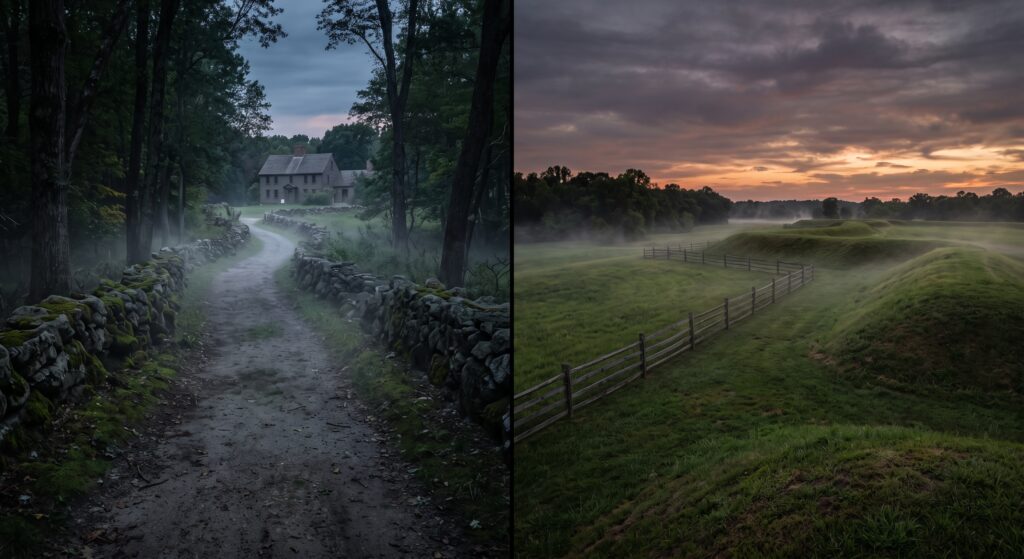
Six years later, the war effectively ended at Yorktown, Virginia. General Cornwallis surrendered his British forces to American and French troops on October 19, 1781, after a prolonged siege. The formal surrender took place at what is now called Surrender Field, a moment that secured American independence.
Between these two events lie six years of war, loss, and hardship that touched nearly every family along the eastern seaboard. Yorktown and Minute Man frame the conflict’s beginning and its conclusion, and both sites have accumulated ghost stories that reflect very different chapters of the same long struggle.
Both parks preserve landscapes that still resemble their eighteenth century appearance far more closely than most Revolutionary War sites. Yorktown’s earthworks and Minute Man’s stone walls and colonial farmhouses survived because the National Park Service prioritized their preservation early. That care may explain why visitors so often describe these places as feeling unusually close to the past, ghost stories aside.
The Folklore and the Legends
Surrender Field’s Fading Melody
Visitors to Surrender Field report spectral redcoats standing at attention among the modern monuments, along with phantom cannon fire echoing across the open ground. Some describe hearing a faint melody resembling “The World Turned Upside Down,” the tune British bands reportedly played as their soldiers laid down arms.
Whether the tune’s connection to the surrender is entirely accurate or a later addition to the story, it captures the emotional weight of the moment. An empire that once controlled thirteen colonies watched its army march into captivity on this ground. That reversal seems to echo across the field for anyone willing to listen closely at dusk.
The Tragic Ghost of Jacky Custis
Among Yorktown’s saddest stories is that of John Parke “Jacky” Custis, George Washington’s stepson. Custis had accumulated significant debts and joined his stepfather at Yorktown as a civilian aide during the siege.
Custis contracted typhus, then called “camp fever,” in the unsanitary conditions surrounding the siege lines. He died shortly after the surrender, a personal tragedy tucked inside a national triumph. Visitors report seeing his figure rushing toward the battlefield in a white nightshirt, with blood-soaked bandages wrapped around his ankles.
The ankle detail connects directly to eighteenth-century medicine. Physicians commonly treated fevers by bleeding patients from veins in the ankles, believing the practice released harmful humors from the body. A dying man, treated this way in his final days, would have worn exactly the bandages witnesses describe. His story serves as a reminder that not every casualty of war dies on a battlefield, and not every ghost story at Yorktown involves a soldier at all.
The Nelson House and Cornwallis’ Cave
Built in 1730, the Nelson House served as Cornwallis’s headquarters during the siege and absorbed heavy cannon fire as a result. American gunners reportedly targeted the house deliberately, aware of its role sheltering British command. Decades later, during the Civil War, Union forces converted the same house into a hospital. Visitors report a secret passage inside, where they say a soldier was mutilated, a detail that blends two separate wars into a single haunted narrative.
A dark cavern along the riverside near Yorktown reportedly sheltered British troops or local residents during the siege. Visitors report moans and whispers drifting from inside the cave, along with 1970s reports of chants linked to unauthorized gatherings inside the space. The cave’s acoustics amplify any sound that enters it, a natural quality that likely contributes heavily to its reputation.
The Battle Road Trail and Hartwell Tavern
The five-mile Battle Road Trail marks the route where colonial militiamen ambushed retreating British soldiers on April 19, 1775. Hikers report phantom musket shots echoing through the trees, along with the distinct scent of black powder on days with no reenactment scheduled nearby.
Hartwell Tavern hosts seasonal candlelight tours each fall, drawing visitors interested in both history and the supernatural. Beyond the tours themselves, colonial New Englanders commonly used protective folk magic. During wartime uncertainty, families built hidden shoes, marked timbers, and counter witchcraft charms directly into their homes to shield themselves from evil spirits. Several historic structures near Hartwell Tavern show evidence of these practices, a detail that offers a different lens on Revolutionary era belief. Colonial families worried about more than British soldiers. Many genuinely feared spiritual harm and built physical protections into their homes to guard against it.
Visitor Information and Decorum
Yorktown National Battlefield closes at sunset, and Surrender Field, Cornwallis’ Cave, and the surrounding monuments are all off limits after that time. Minute Man National Historical Park operates similar hours along the Battle Road Trail.
Hartwell Tavern and the park’s other historic witness houses open seasonally and operate under strict National Park Service supervision. Visitors should confirm hours before planning a candlelight tour or an evening walk, since access varies by season and by specific building.
Nearby historic churches, including Bruton Parish and St. John’s, maintain their own visiting hours and request the same quiet consideration expected at any active place of worship, regardless of any ghost stories attached to their grounds.
References & Further Reading
Minute Man National Historical Park (NPS)
Hike the Battle Road Trail (NPS)
Bruton Parish Church (Williamsburg)
Historic St. John’s Church (Richmond)
For more on this topic, see our complete guide to the The Most Haunted Places in America: A State-by-State Guide.
[…] history echoes through the Green Dragon Tavern and the Granary Burying Ground. Further west, the ghosts of Minute Man National Historical Park still […]
[…] battlefields of the Revolution carry their own weight. The ghosts of Minute Man National Historical Park and the final victory at Yorktown are still witnessed by reenactors and tourists alike. The […]