A looted Aztec relic became an Elizabethan magician’s telephone to heaven, and its true origin stayed hidden for centuries.
A Black Disc in a Glass Case
Walk through the British Museum and you may pass it without a glance. A round disc of polished black stone, dark as a still pond at midnight, resting quietly behind glass. It looks like decoration. It is one of the most notorious occult objects in England.
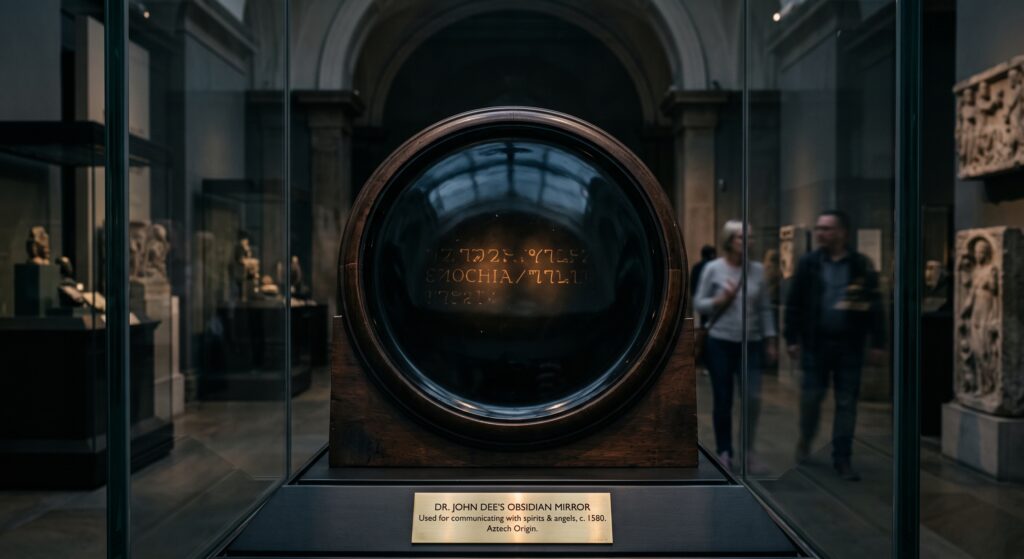
For ten years, a royal advisor believed this mirror let him speak with angels. He built a ceremony around it, recorded its messages, and staked his reputation on what he saw inside. The stone kept a secret about its birth that no one would crack for over 400 years.
Most objects labeled haunted rest on rumor. This one rests on record. The diaries survive, the artifact survives, and modern science has now traced the stone to its source. The result is a rare thing in this field: a mysterious mirror with a documented history that turns out stranger than the legend.
The Magician Behind the Mirror
John Dee, born in 1527, was no mere fringe crank. He advised Queen Elizabeth I, mastered mathematics and astronomy, and helped plan English voyages to the New World. He straddled the blurred line between science and magic that defined his age.
By the 1580s, Dee wanted more than equations. He wanted to speak with heaven itself. Lacking the gift of vision, he hired a scryer, a medium who could see what he could not. That man was Edward Kelley, and their partnership would run for years.
The British Museum records that Dee used the black stone as a shew-stone, one of several reflective tools for his occult research. Kelley would gaze into it and describe the angels he claimed to see.
The Angelic Sessions
The two men prepared with care. They fasted, washed, dressed for the occasion, and prayed. Dee arranged candles and holy furniture in a room he called his oratory. Only then did Kelley look into the glass.
What poured out was extraordinary. Kelley reported angels who spelled messages by pointing to letters in vast tables. From these sessions came Enochian, an entire language Dee believed the angels themselves had dictated. Scholars still study its strange script.
The partnership carried a crack down its center. Dee trusted the messengers as angels. Kelley grew fearful, at times insisting they were demons rather than angels and begging to stop. The rituals continued anyway.
The Secret in the Stone
Here is the revelation that sets this mirror apart. The stone did not come from Europe. It was carved in the heart of the Aztec Empire, then hauled across an ocean after conquest.
In 2021, researchers ran geochemical analysis on the disc. The obsidian traced back to the quarries of Pachuca in Mexico. In the decades before Dee was born, Spanish conquistadors carried Aztec treasures to Europe, and one such object landed in his hands.
The origin drips with irony. To the Aztecs, mirrors belonged to Tezcatlipoca, a god whose name translates as Smoking Mirror. Aztec priests used polished obsidian for divination and conjuring visions of their own. Dee thought he pioneered a channel to the divine. He was in fact borrowing a tool built for exactly that purpose by a civilization he never knew.
Where It Rests Now
Dee’s fortunes collapsed. He returned from Europe to find his library vandalized and his instruments stolen. England had cooled toward his magic. He died in poverty at 81, with no known grave.
The mirror outlived him by centuries. It passed through collectors, including the writer Horace Walpole, before settling into the British Museum, where it sits today. Two ideas of the sacred, Aztec and Elizabethan, meet in a single black disc.
Walpole, a connoisseur of the gothic, labeled it plainly as the black stone into which Dee called his spirits. The object had already become a curiosity of the macabre, prized for its dark reputation as much as its craftsmanship. It traveled through English collections carrying that aura wherever it went.
That is what makes this object more than just a curiosity. It is a genuine artifact that carried real belief across two worlds.
The God in the Glass
To grasp the mirror’s first life, meet Tezcatlipoca. His name means Smoking Mirror, and he ranked among the most powerful deities in the Aztec world. He governed rulers, warriors, and sorcerers, and artists often depicted him with an obsidian mirror in place of a foot.
That mirror was no ornament. Through it, the god was said to see all things, every deed and secret across the land. Obsidian, the dark volcanic glass, was his sacred material. Priests used polished discs of it to peer beyond the visible, seeking omens and visions.
So the object Dee prized already held centuries of divinatory purpose. Aztec seers had gazed into obsidian to touch the unseen long before any English magician was born. When Kelley bent over the black stone, he joined a lineage he could not have imagined.
The irony deepens the more you sit with it. Dee believed he reached toward a Christian heaven. The tool in his hands was forged for a god the conquistadors had tried to erase. Two rival visions of the sacred met in the same dark circle of stone.
The Language the Angels Left
Whatever the source, the sessions produced something that still baffles scholars. Kelley reported angels who dictated words letter by letter, pointing across grids of characters. From this came Enochian, a full system with its alphabet and grammar.
Dee recorded it all in meticulous diaries. The angels, he wrote, delivered not just messages but the very structure of a heavenly tongue. Later occultists treated these papers as sacred, and Enochian remains a fixture of Western ceremonial magic to this day.
Skeptics have a simpler read. Kelley was a known trickster, and the elaborate performance may have served his interests more than heaven’s. Yet the material’s remarkable coherence has sustained the debate for centuries.
Either way, the black mirror sat at the center of it. It was the surface into which Kelley stared, the object through which a language supposedly crossed into another realm. For the folklore that surrounds haunted mirrors more broadly, see our companion posts (post 1, post 2, post 3) on the subject.
References & Further Reading
British Museum Images: Dr Dee’s Mirror
Apollo Magazine: The Aztec Origins of John Dee’s Mirror
Antiquity: Reflections on John Dee’s Obsidian Mirror


[…] a dim chamber built around a mirror and controlled reflection. The practice has deep roots: John Dee’s obsidian mirror, used by Queen Elizabeth I’s court astrologer to communicate with angels, operates on the […]