In 1960, a 19-year-old named Michael Plume died at the construction site of Indiana University’s Memorial Stadium. For decades, students have reported his figure in the west stands. What makes his case extraordinary is not the ghost. It is that the official record of how he died was rewritten more than half a century later.
Most campus hauntings rest on a settled tragedy. Someone died, the cause was known, and the legend grew from there. Plume’s rests on a question that stayed open for 57 years, and on a father who never stopped asking it.
That is what separates this from an ordinary spooky campus tale. The apparition in the rafters is not the point. The mystery of how a young man actually died, and how long it took anyone to admit the original answer was wrong, is the point.
A death that did not add up
Plume was a student and active-duty Air Force member. His body was found slumped at the base of a scaffold in the unfinished stadium, a rope around his neck. Then-Bloomington police and the county coroner ruled it a suicide by hanging, though no autopsy was performed before that verdict was issued.
Small details refused to fit. His shoes were spotlessly clean despite the muddy, dusty construction site all around him. The scaffold where he was found was wobbly yet somehow intact, with the rope tied off far above his slumped body. To anyone who looked closely, the scene raised more questions than it answered.
His father, Bill Plume, said he had spoken with his son by phone within days of his death, and that Michael had been upbeat about an exam and looking forward to his Air Force future. A father’s certainty is not evidence. But combined with the physical oddities, it kept the case from ever truly closing in the family’s mind.
The evidence that mounted for decades
Over the years, the anomalies accumulated. Investigators noted that the rope contained fibers from an Air Force glove like the ones Michael wore, yet his own gloves bore no matching fibers from the rope. That mismatch is difficult to explain if he tied the rope himself.
The Air Force Office of Special Investigations reviewed the case and reached a striking conclusion. His neck had not actually been broken, despite the official ruling of suicide by hanging. The physical findings and the verdict did not match.
Attorneys worked the case for years, driven by a father who refused to let it close. The rumors that swirled around campus, of espionage, of foul play, only grew in the vacuum left by an unconvincing verdict. Folklore rushes to fill the space where facts fall short, and here the facts had left a very large space.
The rumors grew precisely because the official story satisfied no one. A clean-shoed body, a mismatched rope fiber, an unbroken neck: each gap invited a new theory. Some whispered of espionage tied to his Air Force service. Others suspected a cover-up. None of it was proven, but all of it thrived in the absence of a convincing explanation, and the ghost story carried those doubts forward for decades.
The record finally changes
In 2017, just before Bill Plume’s 100th birthday, Monroe County Coroner Joani Shields reviewed the file with fresh eyes. Troubled by the clean shoes, the scaffolding, and the rope, she amended the manner of death from suicide to undetermined. She wrote that the evidence raised real doubt that Michael had taken his own life.
Shields described her role in moving terms. She saw the coroner as a voice for those who could no longer speak, and she did not believe Michael’s story had been told correctly. After nearly six decades, the official record of his death changed.
For a man who had spent 57 years insisting the record was wrong, the correction arrived almost too late, and almost exactly in time. His son’s story, he felt, had finally been told closer to the truth. What he had always believed, the county now formally acknowledged: the suicide verdict could not be trusted.
Why the ghost still matters
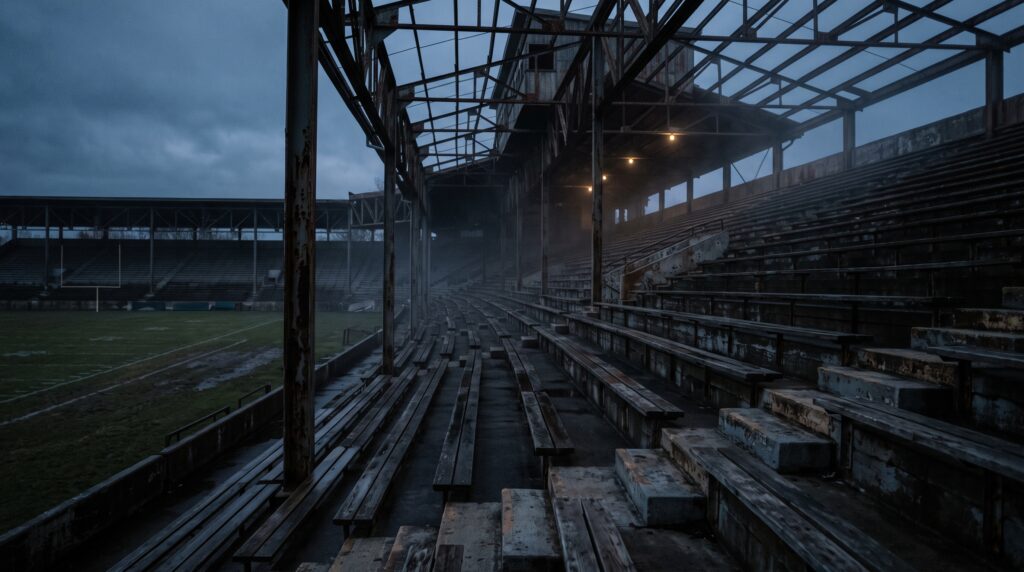
Students and stadium staff have long reported the dangling figure in the west stands during quiet hours, or a sudden chill and dread in that section. Read as a scare, it is just another campus ghost, the kind every old university claims. Read against the real case, it becomes something else entirely: a form of memory.
Campus folklore often preserves the people who died under circumstances that were never fully explained. The stories keep their names alive when the official paperwork fails them. Michael Plume became a legend because his death made no sense to the people who knew him.
The apparition in the rafters is the story a community tells when the official answer feels incomplete. Here, the community proved closer to right than the record, and stayed right for 57 years. The ghost, in a strange way, kept asking the question until someone finally answered it.
This entry touches on suicide, which is a sensitive subject. If you or someone you know is struggling, trained support is available in the United States by calling or texting 988. The legend endures, but the young man at its center was real, and he deserves to be remembered as a person before a phantom.
The case also shows how folklore and fact can circle the same truth from opposite directions. For 57 years, the paperwork said one thing and the campus stories said another. The stories, it turned out, were closer to the family’s reality. That does not make ghosts real. It makes clear how communities use legend to protest an official account they do not trust. Michael Plume became a campus specter because the record of his death felt wrong, and the students, in their own strange way, kept insisting on a review until one finally came.
References & Further Reading
The Indiana Lawyer, Lawyers help 99-year-old man remove suicide as cause of son’s 1960 death