The question is a good one, and it reveals something important about how the Jersey Devil’s description evolved over the nearly three centuries of accounts that have accumulated around it. Early descriptions of the creature from the 18th century emphasize its humanoid qualities: a child or person born with deformities, a small creature seen near homesteads in the Pine Barrens, something frightening but not particularly dramatic. The wings appear in the tradition gradually, growing more prominent as the 19th century progressed. By the time the 1909 sighting wave produced dozens of newspaper accounts across New Jersey, Pennsylvania, and Delaware in a single January week, the Jersey Devil was fully formed: leathery wings, horse-like head, cloven hooves, a serpentine body, and a scream that stopped horses and made dogs go silent.
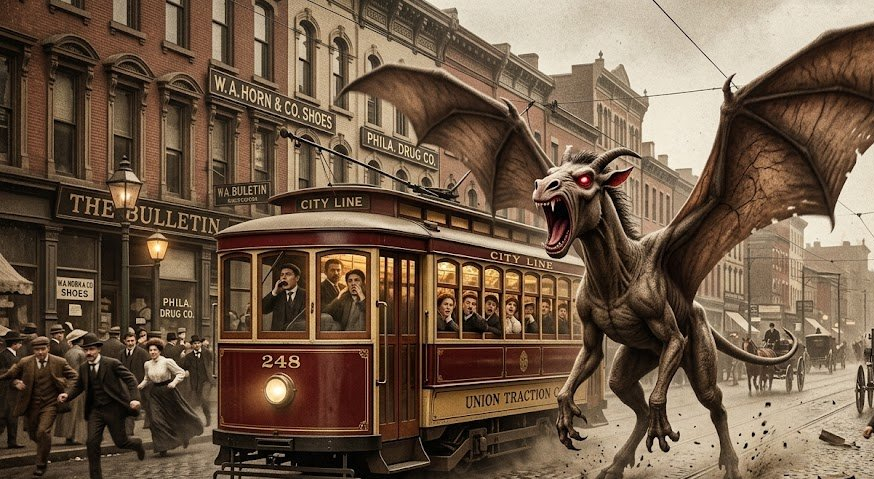
The wings are the feature that most distinguishes the Jersey Devil from other American cryptids, and they connect the tradition to a specific strand of folklore that associates dangerous, devilish entities with flight. Understanding why the wings developed and what they mean in the context of the broader legend is more compelling than asking whether they are real.
The Leeds Devil Origin
The core origin story of the Jersey Devil involves a woman named Jane Leeds (or Mother Leeds in many versions) who, in 1735, while pregnant with her thirteenth child, cursed the unborn baby in a moment of exhausted desperation. The child was born apparently normal before transforming into a creature that flew up the chimney and disappeared into the Pine Barrens. The Leeds family were real: they were among the early Quaker settlers of what is now Atlantic County, and the family’s unusual religious and political history contributed to their sinister reputation in the community.
Historian Brian Regal, who published the most careful scholarly analysis of the Jersey Devil’s origins, argues that the Leeds Devil tradition was substantially shaped by political rivalry between the Leeds and Franklin families in early colonial New Jersey. Daniel Leeds was a Quaker apostate who became an almanac publisher competing with Benjamin Franklin’s father and brother; the Leeds family’s almanac used astrological symbols that their Quaker community considered diabolical, and ‘the Leeds Devil’ may have begun as a political attack and then slowly drifted into a genuine monster tradition.
The 1909 Wave
January 1909 produced the most sustained cluster of Jersey Devil accounts in the legend’s history. Over about a week, dozens of witnesses across New Jersey, Pennsylvania, and Delaware reported encounters with a winged, cloven-hoofed, screaming creature. Police officers, postmasters, and fire department officials were among the witnesses. Trolley cars in Haddon Heights, New Jersey, stopped service after drivers refused to continue. Schools in several towns closed as parents kept children home. The Philadelphia Zoo offered a reward for the creature’s capture.
The 1909 wave has been studied by folklorists as one of the most clearly documented examples of collective creature panic in American history. Whatever triggered the original reports, the combination of rapid newspaper communication, an established legend template, and a community primed by the winter darkness to expect strangeness produced a self-amplifying event in which subsequent witnesses reported what the press had described and the press reported what those witnesses described.
Why the Wings Matter
In Western folk tradition, flight is associated with the demonic, the angelic, and the witchly. Creatures that should not fly but do transgress a natural boundary, like witches riding brooms and demons moving between worlds. The Jersey Devil’s wings mark it as something outside the natural order, something that can move through spaces that ordinary creatures cannot reach. This transgressive quality is what makes the creature so persistently frightening in a landscape that is otherwise entirely navigable. In the Pine Barrens, where the trees are low and the sky is visible, a creature that can fly is a creature that is both nowhere and everywhere at once.