The church of St. Mawnan and St. Stephen in the village of Mawnan Smith, Cornwall, sits on a headland above the Helford River estuary, surrounded by ancient woodland and the kind of atmosphere that accumulates in places where stone buildings have been standing for eight hundred years. In April 1976, two young girls on holiday in the area reported seeing a large, winged figure hovering above the church tower. They described a creature as big as a man, with feathered wings, two large pointed ears, and red eyes. Their father reported the encounter to the paranormal researcher Tony ‘Doc’ Shiels.
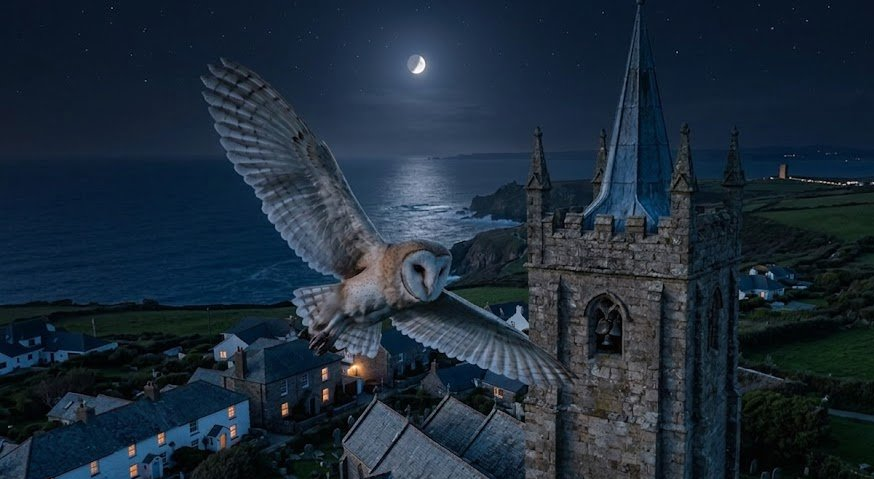
The Owlman of Mawnan, as it became known, generated further sightings over the following years: two teenagers in July 1976 who described a large, grey creature with black-red eyes and wings spread to stand in the trees near the churchyard; another witness in 1978; and additional sightings in 1989 and 1995. The creature appeared consistently in the same location, around the churchyard and wooded areas near the church, and was consistently described in the same general terms: large, winged, humanoid in proportion, with the face of an owl rather than a bird of prey.
Tony Shiels and the Investigation
Doc Shiels was a flamboyant character: a stage magician, surrealist artist, and paranormal researcher who was already well-known in British cryptid circles when the Owlman reports came to him. His enthusiastic promotion of the creature generated both public interest and significant skepticism from researchers who noted his theatrical background and his tendency to be present at unusual phenomena. Shiels himself never claimed to have seen the Owlman but maintained throughout his career that the sightings he documented were genuine.
The Owlman case attracted the attention of researcher Jonathan Downes, founder of the Centre for Fortean Zoology in Exeter, who investigated the sightings extensively over several decades and published a book on the subject in 1997. Downes proposed that the Owlman might represent an unusually large European eagle owl (Bubo bubo), a species not native to Britain but occasionally considered an escapee from captivity, combined with the suggestible atmosphere of an ancient, remote churchyard. He also documented what he described as a genuine cultural strangeness around the Mawnan church site that his investigation could not fully account for in conventional terms.
The Eagle Owl Hypothesis
The European eagle owl is the largest owl in the world, with a wingspan reaching six feet and the capacity to appear enormous when seen unexpectedly in low light. Several large eagle owls have been documented in Devon and Cornwall over the past fifty years, escaping from wildlife collections and establishing themselves in local woodland. An eagle owl seen at dusk or dawn in the trees around an ancient churchyard, with its distinctive ear tufts resembling pointed horns and its orange-red eyes reflecting available light, could plausibly produce the encounter that the original 1976 witnesses described. The size of the creature in accounts, described as man-sized, has always been the most difficult detail to reconcile with the eagle owl theory.
The Place as the Story
What makes the Owlman particularly interesting as folklore is the degree to which the location shapes the experience. The Mawnan church and its wooded headland are genuinely atmospheric: an ancient stone building, the smell of salt air from the estuary below, dense mixed woodland pressing close on three sides, and the specific quality of Cornish coastal light that makes everything feel slightly older and stranger than it probably is. Folklorists who study site-specific cryptid traditions note that certain landscapes seem to invite creature reports in ways that are not fully explained by the biological question. Whatever is or is not in the trees above the church at Mawnan Smith, the church itself and its landscape are worth visiting on their own terms.
References & Further Reading
For more on this topic, see our complete guide to the Cryptids of the World: A Global Guide to Hidden Monsters.