Ohio is not supposed to be Bigfoot country. The mental image of Bigfoot involves ancient Pacific Northwest rainforest, not Midwestern farms, strip-mine reclamation land, or the Ohio River Valley. And yet the Buckeye State sits near the top of the BFRO database for reported sightings, with a regional tradition that predates the national Bigfoot conversation by decades and a creature profile that reflects the specific landscape of central Appalachia rather than the Pacific Northwest original.
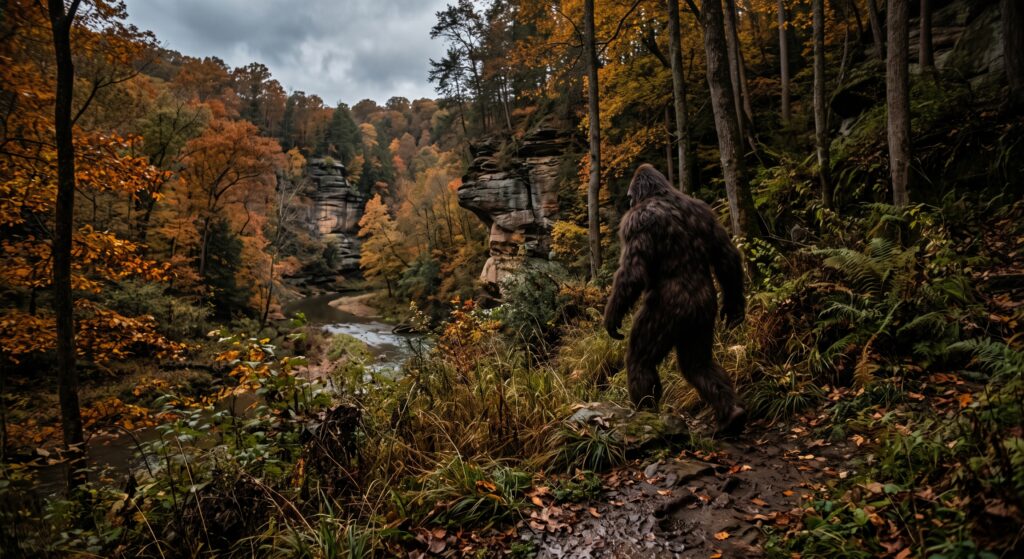
The Ohio Grassman, named for accounts describing a large, hairy, upright figure seen in and near areas of tall grass, meadow, and wetland, is one of the most specifically localized Bigfoot variants in America. Its territory overlaps significantly with the river corridor ecosystems of southeastern Ohio: the Hocking Hills, the Muskingum Watershed, and the broad agricultural valleys that give way to dense second-growth forest as you move into the hill country near the West Virginia border.
Historical Accounts
Reports of the Ohio Grassman predate the modern Bigfoot era by at least a century. Newspaper accounts from the 1860s and 1870s in southeastern Ohio describe encounters with large, hairy, upright figures near river bottoms and swamp edges. An 1869 account from Wood County describes a large creature seen repeatedly by multiple witnesses over several weeks near a swamp. A 1902 account from Clermont County, near the area later associated with the Loveland Frogman, describes a figure taller than any man seen watching a farmstead from the tree line for three successive evenings before the farmer’s dog drove it away.
Don Keating of the Eastern Ohio Bigfoot Investigation Center has documented hundreds of contemporary sightings from the Ohio River watershed and its tributaries, maintaining one of the most comprehensive regional databases of Bigfoot accounts in the United States. Keating’s decades of fieldwork in southeastern Ohio have produced physical evidence including large footprint casts and hair samples, none of which have produced definitive biological identification.
The 1978 Minerva Cases
The Minerva Monster cases of 1978 represent the most detailed multi-witness Bigfoot account in Ohio’s history. Beginning in August 1978 and continuing through October, the Cayton family of Minerva in Stark County reported repeated encounters with a large, hairy, upright creature that appeared near their property. The sightings involved multiple family members at different times, often at close range. The family eventually contacted the police and a local newspaper, generating an investigation and significant regional press coverage.
Officers who responded to the property reported finding no creature but noted unusual smells, disturbed vegetation, and the family’s evident genuine distress. The Cayton family maintained their account consistently over decades and never recanted. Their case has been cited by researchers as one of the most credible multi-witness Bigfoot encounters on record, not because it produced physical evidence but because the witnesses had no apparent motivation for the sustained reports and nothing to gain from the attention.
The Habitat Question
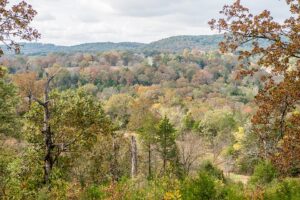
Ohio’s landscape presents an intriguing puzzle for anyone trying to assess whether the Grassman reports could represent a real animal. The state’s forest cover, heavily depleted during the agricultural clearing of the 19th century, has rebounded significantly in the eastern hill country. The Hocking Hills region and the Wayne National Forest together represent tens of thousands of acres of dense, mixed hardwood forest connected by riparian corridors to a much larger forest system extending into West Virginia. Researchers who argue for the biological reality of the Ohio Grassman point to this connected forest system as sufficient habitat for a low-density, wide-ranging primate. Skeptics counter that Ohio’s road density and human population make truly covert long-term survival implausible.
[…] with deep roots in mountain culture. Further west, the dense woods of the Buckeye State hide the Ohio Grassman, while Portage County has recorded its own distinct cluster of Bigfoot […]